

Chemova: Carepoctus solidus n.sp. a New Species otLiparid Fish
185
1991). C. solidus resembles C. reinhardti in some characters (counts, cactus-like prickles on
the skin, 0+2 pores in the temporal sensory canal), but it differs greatly in having an oblique
(versus horizontal) mouth, the pectoral fin situated low on the body (vs. high), with the
uppermost ray level with the end of the mouth cleft (vs. lower half of eye); the opercular flap
small and triangular (vs. widely rounded) and ending below the level of the eye (vs. level with
upper half of eye), the pupil round (vs. longitudinally-oval), the eye lacking a silvery guanine
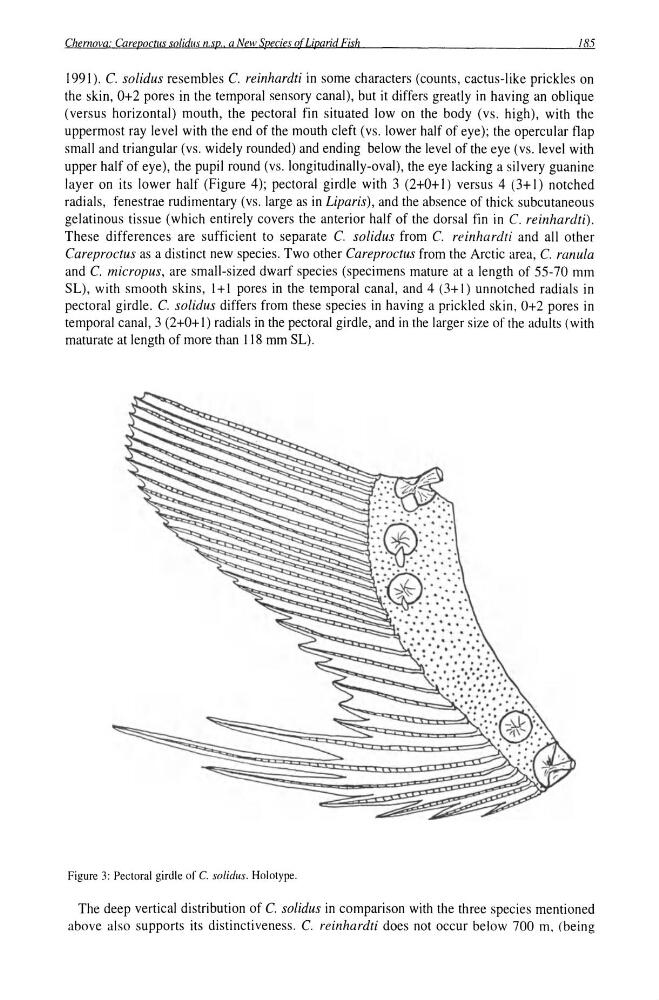
layer on its lower half (Figure 4); pectoral girdle with 3 (2+0+1) versus 4 (3+1) notched
radials, fenestrae rudimentary (vs. large as in Liparis), and the absence of thick subcutaneous
gelatinous tissue (which entirely covers the anterior half of the dorsal fin in C. reinhardti).
These differences are sufficient to separate C. solidus from C. reinhardti and all other
Careproctus as a distinct new species. Two other Careproctus from the Arctic area, C. ranula
and C. micropus, are small-sized dwarf species (specimens mature at a length of 55-70 mm
SL), with smooth skins, I + I pores in the temporal canal, and 4 (3+ I) unnotched radials in
pectoral girdle. C. solidus differs from these species in having a prickled skin, 0+2 pores in
temporal canal, 3 (2+0+ I) radials in the pectoral girdle, and in the larger size of the adults (with
maturate at length of more than 118 mm SL).
Figure 3: Pectoral girdle of C. solidus. Holotype.
The deep vertical distribution of C. solidus in comparison with the three species mentioned
above also supports its distinctiveness. C. reinhardti does not occur below 700 m, (being
185
1991). C. solidus resembles C. reinhardti in some characters (counts, cactus-like prickles on
the skin, 0+2 pores in the temporal sensory canal), but it differs greatly in having an oblique
(versus horizontal) mouth, the pectoral fin situated low on the body (vs. high), with the
uppermost ray level with the end of the mouth cleft (vs. lower half of eye); the opercular flap
small and triangular (vs. widely rounded) and ending below the level of the eye (vs. level with
upper half of eye), the pupil round (vs. longitudinally-oval), the eye lacking a silvery guanine
layer on its lower half (Figure 4); pectoral girdle with 3 (2+0+1) versus 4 (3+1) notched
radials, fenestrae rudimentary (vs. large as in Liparis), and the absence of thick subcutaneous
gelatinous tissue (which entirely covers the anterior half of the dorsal fin in C. reinhardti).
These differences are sufficient to separate C. solidus from C. reinhardti and all other
Careproctus as a distinct new species. Two other Careproctus from the Arctic area, C. ranula
and C. micropus, are small-sized dwarf species (specimens mature at a length of 55-70 mm
SL), with smooth skins, I + I pores in the temporal canal, and 4 (3+ I) unnotched radials in
pectoral girdle. C. solidus differs from these species in having a prickled skin, 0+2 pores in
temporal canal, 3 (2+0+ I) radials in the pectoral girdle, and in the larger size of the adults (with
maturate at length of more than 118 mm SL).
Figure 3: Pectoral girdle of C. solidus. Holotype.
The deep vertical distribution of C. solidus in comparison with the three species mentioned
above also supports its distinctiveness. C. reinhardti does not occur below 700 m, (being