

Petryashov et at.: Macrobenthos Distribution in the Laptev Sea
171
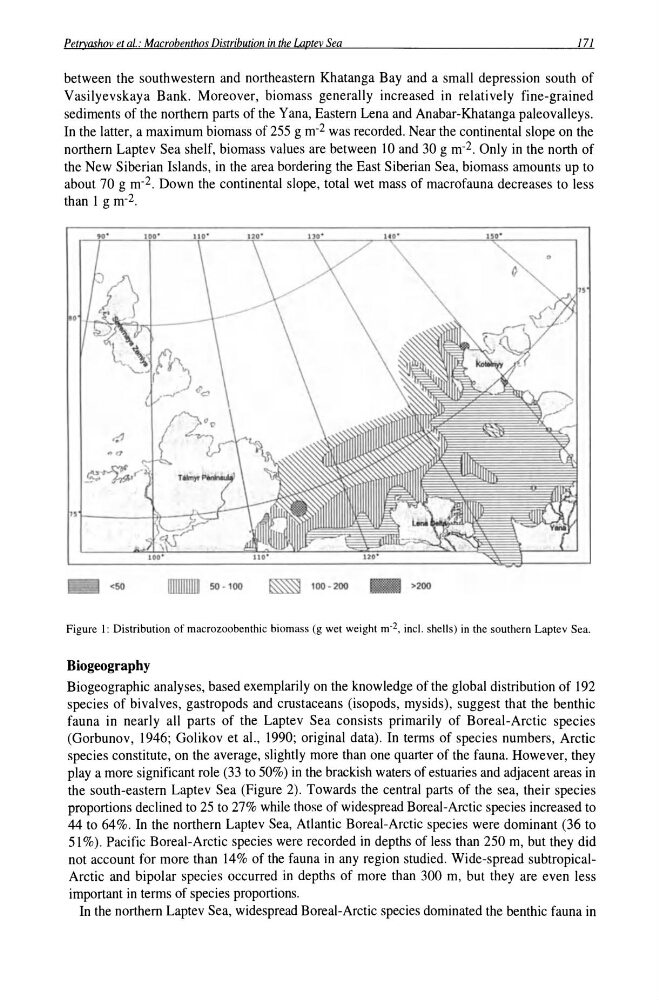
between the southwestern and northeastern Khatanga Bay and a small depression south of
Vasilyevskaya Bank. Moreover, biomass generally increased in relatively fine-grained
sediments of the northern parts of the Yana, Eastern Lena and Anabar-Khatanga paleovalleys.
In the latter, a maximum biomass of 255 g m- 2 was recorded. Near the continental slope on the
northern Laptev Sea shelf, biomass values are between 10 and 30 g m- 2 . Only in the north of
the New Siberian Islands, in the area bordering the East Siberian Sea, biomass amounts up to
about 70 g m- 2 . Down the continental slope, total wet mass of macrofauna decreases to less
than 1 g m- 2 .
<50
mlUlIIIIJ 50 - 100
100 - 200
>200
Figure 1: Distribution of macrozoobenthic biomass (g wet weight m- 2 , inc!. shells) in the southern Laptev Sea.
Biogeography
Biogeographic analyses, based exemplarily on the knowledge of the global distribution of 192
species of bivalves, gastropods and crustaceans (isopods, mysids), suggest that the benthic
fauna in nearly all parts of the Laptev Sea consists primarily of Boreal-Arctic species
(Gorbunov, 1946; Golikov et a!., 1990; original data). In terms of species numbers, Arctic
species constitute, on the average, slightly more than one quarter of the fauna. However, they
playa more significant role (33 to 50%) in the brackish waters of estuaries and adjacent areas in
the south-eastern Laptev Sea (Figure 2). Towards the central parts of the sea, their species
proportions declined to 25 to 27% while those of widespread Boreal-Arctic species increased to
44 to 64%. In the northern Laptev Sea, Atlantic Boreal-Arctic species were dominant (36 to
51 %). Pacific Boreal-Arctic species were recorded in depths of less than 250 m, but they did
not account for more than 14% of the fauna in any region studied. Wide-spread subtropicalArctic and bipolar species occurred in depths of more than 300 m, but they are even less
important in terms of species proportions.
In the northern Laptev Sea, widespread Boreal-Arctic species dominated the benthic fauna in
171
between the southwestern and northeastern Khatanga Bay and a small depression south of
Vasilyevskaya Bank. Moreover, biomass generally increased in relatively fine-grained
sediments of the northern parts of the Yana, Eastern Lena and Anabar-Khatanga paleovalleys.
In the latter, a maximum biomass of 255 g m- 2 was recorded. Near the continental slope on the
northern Laptev Sea shelf, biomass values are between 10 and 30 g m- 2 . Only in the north of
the New Siberian Islands, in the area bordering the East Siberian Sea, biomass amounts up to
about 70 g m- 2 . Down the continental slope, total wet mass of macrofauna decreases to less
than 1 g m- 2 .
<50
mlUlIIIIJ 50 - 100
100 - 200
>200
Figure 1: Distribution of macrozoobenthic biomass (g wet weight m- 2 , inc!. shells) in the southern Laptev Sea.
Biogeography
Biogeographic analyses, based exemplarily on the knowledge of the global distribution of 192
species of bivalves, gastropods and crustaceans (isopods, mysids), suggest that the benthic
fauna in nearly all parts of the Laptev Sea consists primarily of Boreal-Arctic species
(Gorbunov, 1946; Golikov et a!., 1990; original data). In terms of species numbers, Arctic
species constitute, on the average, slightly more than one quarter of the fauna. However, they
playa more significant role (33 to 50%) in the brackish waters of estuaries and adjacent areas in
the south-eastern Laptev Sea (Figure 2). Towards the central parts of the sea, their species
proportions declined to 25 to 27% while those of widespread Boreal-Arctic species increased to
44 to 64%. In the northern Laptev Sea, Atlantic Boreal-Arctic species were dominant (36 to
51 %). Pacific Boreal-Arctic species were recorded in depths of less than 250 m, but they did
not account for more than 14% of the fauna in any region studied. Wide-spread subtropicalArctic and bipolar species occurred in depths of more than 300 m, but they are even less
important in terms of species proportions.
In the northern Laptev Sea, widespread Boreal-Arctic species dominated the benthic fauna in