

170
Land-Ocean Systems in the Siberian Arctic: Dynamics and History
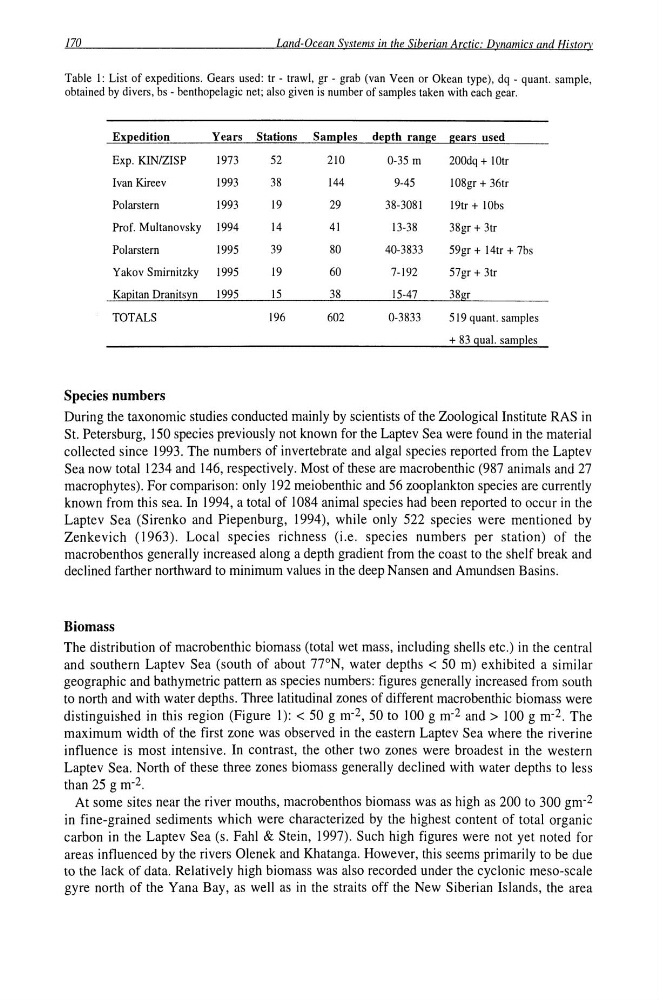
Table I: List of expeditions. Gears used: tr - trawl, gr - grab (van Veen or Okean type), dq - quant. sample,
obtained by divers, bs - benthopelagic net; also given is number of samples taken with each gear.
Ex~edition
Years Stations Sam~les de~th range gears used
Exp. KIN/ZISP
1973
52
210
0-35 m
200dq + JOtr
Ivan Kireev
1993
38
144
9-45
J08gr + 36tr
Polarstern
1993
19
29
38-3081
19tr + lObs
Prof. Multanovsky 1994
14
41
13-38
38gr + 3tr
Polarstern
1995
39
80
40-3833
59gr + 14tr + 7bs
Yakov Smirnitzky
1995
19
60
7-192
57gr + 3tr
Ka~itan Dranitsyn
1995
15
38
15-47
38gr
TOTALS
196
602
0-3833
519 quant. samples
+ 83 gual. samEles
Species numbers
During the taxonomic studies conducted mainly by scientists of the Zoological Institute RAS in
St. Petersburg, 150 species previously not known for the Laptev Sea were found in the material
collected since 1993. The numbers of invertebrate and algal species reported from the Laptev
Sea now total 1234 and 146, respectively. Most of these are macrobenthic (987 animals and 27
macrophytes). For comparison: only 192 meiobenthic and 56 zooplankton species are currently
known from this sea. In 1994, a total of 1084 animal species had been reported to occur in the
Laptev Sea (Sirenko and Piepenburg, 1994), while only 522 species were mentioned by
Zenkevich (1963). Local species richness (i.e. species numbers per station) of the
macrobenthos generally increased along a depth gradient from the coast to the shelf break and
declined farther northward to minimum values in the deep Nansen and Amundsen Basins.
Biomass
The distribution of macrobenthic biomass (total wet mass, including shells etc.) in the central
and southern Laptev Sea (south of about nON, water depths < 50 m) exhibited a similar
geographic and bathymetric pattern as species numbers: figures generally increased from south
to north and with water depths. Three latitudinal zones of different macrobenthic biomass were
distinguished in this region (Figure 1): < 50 g m- 2 , 50 to 100 g m- 2 and> 100 g m-2. The
maximum width of the first zone was observed in the eastern Laptev Sea where the riverine
influence is most intensive. In contrast, the other two zones were broadest in the western
Laptev Sea. North of these three zones biomass generally declined with water depths to less
than 25 g m- 2 .
At some sites near the river mouths, macrobenthos biomass was as high as 200 to 300 gm-2
in fine-grained sediments which were characterized by the highest content of total organic
carbon in the Laptev Sea (s. Fahl & Stein, 1997). Such high figures were not yet noted for
areas influenced by the rivers Olenek and Khatanga. However, this seems primarily to be due
to the lack of data. Relatively high biomass was also recorded under the cyclonic meso-scale
gyre north of the Yana Bay, as well as in the straits off the New Siberian Islands, the area
Land-Ocean Systems in the Siberian Arctic: Dynamics and History
Table I: List of expeditions. Gears used: tr - trawl, gr - grab (van Veen or Okean type), dq - quant. sample,
obtained by divers, bs - benthopelagic net; also given is number of samples taken with each gear.
Ex~edition
Years Stations Sam~les de~th range gears used
Exp. KIN/ZISP
1973
52
210
0-35 m
200dq + JOtr
Ivan Kireev
1993
38
144
9-45
J08gr + 36tr
Polarstern
1993
19
29
38-3081
19tr + lObs
Prof. Multanovsky 1994
14
41
13-38
38gr + 3tr
Polarstern
1995
39
80
40-3833
59gr + 14tr + 7bs
Yakov Smirnitzky
1995
19
60
7-192
57gr + 3tr
Ka~itan Dranitsyn
1995
15
38
15-47
38gr
TOTALS
196
602
0-3833
519 quant. samples
+ 83 gual. samEles
Species numbers
During the taxonomic studies conducted mainly by scientists of the Zoological Institute RAS in
St. Petersburg, 150 species previously not known for the Laptev Sea were found in the material
collected since 1993. The numbers of invertebrate and algal species reported from the Laptev
Sea now total 1234 and 146, respectively. Most of these are macrobenthic (987 animals and 27
macrophytes). For comparison: only 192 meiobenthic and 56 zooplankton species are currently
known from this sea. In 1994, a total of 1084 animal species had been reported to occur in the
Laptev Sea (Sirenko and Piepenburg, 1994), while only 522 species were mentioned by
Zenkevich (1963). Local species richness (i.e. species numbers per station) of the
macrobenthos generally increased along a depth gradient from the coast to the shelf break and
declined farther northward to minimum values in the deep Nansen and Amundsen Basins.
Biomass
The distribution of macrobenthic biomass (total wet mass, including shells etc.) in the central
and southern Laptev Sea (south of about nON, water depths < 50 m) exhibited a similar
geographic and bathymetric pattern as species numbers: figures generally increased from south
to north and with water depths. Three latitudinal zones of different macrobenthic biomass were
distinguished in this region (Figure 1): < 50 g m- 2 , 50 to 100 g m- 2 and> 100 g m-2. The
maximum width of the first zone was observed in the eastern Laptev Sea where the riverine
influence is most intensive. In contrast, the other two zones were broadest in the western
Laptev Sea. North of these three zones biomass generally declined with water depths to less
than 25 g m- 2 .
At some sites near the river mouths, macrobenthos biomass was as high as 200 to 300 gm-2
in fine-grained sediments which were characterized by the highest content of total organic
carbon in the Laptev Sea (s. Fahl & Stein, 1997). Such high figures were not yet noted for
areas influenced by the rivers Olenek and Khatanga. However, this seems primarily to be due
to the lack of data. Relatively high biomass was also recorded under the cyclonic meso-scale
gyre north of the Yana Bay, as well as in the straits off the New Siberian Islands, the area