

172
Land-Ocean Systems in the Siberian Arctic: Dynamics and History
AU .Iie v.ide ""lad boIlal-.C1Ic
and .~anllc hlghbor .. I-IIctlc
WIde .",.ad (sublroplcal .. ,cII<: and bipolar)
~
WIde .",tld boIo.i-OIdIe and h/gNlofl I·IIC11c
Paclfk: wid. I",&ad boI ..... ·.'cIIc
end pacIIIc hlgI1borl I-.ctic:
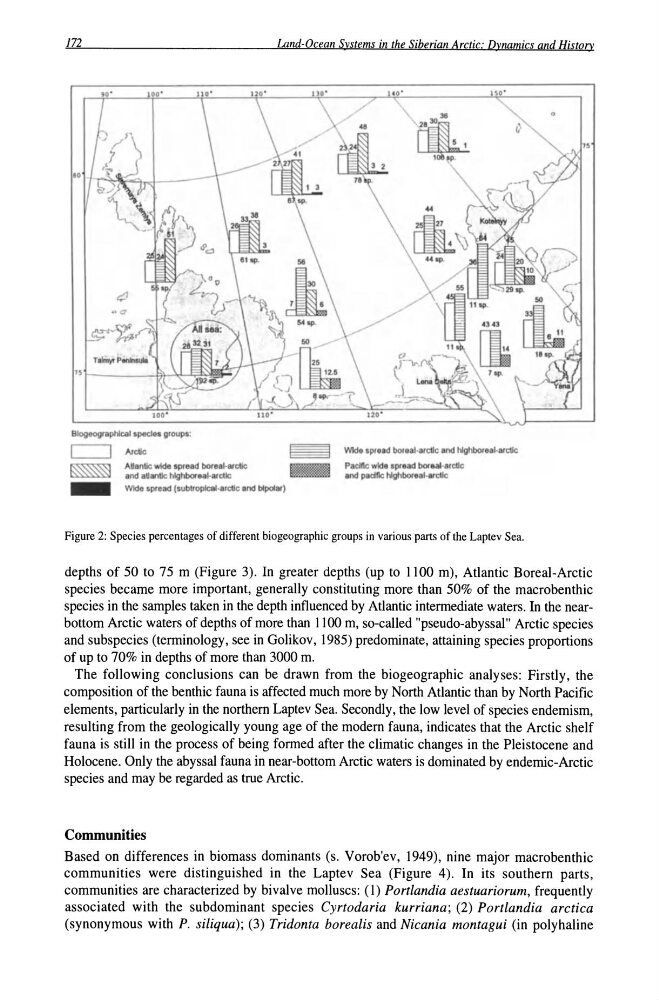
Figure 2: Species percentages of different biogeographic groups in various parts of the Laptev Sea.
depths of 50 to 75 m (Figure 3). In greater depths (up to llO0 m), Atlantic Boreal-Arctic
species became more important, generally constituting more than 50% of the macrobenthic
species in the samples taken in the depth influenced by Atlantic intermediate waters. In the nearbottom Arctic waters of depths of more than 1100 m, so-called "pseudo-abyssal" Arctic species
and subspecies (terminology, see in Golikov, 1985) predominate, attaining species proportions
of up to 70% in depths of more than 3000 m.
The following conclusions can be drawn from the biogeographic analyses: Firstly, the
composition of the benthic fauna is affected much more by North Atlantic than by North Pacific
elements, particularly in the northern Laptev Sea. Secondly, the low level of species endemism,
resulting from the geologically young age of the modern fauna, indicates that the Arctic shelf
fauna is still in the process of being formed after the climatic changes in the Pleistocene and
Holocene. Only the abyssal fauna in near-bottom Arctic waters is dominated by endemic-Arctic
species and may be regarded as true Arctic.
Communities
Based on differences in biomass dominants (s. Vorob'ev, 1949), nine major macrobenthic
communities were distinguished in the Laptev Sea (Figure 4). In its southern parts,
communities are characterized by bivalve molluscs: (1) Portlandia aestuariorum, frequently
associated with the subdominant species Cyrtodaria kurriana; (2) Portlandia arctica
(synonymous with P. siliqua); (3) Tridonta borealis and Nicania montagui (in polyhaline
Land-Ocean Systems in the Siberian Arctic: Dynamics and History
AU .Iie v.ide ""lad boIlal-.C1Ic
and .~anllc hlghbor .. I-IIctlc
WIde .",.ad (sublroplcal .. ,cII<: and bipolar)
~
WIde .",tld boIo.i-OIdIe and h/gNlofl I·IIC11c
Paclfk: wid. I",&ad boI ..... ·.'cIIc
end pacIIIc hlgI1borl I-.ctic:
Figure 2: Species percentages of different biogeographic groups in various parts of the Laptev Sea.
depths of 50 to 75 m (Figure 3). In greater depths (up to llO0 m), Atlantic Boreal-Arctic
species became more important, generally constituting more than 50% of the macrobenthic
species in the samples taken in the depth influenced by Atlantic intermediate waters. In the nearbottom Arctic waters of depths of more than 1100 m, so-called "pseudo-abyssal" Arctic species
and subspecies (terminology, see in Golikov, 1985) predominate, attaining species proportions
of up to 70% in depths of more than 3000 m.
The following conclusions can be drawn from the biogeographic analyses: Firstly, the
composition of the benthic fauna is affected much more by North Atlantic than by North Pacific
elements, particularly in the northern Laptev Sea. Secondly, the low level of species endemism,
resulting from the geologically young age of the modern fauna, indicates that the Arctic shelf
fauna is still in the process of being formed after the climatic changes in the Pleistocene and
Holocene. Only the abyssal fauna in near-bottom Arctic waters is dominated by endemic-Arctic
species and may be regarded as true Arctic.
Communities
Based on differences in biomass dominants (s. Vorob'ev, 1949), nine major macrobenthic
communities were distinguished in the Laptev Sea (Figure 4). In its southern parts,
communities are characterized by bivalve molluscs: (1) Portlandia aestuariorum, frequently
associated with the subdominant species Cyrtodaria kurriana; (2) Portlandia arctica
(synonymous with P. siliqua); (3) Tridonta borealis and Nicania montagui (in polyhaline