

156
Land-Ocean Systems in the Siberian Arctic: Dynamics and History
pancake ICO 0
•
dark nlias
0
•
0
0
:[
10
I
10
.5
.5
"c.
-8 20
(I)
20
"
.e
.e
..
..
~
~
30
30
EJ
~
. O ~
.o~
~I
~
I
I
I
I
I
I
I
0.1
0.2 0.3 0.'
0.5 0.6 0.7 0 .8
0
0. 1 0.2 0.3 0. '
0.5 0.6 0.7
0.8
algal pigments (mg m'')
algal pigments (mg m" )
I young icelbotlom layer
/ $ D
, ~ '1
~
~~
I
I
I
I
I '
I
O. I 0.2 0. 3 0.' 0.5 0.6 0,7 0.8
algal pigments (mg m" )
I
I
I
I
I i
i
0, 1
0,2
0,3
0.'
0,5
0,6
0,7
o,e
-+- Chl.
algal pigments (mg m"l
-¢-- phaeopigmen ts
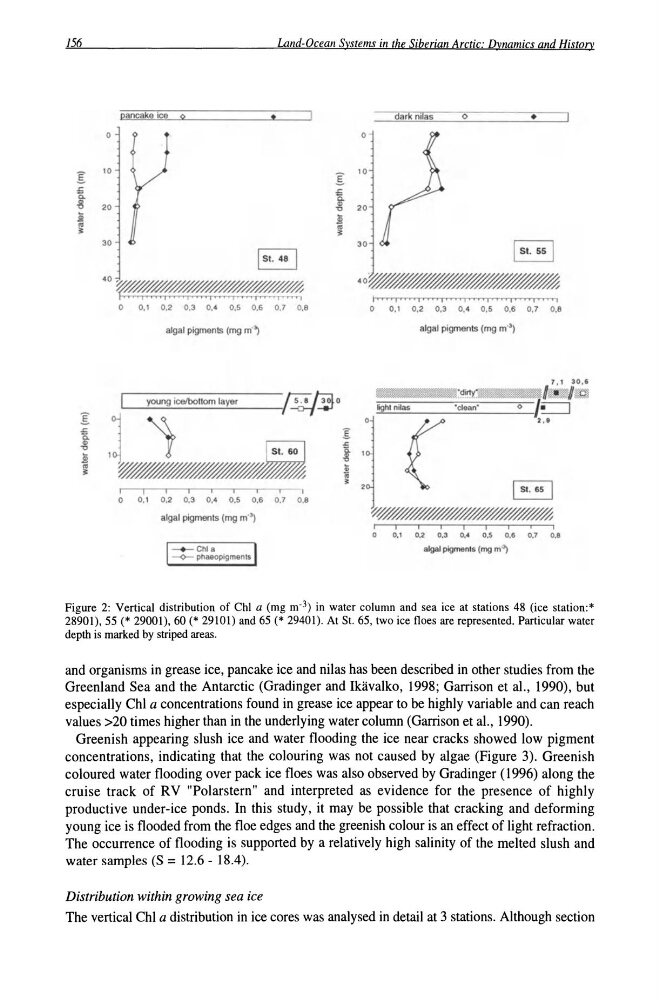
Figure 2: Vertical distribution of Chi a (mg m- 3 ) in water column and sea ice at stations 48 (ice station:*
28901),55 (* 29001), 60 (* 29101) and 65 (* 29401). At St. 65, two ice floes are represented. Particular water
depth is marked by striped areas.
and organisms in grease ice, pancake ice and nilas has been described in other studies from the
Greenland Sea and the Antarctic (Gradinger and Ikavalko, 1998; Garrison et aI., 1990), but
especially ChI a concentrations found in grease ice appear to be highly variable and can reach
values >20 times higher than in the underlying water column (Garrison et aI., 1990).
Greenish appearing slush ice and water flooding the ice near cracks showed low pigment
concentrations, indicating that the colouring was not caused by algae (Figure 3). Greenish
coloured water flooding over pack ice floes was also observed by Gradinger (1996) along the
cruise track of RV "Polarstern" and interpreted as evidence for the presence of highly
productive under-ice ponds. In this study, it may be possible that cracking and deforming
young ice is flooded from the floe edges and the greenish colour is an effect of light refraction.
The occurrence of flooding is supported by a relatively high salinity of the melted slush and
water samples (S = 12.6 - 18.4).
Distribution within growing sea ice
The vertical ChI a distribution in ice cores was analysed in detail at 3 stations. Although section
Land-Ocean Systems in the Siberian Arctic: Dynamics and History
pancake ICO 0
•
dark nlias
0
•
0
0
:[
10
I
10
.5
.5
"c.
-8 20
(I)
20
"
.e
.e
..
..
~
~
30
30
EJ
~
. O ~
.o~
~I
~
I
I
I
I
I
I
I
0.1
0.2 0.3 0.'
0.5 0.6 0.7 0 .8
0
0. 1 0.2 0.3 0. '
0.5 0.6 0.7
0.8
algal pigments (mg m'')
algal pigments (mg m" )
I young icelbotlom layer
/ $ D
, ~ '1
~
~~
I
I
I
I
I '
I
O. I 0.2 0. 3 0.' 0.5 0.6 0,7 0.8
algal pigments (mg m" )
I
I
I
I
I i
i
0, 1
0,2
0,3
0.'
0,5
0,6
0,7
o,e
-+- Chl.
algal pigments (mg m"l
-¢-- phaeopigmen ts
Figure 2: Vertical distribution of Chi a (mg m- 3 ) in water column and sea ice at stations 48 (ice station:*
28901),55 (* 29001), 60 (* 29101) and 65 (* 29401). At St. 65, two ice floes are represented. Particular water
depth is marked by striped areas.
and organisms in grease ice, pancake ice and nilas has been described in other studies from the
Greenland Sea and the Antarctic (Gradinger and Ikavalko, 1998; Garrison et aI., 1990), but
especially ChI a concentrations found in grease ice appear to be highly variable and can reach
values >20 times higher than in the underlying water column (Garrison et aI., 1990).
Greenish appearing slush ice and water flooding the ice near cracks showed low pigment
concentrations, indicating that the colouring was not caused by algae (Figure 3). Greenish
coloured water flooding over pack ice floes was also observed by Gradinger (1996) along the
cruise track of RV "Polarstern" and interpreted as evidence for the presence of highly
productive under-ice ponds. In this study, it may be possible that cracking and deforming
young ice is flooded from the floe edges and the greenish colour is an effect of light refraction.
The occurrence of flooding is supported by a relatively high salinity of the melted slush and
water samples (S = 12.6 - 18.4).
Distribution within growing sea ice
The vertical ChI a distribution in ice cores was analysed in detail at 3 stations. Although section