

J04
Land-Ocean Systems in the Siberian Arctic: Dynamics and History
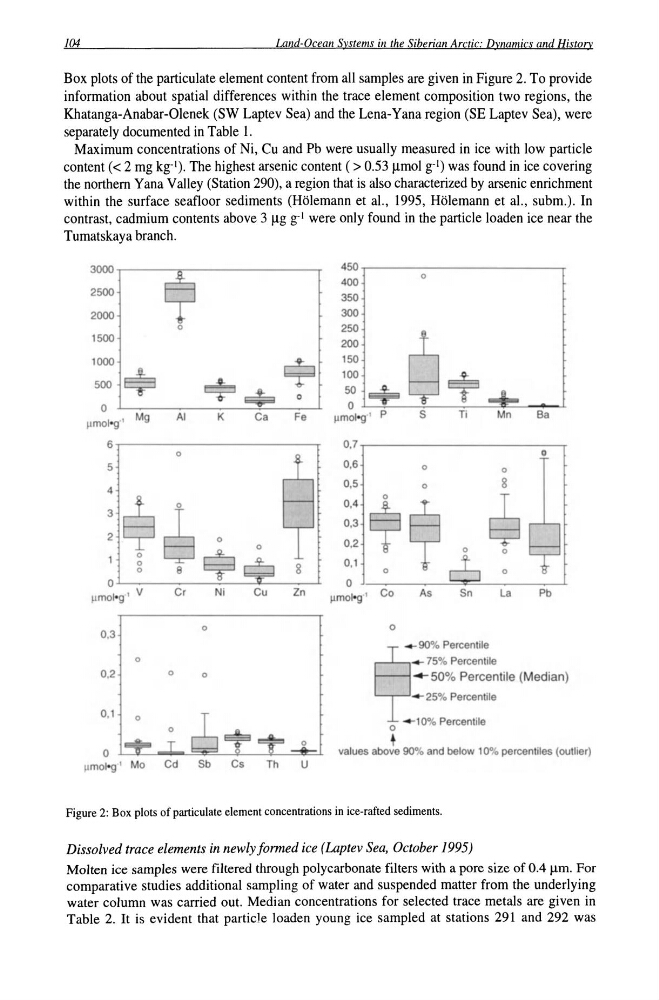
Box plots of the particulate element content from all samples are given in Figure 2. To provide
information about spatial differences within the trace element composition two regions, the
Khatanga-Anabar-Olenek (SW Laptev Sea) and the Lena-Yana region (SE Laptev Sea), were
separately documented in Table 1.
Maximum concentrations of Ni, eu and Pb were usually measured in ice with low particle
content « 2 mg kg-I). The highest arsenic content (> 0.531lmol g-I) was found in ice covering
the northern Yana Valley (Station 290), a region that is also characterized by arsenic enrichment
within the surface seafloor sediments (Holemann et aI., 1995, Holemann et aI., subm.). In
contrast, cadmium contents above 3 Ilg g-I were only found in the particle loaden ice near the
Tumatskaya branch.
3000
450
400
0
2500
350
2000
300
0
250
1500
200
1000
150
100
500
50
0
0
IImolog '
Fe
0
IImol
Ba
6
0,7
0
o
5
0,6
0
o
4
0,5
0
0
3
2
0
$
0
8
8
0
0,4 ~~
0,3
0,2
0,1
0
0
IImolog ' V
Cr
Ni
Cu
Zn
IImol
, Co
As
Sn
0.3
0
o
0
0.2
0
0
0,1
_ 90% Percenlile
~
_ 75"10 Percentile
..- 50% Percentile (Median)
- 25"10 Percentile
o - 10"10 Percentile
+
0
values above 900/0 and below 1 0"10 percentiles (oullier)
IImolog ' Mo
Cd
Sb
Cs
Th
U
Figure 2: Box plots of particulate element concentrations in ice-rafted sediments.
Dissolved trace elements in newly fonned ice (Laptev Sea, October 1995)
Molten ice samples were filtered through polycarbonate filters with a pore size of 0.4 f..Lm. For
comparative studies additional sampling of water and suspended matter from the underlying
water column was carried out. Median concentrations for selected trace metals are given in
Table 2. It is evident that particle loaden young ice sampled at stations 291 and 292 was
Land-Ocean Systems in the Siberian Arctic: Dynamics and History
Box plots of the particulate element content from all samples are given in Figure 2. To provide
information about spatial differences within the trace element composition two regions, the
Khatanga-Anabar-Olenek (SW Laptev Sea) and the Lena-Yana region (SE Laptev Sea), were
separately documented in Table 1.
Maximum concentrations of Ni, eu and Pb were usually measured in ice with low particle
content « 2 mg kg-I). The highest arsenic content (> 0.531lmol g-I) was found in ice covering
the northern Yana Valley (Station 290), a region that is also characterized by arsenic enrichment
within the surface seafloor sediments (Holemann et aI., 1995, Holemann et aI., subm.). In
contrast, cadmium contents above 3 Ilg g-I were only found in the particle loaden ice near the
Tumatskaya branch.
3000
450
400
0
2500
350
2000
300
0
250
1500
200
1000
150
100
500
50
0
0
IImolog '
Fe
0
IImol
Ba
6
0,7
0
o
5
0,6
0
o
4
0,5
0
0
3
2
0
$
0
8
8
0
0,4 ~~
0,3
0,2
0,1
0
0
IImolog ' V
Cr
Ni
Cu
Zn
IImol
, Co
As
Sn
0.3
0
o
0
0.2
0
0
0,1
_ 90% Percenlile
~
_ 75"10 Percentile
..- 50% Percentile (Median)
- 25"10 Percentile
o - 10"10 Percentile
+
0
values above 900/0 and below 1 0"10 percentiles (oullier)
IImolog ' Mo
Cd
Sb
Cs
Th
U
Figure 2: Box plots of particulate element concentrations in ice-rafted sediments.
Dissolved trace elements in newly fonned ice (Laptev Sea, October 1995)
Molten ice samples were filtered through polycarbonate filters with a pore size of 0.4 f..Lm. For
comparative studies additional sampling of water and suspended matter from the underlying
water column was carried out. Median concentrations for selected trace metals are given in
Table 2. It is evident that particle loaden young ice sampled at stations 291 and 292 was