

fluid percolates less vigorously through the porous spires,
a greater percentage of metal from the fluid precipitates
within the deposit instead of being lost to the ocean within
particle-laden plumes (e.g., Haymon and Kastner, 1981;
Koski et al., 1994). Some of the white smoker chimneys
are dominated by zinc- and iron-sulfide minerals, which
form both an initial framework and infilling material
(Koski et al., 1994 – see Figure 4). Others contain abundant barite and silica, both as initial framework material
and as infilling material, with barite then co-precipitating
with silica and sulfide minerals (Hannington and Scott,
1988). Many white smokers lack anhydrite, consistent
with a lack of entrained seawater as they form. In contrast
to black smokers, where flow is rapid through open conduits of >1 cm diameter, flow in white smokers is through
narrow, anastomosing conduits that seal over time, commonly diverting flow horizontally (Fouquet et al., 1993;
Koski et al., 1994). Beehive structures or diffusers are
another type of smoker found at some vent fields. They
have a bulbous morphology, interior temperatures only
slightly less than for black smoker chimneys, highly
porous interiors, and high-temperature (relative to black
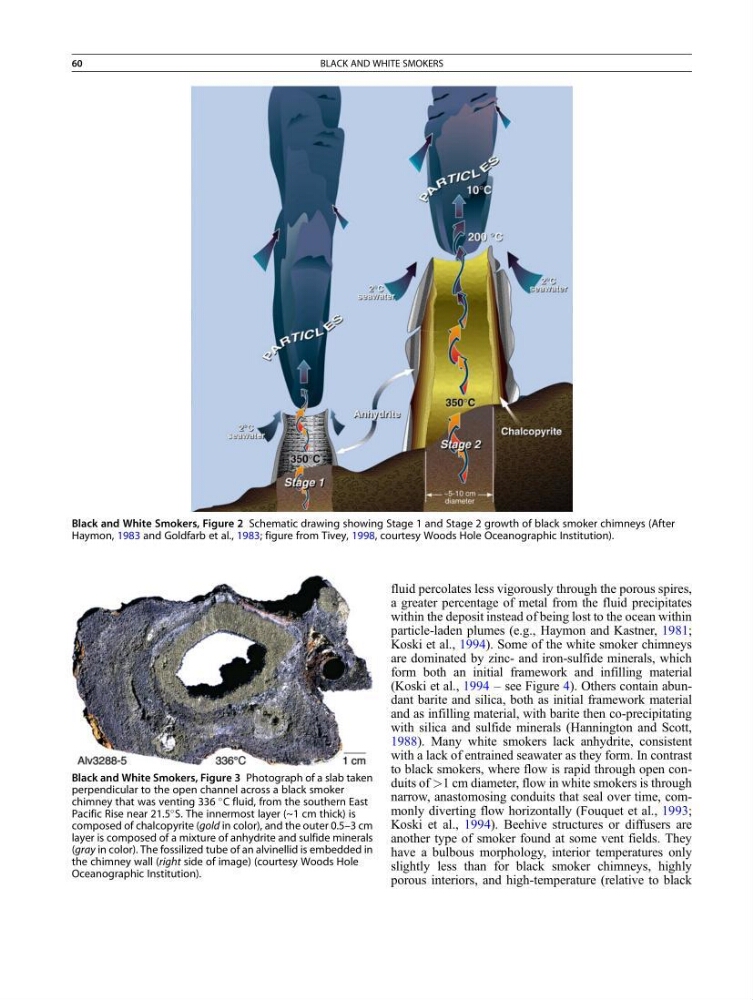
Black and White Smokers, Figure 2 Schematic drawing showing Stage 1 and Stage 2 growth of black smoker chimneys (After
Haymon, 1983 and Goldfarb et al., 1983; figure from Tivey, 1998, courtesy Woods Hole Oceanographic Institution).
Black and White Smokers, Figure 3 Photograph of a slab taken
perpendicular to the open channel across a black smoker
chimney that was venting 336
C fluid, from the southern East
Pacific Rise near 21.5
S. The innermost layer (~1 cm thick) is
composed of chalcopyrite (gold in color), and the outer 0.5–3 cm
layer is composed of a mixture of anhydrite and sulfide minerals
(gray in color). The fossilized tube of an alvinellid is embedded in
the chimney wall (right side of image) (courtesy Woods Hole
Oceanographic Institution).
60
BLACK AND WHITE SMOKERS
a greater percentage of metal from the fluid precipitates
within the deposit instead of being lost to the ocean within
particle-laden plumes (e.g., Haymon and Kastner, 1981;
Koski et al., 1994). Some of the white smoker chimneys
are dominated by zinc- and iron-sulfide minerals, which
form both an initial framework and infilling material
(Koski et al., 1994 – see Figure 4). Others contain abundant barite and silica, both as initial framework material
and as infilling material, with barite then co-precipitating
with silica and sulfide minerals (Hannington and Scott,
1988). Many white smokers lack anhydrite, consistent
with a lack of entrained seawater as they form. In contrast
to black smokers, where flow is rapid through open conduits of >1 cm diameter, flow in white smokers is through
narrow, anastomosing conduits that seal over time, commonly diverting flow horizontally (Fouquet et al., 1993;
Koski et al., 1994). Beehive structures or diffusers are
another type of smoker found at some vent fields. They
have a bulbous morphology, interior temperatures only
slightly less than for black smoker chimneys, highly
porous interiors, and high-temperature (relative to black
Black and White Smokers, Figure 2 Schematic drawing showing Stage 1 and Stage 2 growth of black smoker chimneys (After
Haymon, 1983 and Goldfarb et al., 1983; figure from Tivey, 1998, courtesy Woods Hole Oceanographic Institution).
Black and White Smokers, Figure 3 Photograph of a slab taken
perpendicular to the open channel across a black smoker
chimney that was venting 336
C fluid, from the southern East
Pacific Rise near 21.5
S. The innermost layer (~1 cm thick) is
composed of chalcopyrite (gold in color), and the outer 0.5–3 cm
layer is composed of a mixture of anhydrite and sulfide minerals
(gray in color). The fossilized tube of an alvinellid is embedded in
the chimney wall (right side of image) (courtesy Woods Hole
Oceanographic Institution).
60
BLACK AND WHITE SMOKERS