

and white smoker chimneys) exteriors (up to 70
C;
Fouquet et al., 1993; Koski et al., 1994). They form from
less focused high-temperature fluids that exhibit slower
flow rates than those from black smokers; as in white
smoker chimneys, some flow is diverted and occurs
through sides of these smokers (Fouquet et al., 1993;
Koski et al., 1994). Within some vent fields, hot fluids
are trapped beneath overhanging ledges, termed flanges;
fluids percolate up through the porous flange layers or
flow horizontally and “waterfall” upwards over the lip of
the flange (Delaney et al., 1992).
Carbonate-rich chimneys
Very different types of chimneys are found at the Lost City
vent field, located 15 km from the axis of the Mid-Atlantic
Ridge. The Lost City hydrothermal system is hosted in
mantle rocks (peridotite and serpentinite – see “Peridotites”), and the venting fluids have a higher pH than seawater, low metal and sulfide concentrations, and low
temperature (<100
C) relative to black smoker and white
smoker fluids (Kelley et al., 2005); the very tall spires
being deposited from these fluids are composed of calcium carbonate and magnesium hydroxide minerals
(calcite and/or aragonite (CaCO 3 ) and brucite (MgOH 2 ))
that are saturated in the high pH, carbonate- and
hydroxide-rich fluids.
Summary and conclusions
The morphologies of actively venting seafloor hydrothermal deposits and the composition and appearance of their
hydrothermal plumes reflect the compositions of the fluids
(hydrothermal fluid and seawater) from which they form,
and the styles of flow and mixing of these fluids. “Black
smoker” chimneys with conduit diameters of <2–10 cm
form from very high-temperature (>330–400
C) fluids
that flow at rates of meters per second, and the turbulent
mixing that results when this fluid exits into seawater
results in the formation of particle-laden plumes reminiscent of black smoke. “White smoker” chimneys form from
lower-temperature (~200–330
C) vent fluids that flow
less vigorously through anastomosing narrow conduits
that can become blocked resulting in diversion of flow;
a greater percentage of metals are trapped and deposited
within these chimneys than within black smokers, and
they tend to be richer in zinc because of the lower temperatures that result in saturation and precipitation of zincsulfide minerals.
Over time, collapse and incorporation of these different
types of chimneys and flanges onto and into mounds, and
subsequent reworking of this material as hot fluids flow
through the mounds, forms larger deposits. These larger
deposits (see “Volcanogenic Massive Sulfides” and
“Marine Mineral Resources”) found along the mid-ocean
ridges and along the spreading centers within back-arc
basins are analogs for some types of ore deposits found
on land (e.g., Cyprus-type massive sulfide ore deposits;
Francheteau et al., 1979).
Bibliography
Albarède, F., Michard, A., Minster, J.-F., and Michard, G., 1981.
87 Sr/
86 Sr ratios in hydrothermal waters and deposits from the
East Pacific Rise at 21
N. Earth and Planetary Science Letters,
55, 229–236.
Bischoff, J. L., and Rosenbauer, R. J., 1985. An empirical equation
of state for hydrothermal seawater (3.2 percent NaCl). American
Journal of Science, 285, 725–763.
Bischoff, J. L., and Seyfried, W. E., Jr., 1978. Hydrothermal chemistry of seawater from 25
to 350
C. American Journal of Science, 278, 838–860.
Corliss, J. B., Dymond, J., Gordon, L. I., Edmond, J. M., von
Herzen, R. P., Ballard, R. D., Green, K., Williams, D.,
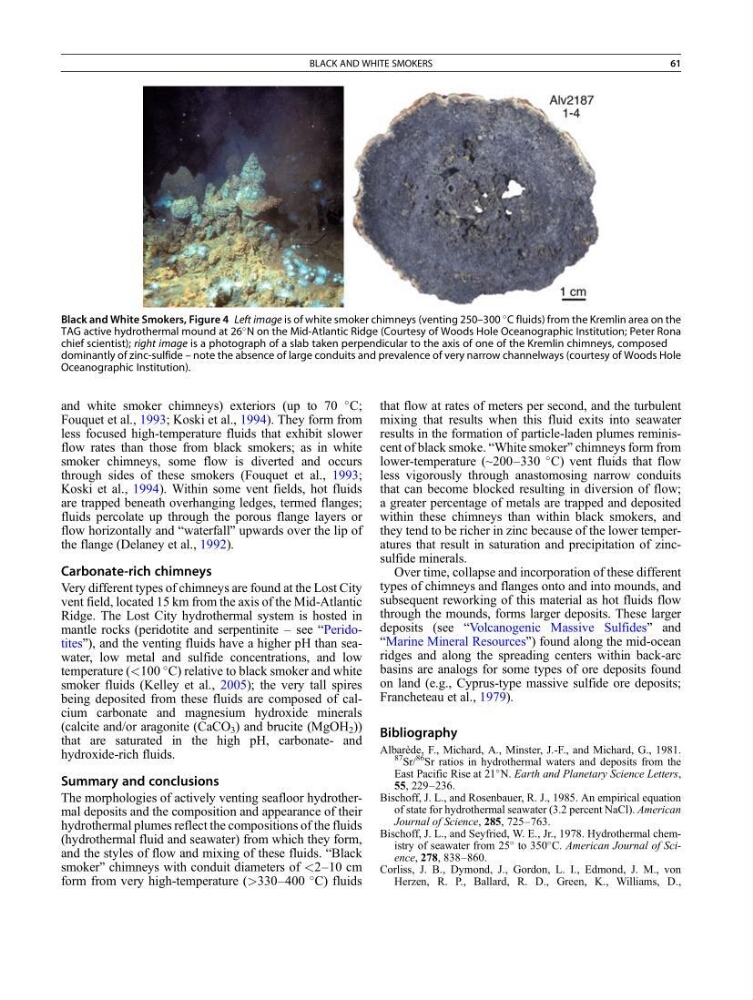
Black and White Smokers, Figure 4 Left image is of white smoker chimneys (venting 250–300
C fluids) from the Kremlin area on the
TAG active hydrothermal mound at 26
N on the Mid-Atlantic Ridge (Courtesy of Woods Hole Oceanographic Institution; Peter Rona
chief scientist); right image is a photograph of a slab taken perpendicular to the axis of one of the Kremlin chimneys, composed
dominantly of zinc-sulfide – note the absence of large conduits and prevalence of very narrow channelways (courtesy of Woods Hole
Oceanographic Institution).
BLACK AND WHITE SMOKERS
61
C;
Fouquet et al., 1993; Koski et al., 1994). They form from
less focused high-temperature fluids that exhibit slower
flow rates than those from black smokers; as in white
smoker chimneys, some flow is diverted and occurs
through sides of these smokers (Fouquet et al., 1993;
Koski et al., 1994). Within some vent fields, hot fluids
are trapped beneath overhanging ledges, termed flanges;
fluids percolate up through the porous flange layers or
flow horizontally and “waterfall” upwards over the lip of
the flange (Delaney et al., 1992).
Carbonate-rich chimneys
Very different types of chimneys are found at the Lost City
vent field, located 15 km from the axis of the Mid-Atlantic
Ridge. The Lost City hydrothermal system is hosted in
mantle rocks (peridotite and serpentinite – see “Peridotites”), and the venting fluids have a higher pH than seawater, low metal and sulfide concentrations, and low
temperature (<100
C) relative to black smoker and white
smoker fluids (Kelley et al., 2005); the very tall spires
being deposited from these fluids are composed of calcium carbonate and magnesium hydroxide minerals
(calcite and/or aragonite (CaCO 3 ) and brucite (MgOH 2 ))
that are saturated in the high pH, carbonate- and
hydroxide-rich fluids.
Summary and conclusions
The morphologies of actively venting seafloor hydrothermal deposits and the composition and appearance of their
hydrothermal plumes reflect the compositions of the fluids
(hydrothermal fluid and seawater) from which they form,
and the styles of flow and mixing of these fluids. “Black
smoker” chimneys with conduit diameters of <2–10 cm
form from very high-temperature (>330–400
C) fluids
that flow at rates of meters per second, and the turbulent
mixing that results when this fluid exits into seawater
results in the formation of particle-laden plumes reminiscent of black smoke. “White smoker” chimneys form from
lower-temperature (~200–330
C) vent fluids that flow
less vigorously through anastomosing narrow conduits
that can become blocked resulting in diversion of flow;
a greater percentage of metals are trapped and deposited
within these chimneys than within black smokers, and
they tend to be richer in zinc because of the lower temperatures that result in saturation and precipitation of zincsulfide minerals.
Over time, collapse and incorporation of these different
types of chimneys and flanges onto and into mounds, and
subsequent reworking of this material as hot fluids flow
through the mounds, forms larger deposits. These larger
deposits (see “Volcanogenic Massive Sulfides” and
“Marine Mineral Resources”) found along the mid-ocean
ridges and along the spreading centers within back-arc
basins are analogs for some types of ore deposits found
on land (e.g., Cyprus-type massive sulfide ore deposits;
Francheteau et al., 1979).
Bibliography
Albarède, F., Michard, A., Minster, J.-F., and Michard, G., 1981.
87 Sr/
86 Sr ratios in hydrothermal waters and deposits from the
East Pacific Rise at 21
N. Earth and Planetary Science Letters,
55, 229–236.
Bischoff, J. L., and Rosenbauer, R. J., 1985. An empirical equation
of state for hydrothermal seawater (3.2 percent NaCl). American
Journal of Science, 285, 725–763.
Bischoff, J. L., and Seyfried, W. E., Jr., 1978. Hydrothermal chemistry of seawater from 25
to 350
C. American Journal of Science, 278, 838–860.
Corliss, J. B., Dymond, J., Gordon, L. I., Edmond, J. M., von
Herzen, R. P., Ballard, R. D., Green, K., Williams, D.,
Black and White Smokers, Figure 4 Left image is of white smoker chimneys (venting 250–300
C fluids) from the Kremlin area on the
TAG active hydrothermal mound at 26
N on the Mid-Atlantic Ridge (Courtesy of Woods Hole Oceanographic Institution; Peter Rona
chief scientist); right image is a photograph of a slab taken perpendicular to the axis of one of the Kremlin chimneys, composed
dominantly of zinc-sulfide – note the absence of large conduits and prevalence of very narrow channelways (courtesy of Woods Hole
Oceanographic Institution).
BLACK AND WHITE SMOKERS
61