

seawater present on the outside of the chimney. Chalcopyrite (CuFeS 2 ) is dominant if temperature is >330
C and
pyrite (FeS 2 ) and wurtzite ((Zn, Fe)S) occur at lower temperatures. Infiltration of seawater and hydrothermal fluid
components across the porous wall also results in the
deposition of sulfide and sulfate minerals and silica in
the interstices of the wall, which gradually makes the
chimney less porous and more metal-rich – see Figure 2.
Interaction of fluids and biota on chimney exteriors can
also result in the formation of an iron-sulfide-rich outermost layer on the chimney (Juniper et al., 1992).
Rapid formation of the Stage 1 chimney wall (it can
form at rates up to 30 cm per day; Goldfarb et al., 1983)
is in part a consequence of anhydrite being an unusual
mineral that is more soluble at low temperatures than at
high temperatures; if seawater is heated to ~150
C or
greater, anhydrite precipitates (Bischoff and Seyfried,
1978). When the very hot vent fluid exits at meter-persecond velocities into seawater, mixtures above ~150
C
will be saturated in anhydrite, with the sulfate coming
from seawater and the calcium from both the vent fluid
and seawater (Styrt et al., 1981; Albarède et al., 1981).
Metal sulfides and oxides (zinc sulfide, iron sulfide,
copper-iron sulfide, manganese oxide, and iron oxide)
also precipitate from the vent fluid and vent fluid/seawater
mixtures as fine-grained particles. Some of these particles
become trapped within and between grains of anhydrite
within the Stage 1 chimney walls, giving the anhydrite,
which is clear to white in its pure form, a gray to black
color (Goldfarb et al., 1983; Haymon, 1983). The
remaining particles form a plume of “smoke” above the
chimney. Because bottom seawater is denser than
the mix of seawater and hydrothermal fluid in the plume,
the plume rises a few 100 m above the seafloor to a depth
where it is of the same buoyancy as the surrounding ocean
water (see “Hydrothermal Plumes”).
Once the initial anhydrite-dominated framework is in
place, chalcopyrite (or chalcopyrite and pyrite or chalcopyrite and wurtzite for lower temperature black smokers)
precipitates on the inner surface of the chimney. Observed
young chimney walls are thin, less than a centimeter to
a few centimeters, with one side of the wall very hot and
one side much colder. The porous chimney wall is subject
to steep gradients of temperature and concentrations of
elements. As the chimney evolves, the innermost layer
thickens (recovery of a chimney known to be only 1 year
old had an innermost chalcopyrite layer that was ~1 cm
thick; Koski et al., 1994). At the same time that the innermost layer is thickening, aqueous ions, including copper,
iron, hydrogen, oxygen, sulfide, sulfate, zinc, sodium,
chloride, and magnesium, are transported from areas of
high to low concentrations (by diffusion). These elements
also are carried by fluids flowing across the wall from
areas of high to low pressure (by advection). As a result
of these processes, minerals become saturated and precipitate in the pore spaces within the chimney walls, and
favorable conditions for microorganisms are established
in the outer parts of the chimney walls. In particular,
within the chimney walls at temperatures less than
~120
C, the steep temperature and concentration gradients provide combinations of reducing chemicals from
vent fluids (hydrogen, hydrogen sulfide, ferrous iron)
and oxidizing chemicals from seawater (oxygen, sulfate,
ferric iron) that can be used by microorganisms (bacteria
and archaea) as sources of energy (see “Chemosynthetic
Life”; Jannasch, 1995). Larger organisms (e.g., alvinellids
and paralvinellids; Haymon and Kastner, 1981; Juniper
et al., 1992) also reside on the exteriors of chimneys, and
their tubes can become incorporated into chimney walls –
see Figure 3. As the chimney grows, earlier-formed minerals, as they are exposed to hotter fluids, can be replaced
by later-formed minerals.
Formation of white smoker chimneys
The style of mixing between vent fluid and seawater differs in chimneys that emit lower-temperature, white to
clear fluids (~200–330
C). One major reason for this is
that the vent fluid is flowing more slowly. Because the
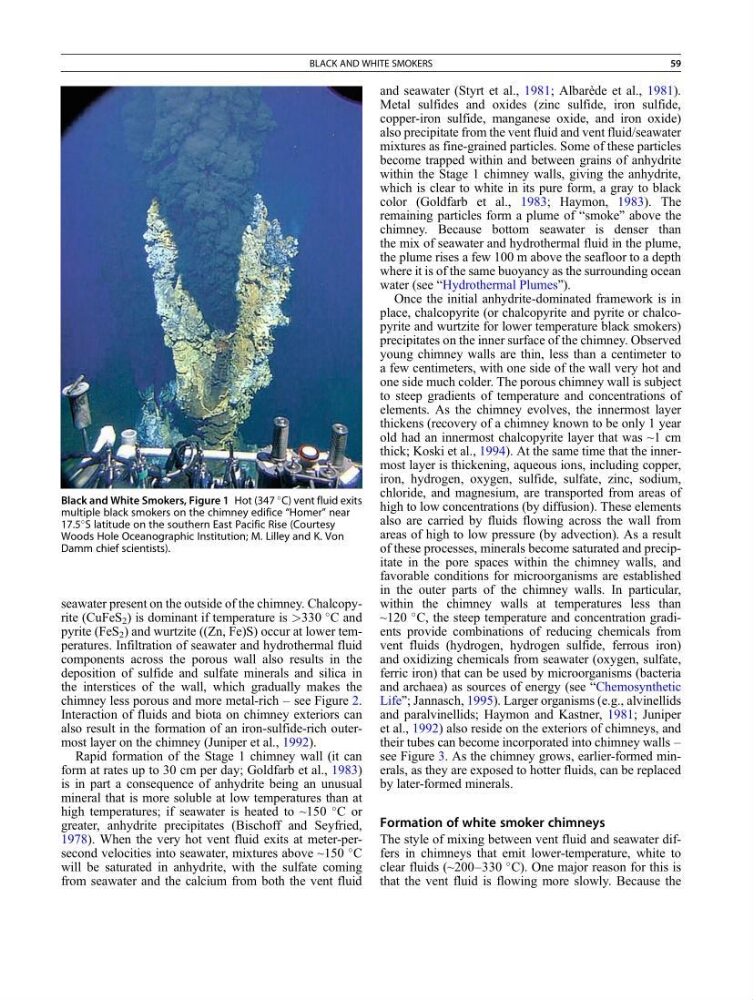
Black and White Smokers, Figure 1 Hot (347
C) vent fluid exits
multiple black smokers on the chimney edifice “Homer” near
17.5
S latitude on the southern East Pacific Rise (Courtesy
Woods Hole Oceanographic Institution; M. Lilley and K. Von
Damm chief scientists).
BLACK AND WHITE SMOKERS
59
C and
pyrite (FeS 2 ) and wurtzite ((Zn, Fe)S) occur at lower temperatures. Infiltration of seawater and hydrothermal fluid
components across the porous wall also results in the
deposition of sulfide and sulfate minerals and silica in
the interstices of the wall, which gradually makes the
chimney less porous and more metal-rich – see Figure 2.
Interaction of fluids and biota on chimney exteriors can
also result in the formation of an iron-sulfide-rich outermost layer on the chimney (Juniper et al., 1992).
Rapid formation of the Stage 1 chimney wall (it can
form at rates up to 30 cm per day; Goldfarb et al., 1983)
is in part a consequence of anhydrite being an unusual
mineral that is more soluble at low temperatures than at
high temperatures; if seawater is heated to ~150
C or
greater, anhydrite precipitates (Bischoff and Seyfried,
1978). When the very hot vent fluid exits at meter-persecond velocities into seawater, mixtures above ~150
C
will be saturated in anhydrite, with the sulfate coming
from seawater and the calcium from both the vent fluid
and seawater (Styrt et al., 1981; Albarède et al., 1981).
Metal sulfides and oxides (zinc sulfide, iron sulfide,
copper-iron sulfide, manganese oxide, and iron oxide)
also precipitate from the vent fluid and vent fluid/seawater
mixtures as fine-grained particles. Some of these particles
become trapped within and between grains of anhydrite
within the Stage 1 chimney walls, giving the anhydrite,
which is clear to white in its pure form, a gray to black
color (Goldfarb et al., 1983; Haymon, 1983). The
remaining particles form a plume of “smoke” above the
chimney. Because bottom seawater is denser than
the mix of seawater and hydrothermal fluid in the plume,
the plume rises a few 100 m above the seafloor to a depth
where it is of the same buoyancy as the surrounding ocean
water (see “Hydrothermal Plumes”).
Once the initial anhydrite-dominated framework is in
place, chalcopyrite (or chalcopyrite and pyrite or chalcopyrite and wurtzite for lower temperature black smokers)
precipitates on the inner surface of the chimney. Observed
young chimney walls are thin, less than a centimeter to
a few centimeters, with one side of the wall very hot and
one side much colder. The porous chimney wall is subject
to steep gradients of temperature and concentrations of
elements. As the chimney evolves, the innermost layer
thickens (recovery of a chimney known to be only 1 year
old had an innermost chalcopyrite layer that was ~1 cm
thick; Koski et al., 1994). At the same time that the innermost layer is thickening, aqueous ions, including copper,
iron, hydrogen, oxygen, sulfide, sulfate, zinc, sodium,
chloride, and magnesium, are transported from areas of
high to low concentrations (by diffusion). These elements
also are carried by fluids flowing across the wall from
areas of high to low pressure (by advection). As a result
of these processes, minerals become saturated and precipitate in the pore spaces within the chimney walls, and
favorable conditions for microorganisms are established
in the outer parts of the chimney walls. In particular,
within the chimney walls at temperatures less than
~120
C, the steep temperature and concentration gradients provide combinations of reducing chemicals from
vent fluids (hydrogen, hydrogen sulfide, ferrous iron)
and oxidizing chemicals from seawater (oxygen, sulfate,
ferric iron) that can be used by microorganisms (bacteria
and archaea) as sources of energy (see “Chemosynthetic
Life”; Jannasch, 1995). Larger organisms (e.g., alvinellids
and paralvinellids; Haymon and Kastner, 1981; Juniper
et al., 1992) also reside on the exteriors of chimneys, and
their tubes can become incorporated into chimney walls –
see Figure 3. As the chimney grows, earlier-formed minerals, as they are exposed to hotter fluids, can be replaced
by later-formed minerals.
Formation of white smoker chimneys
The style of mixing between vent fluid and seawater differs in chimneys that emit lower-temperature, white to
clear fluids (~200–330
C). One major reason for this is
that the vent fluid is flowing more slowly. Because the
Black and White Smokers, Figure 1 Hot (347
C) vent fluid exits
multiple black smokers on the chimney edifice “Homer” near
17.5
S latitude on the southern East Pacific Rise (Courtesy
Woods Hole Oceanographic Institution; M. Lilley and K. Von
Damm chief scientists).
BLACK AND WHITE SMOKERS
59