

forces then slow the bottom part of the wave while the top
continues to move at the same speed, eventually over
reaching the slower moving wave base. Waves may break
as spilling breakers on low-gradient slopes, as plunging
waves on moderate gradients, or as surging waves on steep
slopes. Breaking waves transform their potential
energy into kinetic energy in the form of broken waves
of translation, or wave bores that move shoreward as
turbulent white water. Breaking waves dissipate most of
their forward-moving energy, which is lost in
turbulence. Turbulent flow is an important process
because it stirs up large quantities of bottom sediment
that will remain in suspension for variable amounts of
time depending on the grain size, larger particles
settling faster than smaller ones according to Stoke’s
law and measured in numerous ways in the lab and in
the field. This entrained sediment is transported more or
less parallel to the shore by the longshore current,
which typically reaches from the shoreline through the
breaker zone. Under high-energy conditions, breaking
storm waves advance across the upper shoreface,
sending surge and fast-moving swash up the beachface
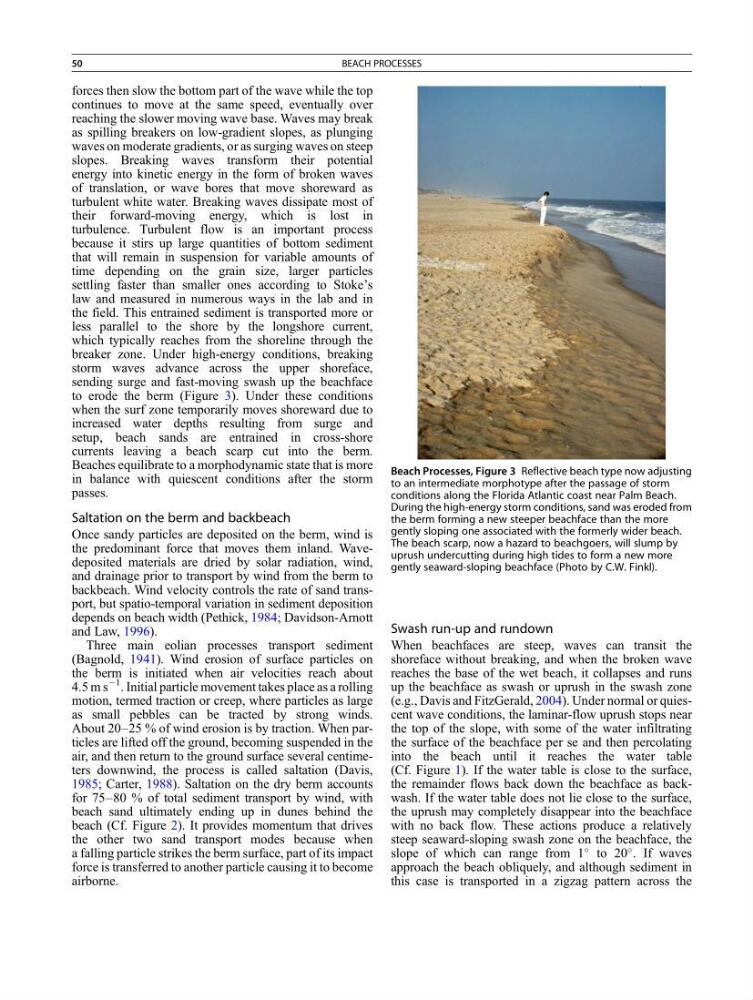
to erode the berm (Figure 3). Under these conditions
when the surf zone temporarily moves shoreward due to
increased water depths resulting from surge and
setup, beach sands are entrained in cross-shore
currents leaving a beach scarp cut into the berm.
Beaches equilibrate to a morphodynamic state that is more
in balance with quiescent conditions after the storm
passes.
Saltation on the berm and backbeach
Once sandy particles are deposited on the berm, wind is
the predominant force that moves them inland. Wavedeposited materials are dried by solar radiation, wind,
and drainage prior to transport by wind from the berm to
backbeach. Wind velocity controls the rate of sand transport, but spatio-temporal variation in sediment deposition
depends on beach width (Pethick, 1984; Davidson-Arnott
and Law, 1996).
Three main eolian processes transport sediment
(Bagnold, 1941). Wind erosion of surface particles on
the berm is initiated when air velocities reach about
4.5 m s
À1
. Initial particle movement takes place as a rolling
motion, termed traction or creep, where particles as large
as small pebbles can be tracted by strong winds.
About 20–25 % of wind erosion is by traction. When particles are lifted off the ground, becoming suspended in the
air, and then return to the ground surface several centimeters downwind, the process is called saltation (Davis,
1985; Carter, 1988). Saltation on the dry berm accounts
for 75–80 % of total sediment transport by wind, with
beach sand ultimately ending up in dunes behind the
beach (Cf. Figure 2). It provides momentum that drives
the other two sand transport modes because when
a falling particle strikes the berm surface, part of its impact
force is transferred to another particle causing it to become
airborne.
Swash run-up and rundown
When beachfaces are steep, waves can transit the
shoreface without breaking, and when the broken wave
reaches the base of the wet beach, it collapses and runs
up the beachface as swash or uprush in the swash zone
(e.g., Davis and FitzGerald, 2004). Under normal or quiescent wave conditions, the laminar-flow uprush stops near
the top of the slope, with some of the water infiltrating
the surface of the beachface per se and then percolating
into the beach until it reaches the water table
(Cf. Figure 1). If the water table is close to the surface,
the remainder flows back down the beachface as backwash. If the water table does not lie close to the surface,
the uprush may completely disappear into the beachface
with no back flow. These actions produce a relatively
steep seaward-sloping swash zone on the beachface, the
slope of which can range from 1
to 20
. If waves
approach the beach obliquely, and although sediment in
this case is transported in a zigzag pattern across the
Beach Processes, Figure 3 Reflective beach type now adjusting
to an intermediate morphotype after the passage of storm
conditions along the Florida Atlantic coast near Palm Beach.
During the high-energy storm conditions, sand was eroded from
the berm forming a new steeper beachface than the more
gently sloping one associated with the formerly wider beach.
The beach scarp, now a hazard to beachgoers, will slump by
uprush undercutting during high tides to form a new more
gently seaward-sloping beachface (Photo by C.W. Finkl).
50
BEACH PROCESSES
continues to move at the same speed, eventually over
reaching the slower moving wave base. Waves may break
as spilling breakers on low-gradient slopes, as plunging
waves on moderate gradients, or as surging waves on steep
slopes. Breaking waves transform their potential
energy into kinetic energy in the form of broken waves
of translation, or wave bores that move shoreward as
turbulent white water. Breaking waves dissipate most of
their forward-moving energy, which is lost in
turbulence. Turbulent flow is an important process
because it stirs up large quantities of bottom sediment
that will remain in suspension for variable amounts of
time depending on the grain size, larger particles
settling faster than smaller ones according to Stoke’s
law and measured in numerous ways in the lab and in
the field. This entrained sediment is transported more or
less parallel to the shore by the longshore current,
which typically reaches from the shoreline through the
breaker zone. Under high-energy conditions, breaking
storm waves advance across the upper shoreface,
sending surge and fast-moving swash up the beachface
to erode the berm (Figure 3). Under these conditions
when the surf zone temporarily moves shoreward due to
increased water depths resulting from surge and
setup, beach sands are entrained in cross-shore
currents leaving a beach scarp cut into the berm.
Beaches equilibrate to a morphodynamic state that is more
in balance with quiescent conditions after the storm
passes.
Saltation on the berm and backbeach
Once sandy particles are deposited on the berm, wind is
the predominant force that moves them inland. Wavedeposited materials are dried by solar radiation, wind,
and drainage prior to transport by wind from the berm to
backbeach. Wind velocity controls the rate of sand transport, but spatio-temporal variation in sediment deposition
depends on beach width (Pethick, 1984; Davidson-Arnott
and Law, 1996).
Three main eolian processes transport sediment
(Bagnold, 1941). Wind erosion of surface particles on
the berm is initiated when air velocities reach about
4.5 m s
À1
. Initial particle movement takes place as a rolling
motion, termed traction or creep, where particles as large
as small pebbles can be tracted by strong winds.
About 20–25 % of wind erosion is by traction. When particles are lifted off the ground, becoming suspended in the
air, and then return to the ground surface several centimeters downwind, the process is called saltation (Davis,
1985; Carter, 1988). Saltation on the dry berm accounts
for 75–80 % of total sediment transport by wind, with
beach sand ultimately ending up in dunes behind the
beach (Cf. Figure 2). It provides momentum that drives
the other two sand transport modes because when
a falling particle strikes the berm surface, part of its impact
force is transferred to another particle causing it to become
airborne.
Swash run-up and rundown
When beachfaces are steep, waves can transit the
shoreface without breaking, and when the broken wave
reaches the base of the wet beach, it collapses and runs
up the beachface as swash or uprush in the swash zone
(e.g., Davis and FitzGerald, 2004). Under normal or quiescent wave conditions, the laminar-flow uprush stops near
the top of the slope, with some of the water infiltrating
the surface of the beachface per se and then percolating
into the beach until it reaches the water table
(Cf. Figure 1). If the water table is close to the surface,
the remainder flows back down the beachface as backwash. If the water table does not lie close to the surface,
the uprush may completely disappear into the beachface
with no back flow. These actions produce a relatively
steep seaward-sloping swash zone on the beachface, the
slope of which can range from 1
to 20
. If waves
approach the beach obliquely, and although sediment in
this case is transported in a zigzag pattern across the
Beach Processes, Figure 3 Reflective beach type now adjusting
to an intermediate morphotype after the passage of storm
conditions along the Florida Atlantic coast near Palm Beach.
During the high-energy storm conditions, sand was eroded from
the berm forming a new steeper beachface than the more
gently sloping one associated with the formerly wider beach.
The beach scarp, now a hazard to beachgoers, will slump by
uprush undercutting during high tides to form a new more
gently seaward-sloping beachface (Photo by C.W. Finkl).
50
BEACH PROCESSES