

Beaches are thus complex processual systems that
require much tenacity and expertise to tease out the secrets
of beach formation and modification. In spite of the complexity involved, it is possible to outline some of the main
processes that are responsible for major beach features. It
is also perhaps worth mentioning at this point that it is
not profitable to attempt discussion of beach processes
without considering the morphological properties of
beach features. The association of process and form
(Hardisty, 1990) thus leads to appreciation of beach
morphodynamics (e.g., Short, 2006), which includes the
interaction between breaking waves, currents, rocky headland or submerged hardgrounds, and the sediments that
compose the beach. Beaches are dynamic features where
composition, morphology, and orientation are spatiotemporally variable as, for example, in the case of headland bay beaches that rotate between promontories
(Klein et al., 2002; Short and Trembanis, 2004).
Small-scale beach processes
Waves and currents sort the sediment and move it alongshore and cross-shore. The concept of a “river of sand”
is sometimes promoted, but it is a misnomer because there
can be many interruptions to the alongshore sediment flow
as in the case of capes, promontories (headlands), submarine canyons, deeply dredged inlets, or other engineering
structures such as groins and jetties. Alongshore drift
may be predominantly in one direction, but there can be
seasonal reversals (e.g., during monsoons) or interruptions
due to storms, making the concepts of gross and net
sediment transport viable (Dean and Dalrymple, 2002).
As a general rule in sandy environments, coarser materials
remain closer to shore, but along high-energy coasts
coarse materials may be heaped up on the beachface and
berm. Below mobile surface sediments, bedrock platforms
or consolidated materials slope gently seaward, serving as
a foundation for the beach. Some beach sediments are
heaped up on marine benches during storms and because
they lie beyond normal waves and tidal cycles, they are
referred to as perched beaches being the result of special
extreme processes.
Beaches exist in a state of dynamic equilibrium with
tides and waves. Storm waves tend to move the sand out
to deeper water and flatten the beach cross-shore profile
while less energetic waves in quiescent periods tend to
move sediment shoreward to build up the beach. Some
beaches retain sand that is trapped between headlands,
while in other settings sand transits the beach by entering
in one end and exiting in the other, somewhat in the context of a conveyor belt. The beach therefore exists when
processes and materials balance each other over time
(e.g., Dean and Dalrymple, 2002; Davis and FitzGerald,
2004).
The surf zone, the most dynamic part of the beach,
extends from the breaker zone to the shore (Wright and
Short, 1984). Waves theoretically break when the slope
of the advancing face is steeper than 1:0.78 but may be
closer to 1:1 based on field data. Waves typically start to
interact with the seafloor when the water depth is about
75–80 % of the wave height (Bascom, 1980). Frictional
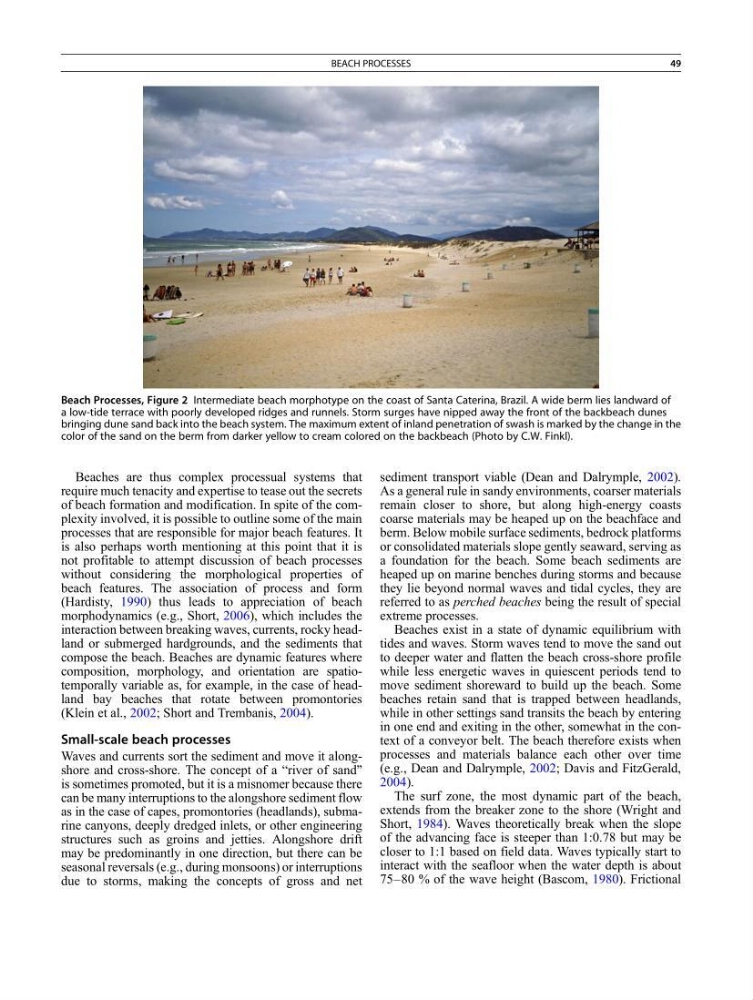
Beach Processes, Figure 2 Intermediate beach morphotype on the coast of Santa Caterina, Brazil. A wide berm lies landward of
a low-tide terrace with poorly developed ridges and runnels. Storm surges have nipped away the front of the backbeach dunes
bringing dune sand back into the beach system. The maximum extent of inland penetration of swash is marked by the change in the
color of the sand on the berm from darker yellow to cream colored on the backbeach (Photo by C.W. Finkl).
BEACH PROCESSES
49
require much tenacity and expertise to tease out the secrets
of beach formation and modification. In spite of the complexity involved, it is possible to outline some of the main
processes that are responsible for major beach features. It
is also perhaps worth mentioning at this point that it is
not profitable to attempt discussion of beach processes
without considering the morphological properties of
beach features. The association of process and form
(Hardisty, 1990) thus leads to appreciation of beach
morphodynamics (e.g., Short, 2006), which includes the
interaction between breaking waves, currents, rocky headland or submerged hardgrounds, and the sediments that
compose the beach. Beaches are dynamic features where
composition, morphology, and orientation are spatiotemporally variable as, for example, in the case of headland bay beaches that rotate between promontories
(Klein et al., 2002; Short and Trembanis, 2004).
Small-scale beach processes
Waves and currents sort the sediment and move it alongshore and cross-shore. The concept of a “river of sand”
is sometimes promoted, but it is a misnomer because there
can be many interruptions to the alongshore sediment flow
as in the case of capes, promontories (headlands), submarine canyons, deeply dredged inlets, or other engineering
structures such as groins and jetties. Alongshore drift
may be predominantly in one direction, but there can be
seasonal reversals (e.g., during monsoons) or interruptions
due to storms, making the concepts of gross and net
sediment transport viable (Dean and Dalrymple, 2002).
As a general rule in sandy environments, coarser materials
remain closer to shore, but along high-energy coasts
coarse materials may be heaped up on the beachface and
berm. Below mobile surface sediments, bedrock platforms
or consolidated materials slope gently seaward, serving as
a foundation for the beach. Some beach sediments are
heaped up on marine benches during storms and because
they lie beyond normal waves and tidal cycles, they are
referred to as perched beaches being the result of special
extreme processes.
Beaches exist in a state of dynamic equilibrium with
tides and waves. Storm waves tend to move the sand out
to deeper water and flatten the beach cross-shore profile
while less energetic waves in quiescent periods tend to
move sediment shoreward to build up the beach. Some
beaches retain sand that is trapped between headlands,
while in other settings sand transits the beach by entering
in one end and exiting in the other, somewhat in the context of a conveyor belt. The beach therefore exists when
processes and materials balance each other over time
(e.g., Dean and Dalrymple, 2002; Davis and FitzGerald,
2004).
The surf zone, the most dynamic part of the beach,
extends from the breaker zone to the shore (Wright and
Short, 1984). Waves theoretically break when the slope
of the advancing face is steeper than 1:0.78 but may be
closer to 1:1 based on field data. Waves typically start to
interact with the seafloor when the water depth is about
75–80 % of the wave height (Bascom, 1980). Frictional
Beach Processes, Figure 2 Intermediate beach morphotype on the coast of Santa Caterina, Brazil. A wide berm lies landward of
a low-tide terrace with poorly developed ridges and runnels. Storm surges have nipped away the front of the backbeach dunes
bringing dune sand back into the beach system. The maximum extent of inland penetration of swash is marked by the change in the
color of the sand on the berm from darker yellow to cream colored on the backbeach (Photo by C.W. Finkl).
BEACH PROCESSES
49