

beachface, the net result is sediment transport in the direction of the waves. As sediment accumulates in a seawardbuilding swash zone, it constructs a berm, the nearly horizontal to slightly landward-dipping sand surface that
merges with the backbeach. This is the so-called dry beach
where most people sit or lay down when they go to the
beach. The swash zone may contain small-scale features
such as beach cusps, spaced about every 20–30 m apart,
and which are thought to be produced by edge waves
(Guza and Inman, 1975). On intertidal flat-lying parts of
the foreshore, swash currents may produce various types
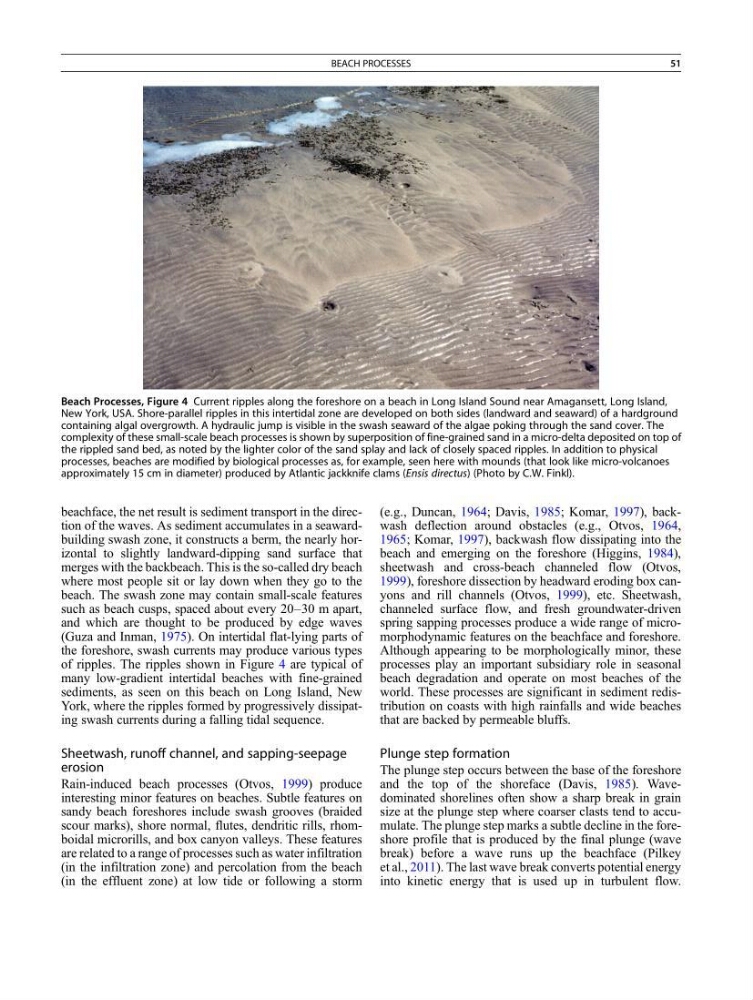
of ripples. The ripples shown in Figure 4 are typical of
many low-gradient intertidal beaches with fine-grained
sediments, as seen on this beach on Long Island, New
York, where the ripples formed by progressively dissipating swash currents during a falling tidal sequence.
Sheetwash, runoff channel, and sapping-seepage
erosion
Rain-induced beach processes (Otvos, 1999) produce
interesting minor features on beaches. Subtle features on
sandy beach foreshores include swash grooves (braided
scour marks), shore normal, flutes, dendritic rills, rhomboidal microrills, and box canyon valleys. These features
are related to a range of processes such as water infiltration
(in the infiltration zone) and percolation from the beach
(in the effluent zone) at low tide or following a storm
(e.g., Duncan, 1964; Davis, 1985; Komar, 1997), backwash deflection around obstacles (e.g., Otvos, 1964,
1965; Komar, 1997), backwash flow dissipating into the
beach and emerging on the foreshore (Higgins, 1984),
sheetwash and cross-beach channeled flow (Otvos,
1999), foreshore dissection by headward eroding box canyons and rill channels (Otvos, 1999), etc. Sheetwash,
channeled surface flow, and fresh groundwater-driven
spring sapping processes produce a wide range of micromorphodynamic features on the beachface and foreshore.
Although appearing to be morphologically minor, these
processes play an important subsidiary role in seasonal
beach degradation and operate on most beaches of the
world. These processes are significant in sediment redistribution on coasts with high rainfalls and wide beaches
that are backed by permeable bluffs.
Plunge step formation
The plunge step occurs between the base of the foreshore
and the top of the shoreface (Davis, 1985). Wavedominated shorelines often show a sharp break in grain
size at the plunge step where coarser clasts tend to accumulate. The plunge step marks a subtle decline in the foreshore profile that is produced by the final plunge (wave
break) before a wave runs up the beachface (Pilkey
et al., 2011). The last wave break converts potential energy
into kinetic energy that is used up in turbulent flow.
Beach Processes, Figure 4 Current ripples along the foreshore on a beach in Long Island Sound near Amagansett, Long Island,
New York, USA. Shore-parallel ripples in this intertidal zone are developed on both sides (landward and seaward) of a hardground
containing algal overgrowth. A hydraulic jump is visible in the swash seaward of the algae poking through the sand cover. The
complexity of these small-scale beach processes is shown by superposition of fine-grained sand in a micro-delta deposited on top of
the rippled sand bed, as noted by the lighter color of the sand splay and lack of closely spaced ripples. In addition to physical
processes, beaches are modified by biological processes as, for example, seen here with mounds (that look like micro-volcanoes
approximately 15 cm in diameter) produced by Atlantic jackknife clams (Ensis directus) (Photo by C.W. Finkl).
BEACH PROCESSES
51
merges with the backbeach. This is the so-called dry beach
where most people sit or lay down when they go to the
beach. The swash zone may contain small-scale features
such as beach cusps, spaced about every 20–30 m apart,
and which are thought to be produced by edge waves
(Guza and Inman, 1975). On intertidal flat-lying parts of
the foreshore, swash currents may produce various types
of ripples. The ripples shown in Figure 4 are typical of
many low-gradient intertidal beaches with fine-grained
sediments, as seen on this beach on Long Island, New
York, where the ripples formed by progressively dissipating swash currents during a falling tidal sequence.
Sheetwash, runoff channel, and sapping-seepage
erosion
Rain-induced beach processes (Otvos, 1999) produce
interesting minor features on beaches. Subtle features on
sandy beach foreshores include swash grooves (braided
scour marks), shore normal, flutes, dendritic rills, rhomboidal microrills, and box canyon valleys. These features
are related to a range of processes such as water infiltration
(in the infiltration zone) and percolation from the beach
(in the effluent zone) at low tide or following a storm
(e.g., Duncan, 1964; Davis, 1985; Komar, 1997), backwash deflection around obstacles (e.g., Otvos, 1964,
1965; Komar, 1997), backwash flow dissipating into the
beach and emerging on the foreshore (Higgins, 1984),
sheetwash and cross-beach channeled flow (Otvos,
1999), foreshore dissection by headward eroding box canyons and rill channels (Otvos, 1999), etc. Sheetwash,
channeled surface flow, and fresh groundwater-driven
spring sapping processes produce a wide range of micromorphodynamic features on the beachface and foreshore.
Although appearing to be morphologically minor, these
processes play an important subsidiary role in seasonal
beach degradation and operate on most beaches of the
world. These processes are significant in sediment redistribution on coasts with high rainfalls and wide beaches
that are backed by permeable bluffs.
Plunge step formation
The plunge step occurs between the base of the foreshore
and the top of the shoreface (Davis, 1985). Wavedominated shorelines often show a sharp break in grain
size at the plunge step where coarser clasts tend to accumulate. The plunge step marks a subtle decline in the foreshore profile that is produced by the final plunge (wave
break) before a wave runs up the beachface (Pilkey
et al., 2011). The last wave break converts potential energy
into kinetic energy that is used up in turbulent flow.
Beach Processes, Figure 4 Current ripples along the foreshore on a beach in Long Island Sound near Amagansett, Long Island,
New York, USA. Shore-parallel ripples in this intertidal zone are developed on both sides (landward and seaward) of a hardground
containing algal overgrowth. A hydraulic jump is visible in the swash seaward of the algae poking through the sand cover. The
complexity of these small-scale beach processes is shown by superposition of fine-grained sand in a micro-delta deposited on top of
the rippled sand bed, as noted by the lighter color of the sand splay and lack of closely spaced ripples. In addition to physical
processes, beaches are modified by biological processes as, for example, seen here with mounds (that look like micro-volcanoes
approximately 15 cm in diameter) produced by Atlantic jackknife clams (Ensis directus) (Photo by C.W. Finkl).
BEACH PROCESSES
51