

Conclusions
A master APW path for the Jurassic Pangaea was
constructed using selected Eurasian, North American,
African, and South American high-quality poles. The
resultant path reveals a distinctive cusp at $197 Ma and
a subsequent standstill which seemed to persist until the
Late Jurassic. The 197–185 Ma Early Jurassic track
reveals a c. 50
shift in the pole positions during this time
and a minimum angular change of poles of approximately
4
Myr
À1
. This path clearly shows that Pangaea would
have been subjected to a 50
CW rotation between the
Sinemurian ($197 Ma) and Pliensbachian ($185 Ma),
0°E
0°
30°S
L.Sinemurian-E.Pliensbachian (193 Ma)
0°E
30°N
L.Pliensbachian-Toarcian (185 Ma)
0°E
30°N
0°
30°S
Hettangian
Pliensbachian
Toarcian
L.Triassic-Sinemurian (200 Ma)
0°E
30°N
0°E
0°
30°S
0°E
60°N
60°S
60°N
60°S
60°N
60°S
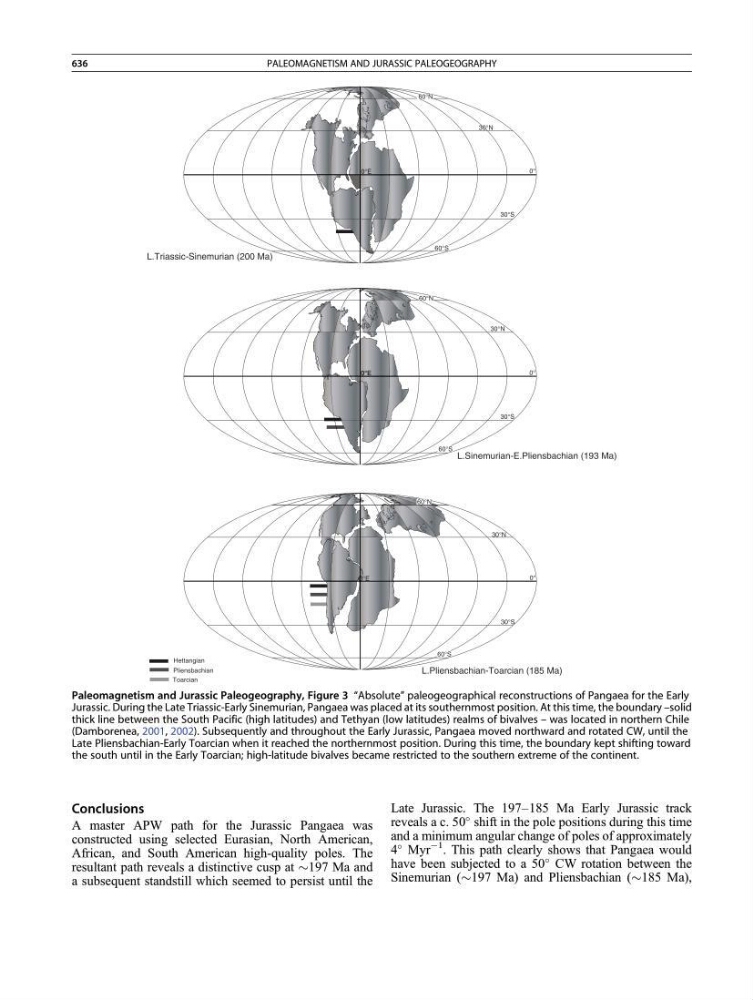
Paleomagnetism and Jurassic Paleogeography, Figure 3 “Absolute” paleogeographical reconstructions of Pangaea for the Early
Jurassic. During the Late Triassic-Early Sinemurian, Pangaea was placed at its southernmost position. At this time, the boundary –solid
thick line between the South Pacific (high latitudes) and Tethyan (low latitudes) realms of bivalves – was located in northern Chile
(Damborenea, 2001, 2002). Subsequently and throughout the Early Jurassic, Pangaea moved northward and rotated CW, until the
Late Pliensbachian-Early Toarcian when it reached the northernmost position. During this time, the boundary kept shifting toward
the south until in the Early Toarcian; high-latitude bivalves became restricted to the southern extreme of the continent.
636
PALEOMAGNETISM AND JURASSIC PALEOGEOGRAPHY