

geographic distribution limited to certain climatic regions.
In this study, paleobiogeographic data were analyzed in
order to confront paleolatitudes with paleoclimatic proxies
(Iglesia Llanos and Prezzi, 2013).
When taking into account marine invertebrates, it is
known that bivalves are very sensitive to water temperatures. In the Southern Hemisphere (Figure 3) during the
Hettangian-Sinemurian ($200 Ma), the boundary
between the South Pacific high latitudes and Tethyan
low latitudes realms was located in northern Chile
(Damborenea, 2001, 2002). This coincides with the time
that the supercontinent was located at its southernmost
position (Iglesia Llanos and Prezzi, 2013). By the end of
the Sinemurian and throughout the Early Jurassic, the
same boundary shifted to the south until the Toarcian,
high-latitude bivalves became restricted to southernmost
South America. At this time, the continent was located
far off to the north (Figure 3). The Pliensbachian marked
the first expansion of colonial corals (warm water temperatures) in west-central Argentina. Meanwhile in the
Northern Hemisphere, average water temperatures indicated a major drop – from 18
C to 14
C – during the
Pliensbachian–Toarcian boundary (Rosales et al., 2004).
This drop was also recorded in the Arctic and was the
likely cause of the significant turnover registered in Boreal
marine invertebrates during this time. Moreover, the
sub-Tethyan and Low Boreal bivalves that dwelt northward of 68
N present-day coordinates in the terminal
Pliensbachian migrated southward to the latitude 55
N at
the beginning of the Toarcian and returned to North Siberia in the Late Toarcian (Zakharov et al., 2006). Likewise,
ostracods experienced an extinction episode during the
Late Pliensbachian and Early Toarcian (Arias, 2009). On
the other hand, ammonites of the Tethyan Realm kept
moving to the north until the Late Pliensbachian, when
the Boreal Realm commenced to shift southward
replacing the Mediterranean fauna. Subsequently throughout the Late Pliensbachian and Earliest Toarcian, ammonites were affected by a major extinction which caused
particularly the Tethyan species to disappear and be
replaced in the Early Toarcian (Macchioni and Cecca,
2002), when the continent was located at its northernmost
position (Figure 3).
The paleoflora, vertebrates, and geological records
from both the Southern and Northern Hemispheres also
are consistent with the paleolatitudes determined from
the paleomagnetic record (Iglesia Llanos and Prezzi,
2013).
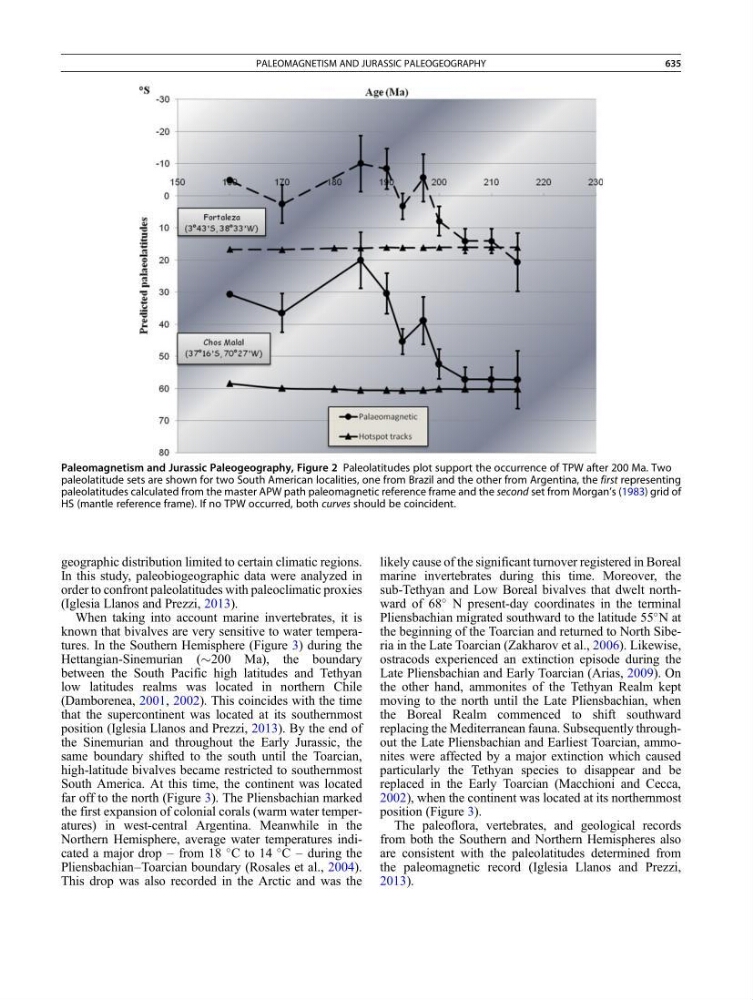
Paleomagnetism and Jurassic Paleogeography, Figure 2 Paleolatitudes plot support the occurrence of TPW after 200 Ma. Two
paleolatitude sets are shown for two South American localities, one from Brazil and the other from Argentina, the first representing
paleolatitudes calculated from the master APW path paleomagnetic reference frame and the second set from Morgan’s (1983) grid of
HS (mantle reference frame). If no TPW occurred, both curves should be coincident.
PALEOMAGNETISM AND JURASSIC PALEOGEOGRAPHY
635