

Proxy, as used here and elsewhere, is short for proxy variable.
The word “proxy” is commonly used to describe a stand-in,
as in “proxy vote” or “fighting by proxy.” By analogy, “proxy
variables” in the parlance of paleoenvironmental reconstruction are measurable descriptors which stand in for desired
(but unobservable) variables such as temperature, salinity,
nutrient content, oxygen content, carbon dioxide concentration, wind speed, and productivity. These are the target
parameters. The concept of a proxy, then, presumes the existence (in principle) of a target, that is, the proxied parameter
of the system being reconstructed. Consequently, each proxy
is associated with a rule or rules denoting how the transform
from proxy to target is to be accomplished. Usually, this
means that a transforming algorithm has to be established
by calibration.
Source of proxies
Proxies are preserved in different types of sediments and
corals. Depending on productivity and sediment transport
by rivers and the atmosphere, the temporal resolution can
vary from millennia in offshore and low-productive areas
to centuries or decades on continental margins or in
coastal areas. In oxygen-depleted areas, sediments can
be deposited in annual layers, varves, caused by seasonal
sedimentation patterns. Varves are only common in
oxygen-free areas due to the lack of bioturbation, e.g.,
are formed in high-production areas or in anoxic basins
on the continental slope. A particularly high temporal resolution is provided by skeletons of tropical corals, which
even allow the reconstruction of annual cycles.
Paleoclimate reconstructions are not restricted to the
oceans. Often, they also include land-based phenomena
such as tree rings, which permit global temperature reconstructions over the past 1500 years (Mann et al., 2009).
Important information is also provided by loess deposits,
especially in China (Guo et al., 2002).
What can be reconstructed?
Temperatures
Most often, temperature is reconstructed, because it is an
important parameter and because temperatures can be
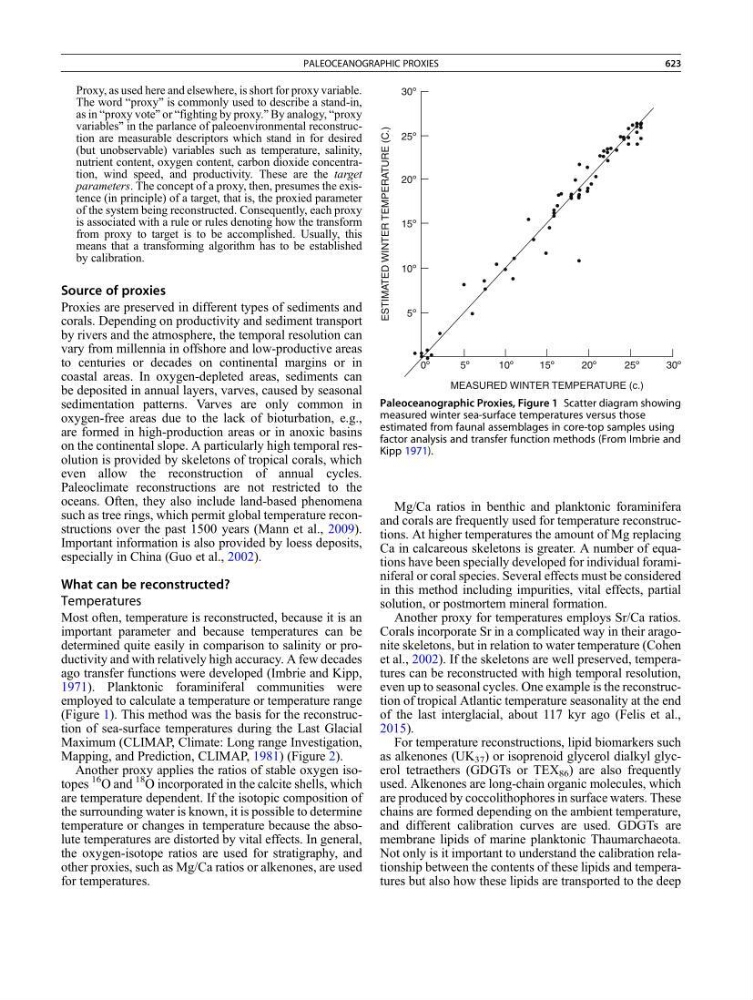
determined quite easily in comparison to salinity or productivity and with relatively high accuracy. A few decades
ago transfer functions were developed (Imbrie and Kipp,
1971). Planktonic foraminiferal communities were
employed to calculate a temperature or temperature range
(Figure 1). This method was the basis for the reconstruction of sea-surface temperatures during the Last Glacial
Maximum (CLIMAP, Climate: Long range Investigation,
Mapping, and Prediction, CLIMAP, 1981) (Figure 2).
Another proxy applies the ratios of stable oxygen isotopes
16
O and
18
O incorporated in the calcite shells, which
are temperature dependent. If the isotopic composition of
the surrounding water is known, it is possible to determine
temperature or changes in temperature because the absolute temperatures are distorted by vital effects. In general,
the oxygen-isotope ratios are used for stratigraphy, and
other proxies, such as Mg/Ca ratios or alkenones, are used
for temperatures.
Mg/Ca ratios in benthic and planktonic foraminifera
and corals are frequently used for temperature reconstructions. At higher temperatures the amount of Mg replacing
Ca in calcareous skeletons is greater. A number of equations have been specially developed for individual foraminiferal or coral species. Several effects must be considered
in this method including impurities, vital effects, partial
solution, or postmortem mineral formation.
Another proxy for temperatures employs Sr/Ca ratios.
Corals incorporate Sr in a complicated way in their aragonite skeletons, but in relation to water temperature (Cohen
et al., 2002). If the skeletons are well preserved, temperatures can be reconstructed with high temporal resolution,
even up to seasonal cycles. One example is the reconstruction of tropical Atlantic temperature seasonality at the end
of the last interglacial, about 117 kyr ago (Felis et al.,
2015).
For temperature reconstructions, lipid biomarkers such
as alkenones (UK 37 ) or isoprenoid glycerol dialkyl glycerol tetraethers (GDGTs or TEX 86 ) are also frequently
used. Alkenones are long-chain organic molecules, which
are produced by coccolithophores in surface waters. These
chains are formed depending on the ambient temperature,
and different calibration curves are used. GDGTs are
membrane lipids of marine planktonic Thaumarchaeota.
Not only is it important to understand the calibration relationship between the contents of these lipids and temperatures but also how these lipids are transported to the deep
30º
25º
20º
15º
10º
5º
0º
5º
MEASURED WINTER TEMPERATURE (c.)
ESTIMATED WINTER TEMPERATURE (C.)
10º
15º
20º
25º
30º
Paleoceanographic Proxies, Figure 1 Scatter diagram showing
measured winter sea-surface temperatures versus those
estimated from faunal assemblages in core-top samples using
factor analysis and transfer function methods (From Imbrie and
Kipp 1971).
PALEOCEANOGRAPHIC PROXIES
623