

sea and how they can be changed, both on their way and at
the seabed (see, e.g., Mollenhauer et al., 2015).
Salinity
Salinity is much more difficult to determine than temperatures. One possibility is to use stable oxygen isotopes,
when temperatures are determined by other methods,
e.g., Mg/Ca ratios or alkenones.
Productivity
In the reconstruction of productivity, it is necessary to distinguish between flux proxies (export of biogenic material
formed in the surface water) and nutrient proxies
(containing information on nutrients such as phosphate
and nitrogen).
General information on the productivity of surface
waters is provided by the accumulation of organic carbon.
However, this information is qualitative, since the settling
of organic matter to the seafloor does not exactly correspond to primary production. The fraction of the primary
production depends on the production system or on the
water depth. Also, laterally introduced organic matter
influences the results. Another method was developed by
Herguera and Berger (1994). They used the abundance
of benthic foraminifera in the sediment as a measure of
productivity, because their frequency is related to the food
supply, the amount of organic matter deposited on the
seafloor.
The ratios of stable carbon and nitrogen isotopes are
nutrient proxies, expressed as deviations from a standard
d
13
C or d
15
N. A measure for fertility is the difference in
d
13
C between foraminifera living in different areas in the
ocean, e.g., shallow-living versus deep-living planktonic
foraminifera or planktonic versus benthic foraminifera.
Reconstructions depend on a variety of background information, e.g., on exchange with the atmosphere or calcification depth of planktonic foraminifera, or whether
benthic foraminifera live on the surface or in the sediment.
Nitrogen isotopes, the ratio of
14
N/
15
N, are another
tool. During the uptake of nitrogen by phytoplankton, isotope fractionation takes place with a preferential uptake of
14
N, so
15
N becomes enriched in the seawater. The organic
matter that is exported from the photic zone is enriched in
14
N, which will subsequently be set free in the deep ocean
or on the seafloor by oxidation of the organic matter. For a
review of the marine nitrogen cycle, see Altabet (2006).
180ºW
90ºS
60ºS
30ºS
Latitude
0º
30ºN
60ºN
90ºN
0
5
10
15
20
sea surface temperature
25
150ºW 120ºW 90ºW
60ºW
30ºW
0º
Longitude
30ºE
60ºE
90ºE
120ºE 150ºE
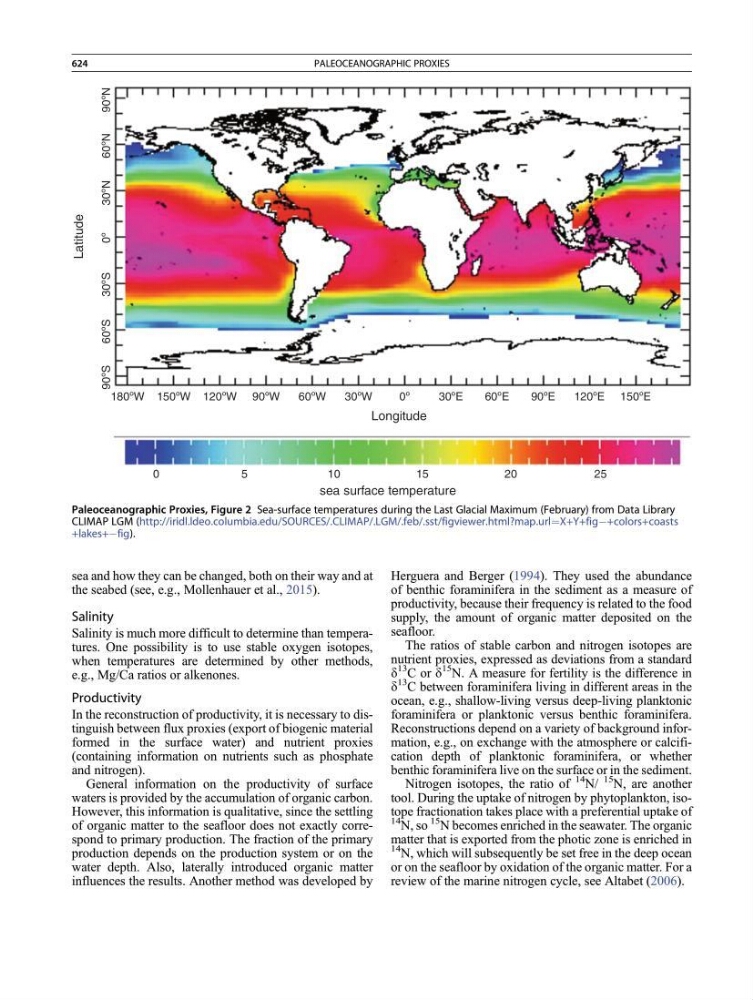
Paleoceanographic Proxies, Figure 2 Sea-surface temperatures during the Last Glacial Maximum (February) from Data Library
CLIMAP LGM (http://iridl.ldeo.columbia.edu/SOURCES/.CLIMAP/.LGM/.feb/.sst/figviewer.html?map.url¼X+Y+figÀ+colors+coasts
+lakes+Àfig).
624
PALEOCEANOGRAPHIC PROXIES