

Bibliography
Frisch, W., Meschede, M., and Blakey, R. C., 2011. Plate Tectonics.
Heidelberg/Dordrecht/London/New York: Springer. 212 pp.
Schubert, G., Yuen, D. A., and Turcotte, D. L., 1975. Role of phase
transitions in a dynamic mantle. Geophysical Journal of the
Royal Astronomical Society, 42, 705–735.
Stern, R. J., 2002. Subduction zones. Reviews of Geophysics, 40,
3–1. to 3–38.
Cross-references
Magmatism at Convergent Plate Boundaries
Ophiolites
Subduction
PALEOCEANOGRAPHIC PROXIES
Gerold Wefer
MARUM-Center for Marine Environmental Sciences,
University of Bremen, Bremen, Germany
Definition
Proxies stand in for direct measurements of past environmental conditions such as temperature, salinity, etc.
Introduction
Measured climate information such as temperature is only
available back to the late nineteenth century. To extend the
record further back in history, proxies have to be used.
Proxies are physical and chemical parameters that can be
transformed through a calibration process to real measured
variables such as temperature. From the ratios of stable
oxygen isotopes in the carbonate shells of marine organisms, e.g., past temperatures can be reconstructed if the
isotopic composition of the seawater is known. The information is stored in sediments of the shelf areas, continental
margins and abyssal plains, and in the skeletons of tropical
or cold-water corals. Environmental information can be
obtained from the quantity and composition of organic
matter, carbonate, and opal shells and from the species
compositions of plants and animals. An overview of the
use of proxies in paleoceanography is given by Fischer
and Wefer (1999).
New results on proxy research are presented at many
conferences, particularly at the triennial International
Conference on Paleoceanography (ICP). The 11th ICP
took place in Barcelona (Spain) in 2013; the next will be
held in Utrecht (Netherlands) in 2016.
What is a proxy
The definition of a proxy, according to Wefer et al. (1999):
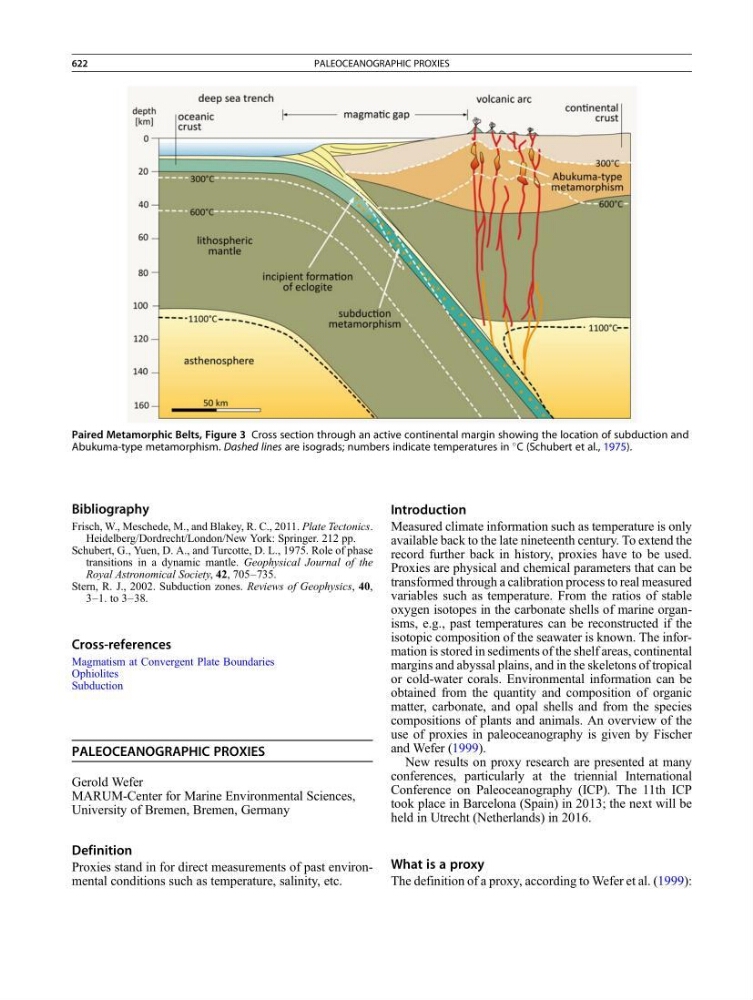
Paired Metamorphic Belts, Figure 3 Cross section through an active continental margin showing the location of subduction and
Abukuma-type metamorphism. Dashed lines are isograds; numbers indicate temperatures in
C (Schubert et al., 1975).
622
PALEOCEANOGRAPHIC PROXIES