

fluctuations during the Plio-Pleistocene glacial cycles,
which influencing the burial and oxidation of pyrite on
continental shelves (Figure 4).
Conclusions
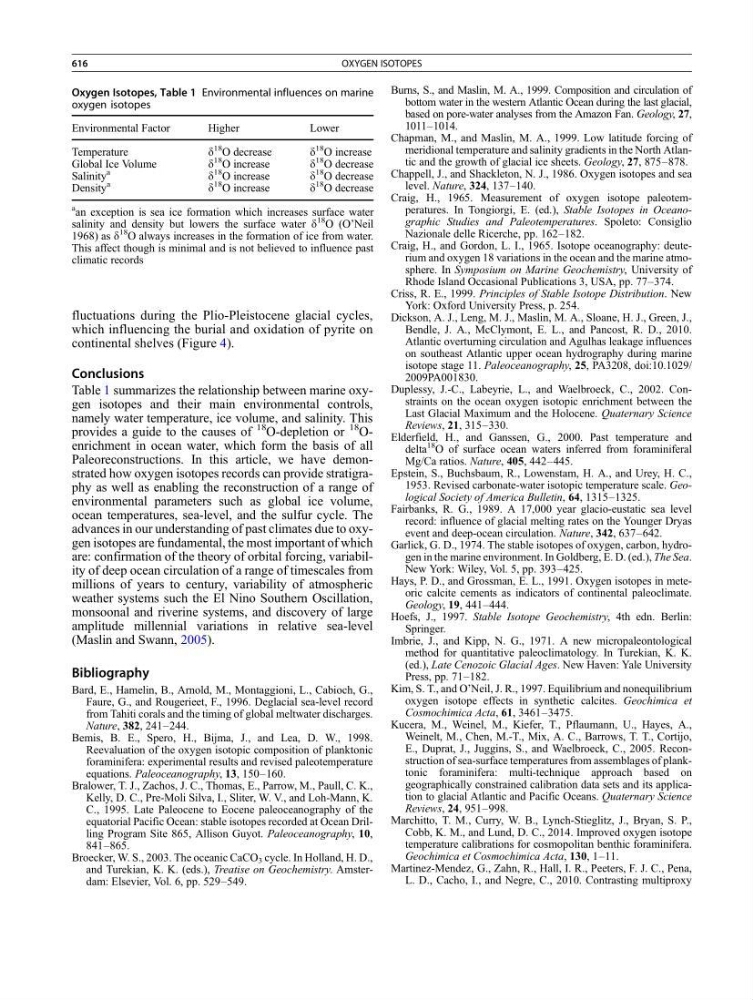
Table 1 summarizes the relationship between marine oxygen isotopes and their main environmental controls,
namely water temperature, ice volume, and salinity. This
provides a guide to the causes of
18
O-depletion or
18
Oenrichment in ocean water, which form the basis of all
Paleoreconstructions. In this article, we have demonstrated how oxygen isotopes records can provide stratigraphy as well as enabling the reconstruction of a range of
environmental parameters such as global ice volume,
ocean temperatures, sea-level, and the sulfur cycle. The
advances in our understanding of past climates due to oxygen isotopes are fundamental, the most important of which
are: confirmation of the theory of orbital forcing, variability of deep ocean circulation of a range of timescales from
millions of years to century, variability of atmospheric
weather systems such the El Nino Southern Oscillation,
monsoonal and riverine systems, and discovery of large
amplitude millennial variations in relative sea-level
(Maslin and Swann, 2005).
Bibliography
Bard, E., Hamelin, B., Arnold, M., Montaggioni, L., Cabioch, G.,
Faure, G., and Rougerieet, F., 1996. Deglacial sea-level record
from Tahiti corals and the timing of global meltwater discharges.
Nature, 382, 241–244.
Bemis, B. E., Spero, H., Bijma, J., and Lea, D. W., 1998.
Reevaluation of the oxygen isotopic composition of planktonic
foraminifera: experimental results and revised paleotemperature
equations. Paleoceanography, 13, 150–160.
Bralower, T. J., Zachos, J. C., Thomas, E., Parrow, M., Paull, C. K.,
Kelly, D. C., Pre-Moli Silva, I., Sliter, W. V., and Loh-Mann, K.
C., 1995. Late Paleocene to Eocene paleoceanography of the
equatorial Pacific Ocean: stable isotopes recorded at Ocean Drilling Program Site 865, Allison Guyot. Paleoceanography, 10,
841–865.
Broecker, W. S., 2003. The oceanic CaCO 3 cycle. In Holland, H. D.,
and Turekian, K. K. (eds.), Treatise on Geochemistry. Amsterdam: Elsevier, Vol. 6, pp. 529–549.
Burns, S., and Maslin, M. A., 1999. Composition and circulation of
bottom water in the western Atlantic Ocean during the last glacial,
based on pore-water analyses from the Amazon Fan. Geology, 27,
1011–1014.
Chapman, M., and Maslin, M. A., 1999. Low latitude forcing of
meridional temperature and salinity gradients in the North Atlantic and the growth of glacial ice sheets. Geology, 27, 875–878.
Chappell, J., and Shackleton, N. J., 1986. Oxygen isotopes and sea
level. Nature, 324, 137–140.
Craig, H., 1965. Measurement of oxygen isotope paleotemperatures. In Tongiorgi, E. (ed.), Stable Isotopes in Oceanographic Studies and Paleotemperatures. Spoleto: Consiglio
Nazionale delle Ricerche, pp. 162–182.
Craig, H., and Gordon, L. I., 1965. Isotope oceanography: deuterium and oxygen 18 variations in the ocean and the marine atmosphere. In Symposium on Marine Geochemistry, University of
Rhode Island Occasional Publications 3, USA, pp. 77–374.
Criss, R. E., 1999. Principles of Stable Isotope Distribution. New
York: Oxford University Press, p. 254.
Dickson, A. J., Leng, M. J., Maslin, M. A., Sloane, H. J., Green, J.,
Bendle, J. A., McClymont, E. L., and Pancost, R. D., 2010.
Atlantic overturning circulation and Agulhas leakage influences
on southeast Atlantic upper ocean hydrography during marine
isotope stage 11. Paleoceanography, 25, PA3208, doi:10.1029/
2009PA001830.
Duplessy, J.-C., Labeyrie, L., and Waelbroeck, C., 2002. Constraints on the ocean oxygen isotopic enrichment between the
Last Glacial Maximum and the Holocene. Quaternary Science
Reviews, 21, 315–330.
Elderfield, H., and Ganssen, G., 2000. Past temperature and
delta
18 O of surface ocean waters inferred from foraminiferal
Mg/Ca ratios. Nature, 405, 442–445.
Epstein, S., Buchsbaum, R., Lowenstam, H. A., and Urey, H. C.,
1953. Revised carbonate-water isotopic temperature scale. Geological Society of America Bulletin, 64, 1315–1325.
Fairbanks, R. G., 1989. A 17,000 year glacio-eustatic sea level
record: influence of glacial melting rates on the Younger Dryas
event and deep-ocean circulation. Nature, 342, 637–642.
Garlick, G. D., 1974. The stable isotopes of oxygen, carbon, hydrogen in the marine environment. In Goldberg, E. D. (ed.), The Sea.
New York: Wiley, Vol. 5, pp. 393–425.
Hays, P. D., and Grossman, E. L., 1991. Oxygen isotopes in meteoric calcite cements as indicators of continental paleoclimate.
Geology, 19, 441–444.
Hoefs, J., 1997. Stable Isotope Geochemistry, 4th edn. Berlin:
Springer.
Imbrie, J., and Kipp, N. G., 1971. A new micropaleontological
method for quantitative paleoclimatology. In Turekian, K. K.
(ed.), Late Cenozoic Glacial Ages. New Haven: Yale University
Press, pp. 71–182.
Kim, S. T., and O’Neil, J. R., 1997. Equilibrium and nonequilibrium
oxygen isotope effects in synthetic calcites. Geochimica et
Cosmochimica Acta, 61, 3461–3475.
Kucera, M., Weinel, M., Kiefer, T., Pflaumann, U., Hayes, A.,
Weinelt, M., Chen, M.-T., Mix, A. C., Barrows, T. T., Cortijo,
E., Duprat, J., Juggins, S., and Waelbroeck, C., 2005. Reconstruction of sea-surface temperatures from assemblages of planktonic foraminifera: multi-technique approach based on
geographically constrained calibration data sets and its application to glacial Atlantic and Pacific Oceans. Quaternary Science
Reviews, 24, 951–998.
Marchitto, T. M., Curry, W. B., Lynch-Stieglitz, J., Bryan, S. P.,
Cobb, K. M., and Lund, D. C., 2014. Improved oxygen isotope
temperature calibrations for cosmopolitan benthic foraminifera.
Geochimica et Cosmochimica Acta, 130, 1–11.
Martinez-Mendez, G., Zahn, R., Hall, I. R., Peeters, F. J. C., Pena,
L. D., Cacho, I., and Negre, C., 2010. Contrasting multiproxy
Oxygen Isotopes, Table 1 Environmental influences on marine
oxygen isotopes
Environmental Factor
Higher
Lower
Temperature
d
18
O decrease
d
18 O increase
Global Ice Volume
d
18
O increase
d
18 O decrease
Salinity
a
d
18
O increase
d
18 O decrease
Density
a
d
18
O increase
d
18 O decrease
a an exception is sea ice formation which increases surface water
salinity and density but lowers the surface water d
18
O (O’Neil
1968) as d
18
O always increases in the formation of ice from water.
This affect though is minimal and is not believed to influence past
climatic records
616
OXYGEN ISOTOPES