

Influence of diagenesis
Oxygen isotopes in marine minerals can become altered
from their primary compositions following sediment
burial. This effect arises due to the higher d
18
O composition of cold deep ocean water compared to warmer surface
waters, where many planktonic (surface dwelling) organisms live. Following sedimentation on the seafloor, such
planktonic organisms may partially dissolve due to carbonate or silicic acid undersaturation, or barite reduction
(Schrag, 1999; Broecker, 2003), before recrystallizing in
pore waters with a higher saturation state (Schrag et al.,
2013). Diagenesis may in principal have a large effect on
Paleoceanographic reconstructions, principally through
biasing temperature reconstructions towards lower values.
Several studies had previously argued for relatively
cool tropical surface ocean waters during the Mesozoic,
a period of prolonged greenhouse warming (e.g., Shackleton and Boersma, 1981; Bralower et al., 1995). However,
subsequent studies have utilized well-preserved planktonic foraminifera recovered from clay-rich lithologies
that limit the impact of pore water recrystallization to demonstrate that cool temperatures were likely to have been
the result of diagenesis (e.g., Wilson and Norris, 2001;
Pearson et al., 2007; Pearson, 2012).
Sulfur cycle
Oxygen isotopes can also be used to examine the sulfur
cycle (Turchyn and Schrag, 2004; Turchyn et al., 2009).
The amount of sulfate in the ocean is controlled by three
major processes: input from rivers, sulfate reduction and
sulfide reoxidation on continental shelves and slopes,
and burial of anhydrite and pyrite in ocean crusts. These
controls on the biogeochemistry of the sulfur cycle can
be monitored using oxygen isotopes as each source has
a distinct isotopic signature. Natural riverine input has a
d
18 O SO4 of À2 to +7% VSMOW which is a mixture of
weathered evaporate deposits (11–13%) and oxidiative
pyrite (À4 to +2%). While sulfur reduction leaves the
sulfate pool enriched by 8–10% (up to 25% enriched
in sulfate-limited environments) and sulfide reoxidation
on continental shelves
18 O-enriches sulfate by 8–17%
compared with the d
18 O of seawater, depending on what
metals are present. The final effect on d
18 O SO4 is direct
sulfide oxidation in hydrothermal and some shallow sediment environments which produces sulfate with the
same d
18 O as the seawater it was oxidized in. Turchyn
and Schrag (2004) have modeled these various inputs to
the d
18 O SO4 and suggest that the oxygen isotope shifts
over the past 10 million years can be linked to sea-level
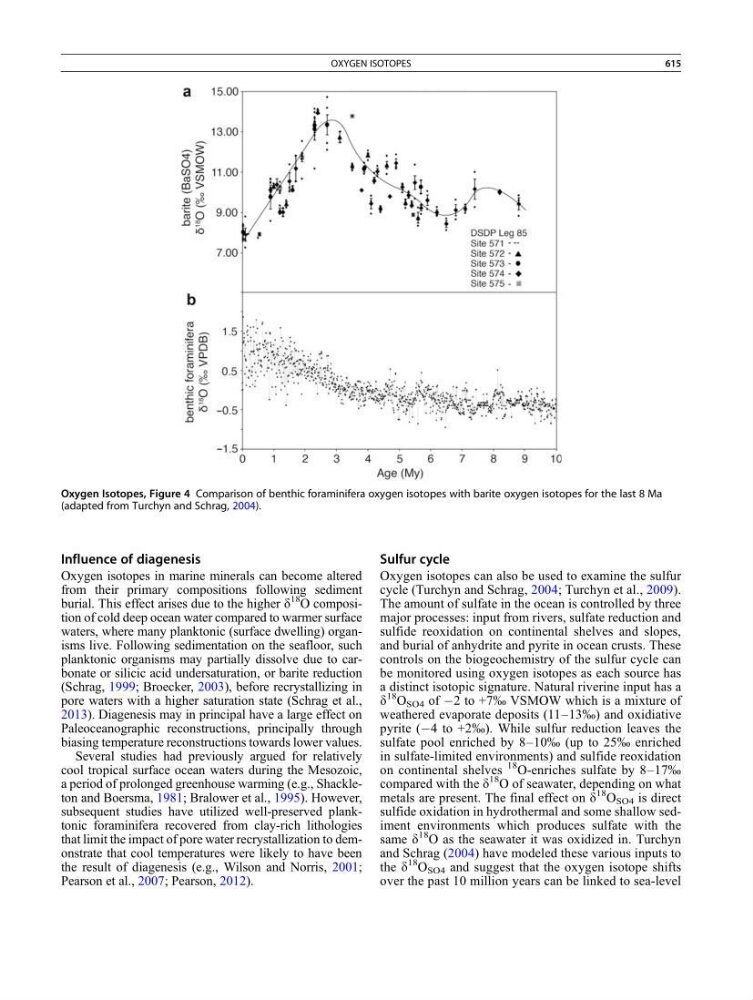
Oxygen Isotopes, Figure 4 Comparison of benthic foraminifera oxygen isotopes with barite oxygen isotopes for the last 8 Ma
(adapted from Turchyn and Schrag, 2004).
OXYGEN ISOTOPES
615