

When;
T ¼ isotopic temperature estimate
d c ¼ d
18
O of the foraminifera calcite test
d w ¼ d
18
O of the surface waters,
Alternative equations have been proposed by Bemis
et al. (1998), which take the form of linear relationships
between (foraminifera) calcite d
18
O and temperature,
e.g.,:
Dd c ¼ Dd w À 0:23DT
ð6Þ
Moreover different calibration equation have been developed for different species of planktonic and benthic foraminifera (Marchitto et al., 2014). Although these
equations differ in their predictions of absolute temperature, they consistently predict a gradient of ~ À0.2 to
À0.3%/
o
C. An important pre-requisite to reconstructing
absolute past temperatures from d
18
O is a knowledge of
the seawater d
18
O (d w ). Since d w has varied in the past,
temperature reconstructions require that there should be
little or no change in global ice volume and/or local
conditions during the period of reconstruction or there
should be independent estimates of both these influences.
Paleosalinity (Dd local )
Calculation of surface water salinity or sea surface salinity
(SSS) is possible in locations where the Dd local is primarily
controlled either by the balance of evaporation verses precipitation (E-P) or the input of
18 O-depleted freshwater
such as from melting icebergs or rivers. The local influence on the marine oxygen isotope record is calculated
by subtracting the temperature influence and the global
ice volume variations from the precipitate record:
Dd local ¼ Dd
18 O M À Dd T À Dd GIV
ð7Þ
Sea surface temperatures can be independently
reconstructed in five ways; planktonic foraminifera
assemblage data (e.g., Imbrie and Kipp, 1971; Pflaumann
et al., 2003), ratios of n-alkenones with differing number
of unsaturated bonds (U
K
37 ) (Prahl and Wakeham,
1987), the number of cyclic inclusions in archaea-derived
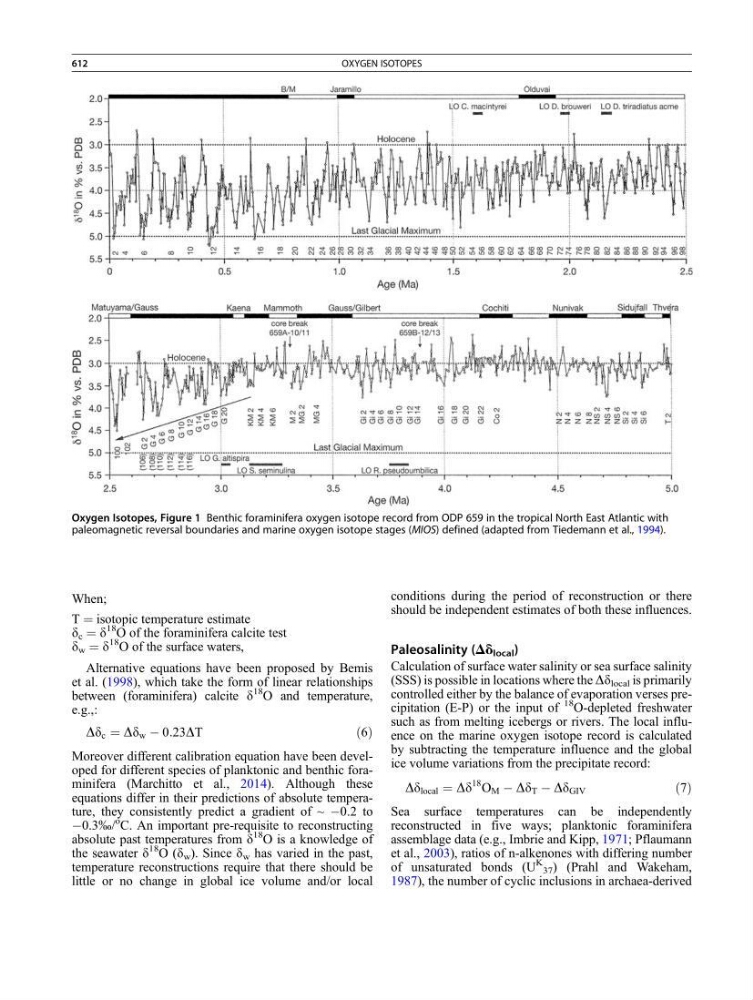
Oxygen Isotopes, Figure 1 Benthic foraminifera oxygen isotope record from ODP 659 in the tropical North East Atlantic with
paleomagnetic reversal boundaries and marine oxygen isotope stages (MIOS) defined (adapted from Tiedemann et al., 1994).
612
OXYGEN ISOTOPES