

biomarkers (TEX 86 ) (Schouten et al., 2002), clumped oxygen isotopes (Eiler, J.M., 2007, EPSL 3–4, p 309–327)
and Mg/Ca ratios in planktonic foraminifera tests
(Elderfield and Ganssen, 2000). These estimates of temperature can be converted to Dd T using Eqs 2, 3, 4, 5,
and 6. The isotopic effect of changing global ice
volume can be estimated by converting RSL or ESL to
oxygen isotopic variation using a simple linear relationship of ~0.008–0.01 % m
À1
. Once Dd local has been calculated then the relationship between it and sea surface
salinity can be estimated. This relationship depends on
the oxygen isotope value of the end-member inputs i.e.,
freshwater (d fresh ) and mean marine sea water (d ocean ).
These values vary with locality due to the input of meltwater or precipitation or river runoff compared with the influence of evaporation and ocean circulation. The oxygen
isotope-salinity relationship can be defined as:
Dd local ¼ d ocean À d fresh =S ocean À S fresh
ð
Þ S local þ d fresh ð8Þ
where salinity of freshwater (S fresh ) is equal to zero and
can therefore be omitted and the equation solved for local
Salinity:
S local ¼ d fresh À Dd local
ð
ÞS ocean =d fresh À d ocean
ð
Þ
ð 9Þ
Calculation of surface water salinity, however, is fraught
with difficulties due to the propagation of the uncertainties
associated with estimating each unknown parameter in
Eq. 6 (Schmidt, 1999; Rohling, 2000). These include
(i) uncertainties in the paleo-SST estimates, which are
Æ1–1.5
C for mid- to high-latitude sites and over at least
Æ2
C in the tropics (see Elderfield and Ganssen, 2000;
Pflaumann et al., 2003; Kucera et al., 2005),
(ii) Estimation of the Dd GIV has been shown above to
contain uncertainties, which are usually quoted as
Æ0.001 %
C
À1
, (iii) accurate determination of the mean
ocean salinity (S ocean ) due to the concentration effect of
changing global ice-volume effect. This can be calculated
using Eq. 9, but suffers from the uncertainties in estimating past sea-levels, which can be on the order of centimeters to meters.
S ocean ¼ 34:74 Â RSL= 3900 À RSL
ð
Þ
ð 10Þ
(iv) The estimation of the oxygen isotope
freshwater endmember (d fresh ) also has inherent uncertainties. Selection of freshwater endmember compositions
of ~ À20% or À40% can produce significantly different
mixing gradients resulting in salinity estimates that vary
greatly.
Not only are there large errors associated with each of
the above assumptions but these errors are cumulative in
the calculations (Rohling, 2000). Salinity reconstructions
have been used to infer a large number of climatic parameters including: iceberg discharge (Maslin et al., 1995;
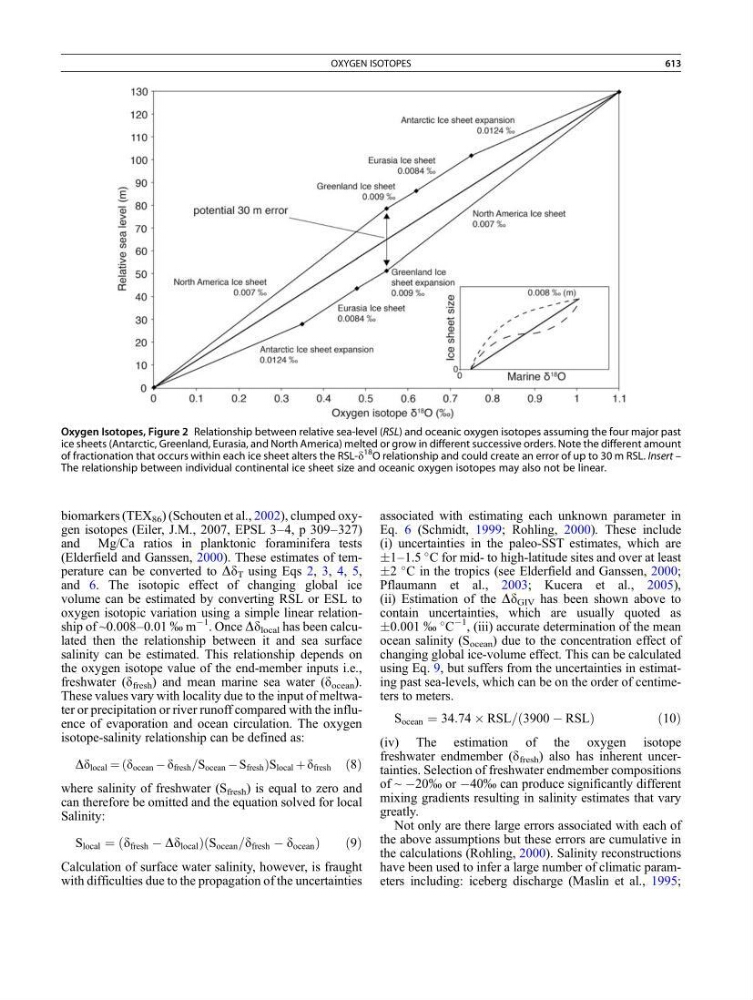
Oxygen Isotopes, Figure 2 Relationship between relative sea-level (RSL) and oceanic oxygen isotopes assuming the four major past
ice sheets (Antarctic, Greenland, Eurasia, and North America) melted or grow in different successive orders. Note the different amount
of fractionation that occurs within each ice sheet alters the RSL-d
18 O relationship and could create an error of up to 30 m RSL. Insert –
The relationship between individual continental ice sheet size and oceanic oxygen isotopes may also not be linear.
OXYGEN ISOTOPES
613