

controlled by the globally significant impact of the storage
and release of
16
O-enriched freshwater in continental ice
sheets (Dd GIV ), and the local balance of evaporation
verses freshwater inputs from precipitation, river, or iceberg discharge (Dd local ). Second is the water temperature
at which the precipitate forms (Dd T ). A greater proportion
of
16
O is incorporated into marine minerals at higher temperatures. The oxygen isotope composition of marine carbonates is also controlled by the carbonate ion
concentration of the seawater from which they precipitate
and by the impact of postdepositional dissolution under
conditions of carbonate ion undersaturation. In the sections below, these influences are examined and examples
given of how they can be used to reconstruct past climate
on a range of timescales.
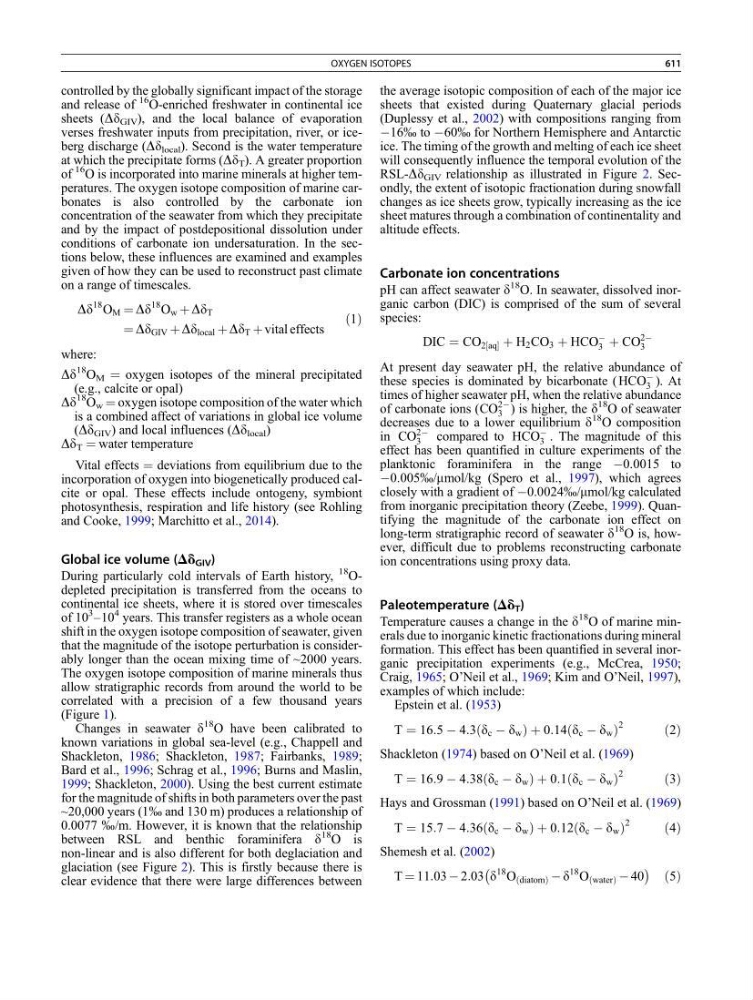
Dd
18 O M ¼ Dd
18 O w þ Dd T
¼ Dd GIV þ Dd local þ Dd T þ vital effects
ð1Þ
where:
Dd
18
O M ¼ oxygen isotopes of the mineral precipitated
(e.g., calcite or opal)
Dd
18
O w ¼ oxygen isotope composition of the water which
is a combined affect of variations in global ice volume
(Dd GIV ) and local influences (Dd local )
Dd T ¼ water temperature
Vital effects ¼ deviations from equilibrium due to the
incorporation of oxygen into biogenetically produced calcite or opal. These effects include ontogeny, symbiont
photosynthesis, respiration and life history (see Rohling
and Cooke, 1999; Marchitto et al., 2014).
Global ice volume (Dd GIV )
During particularly cold intervals of Earth history,
18
Odepleted precipitation is transferred from the oceans to
continental ice sheets, where it is stored over timescales
of 10
3
–10
4 years. This transfer registers as a whole ocean
shift in the oxygen isotope composition of seawater, given
that the magnitude of the isotope perturbation is considerably longer than the ocean mixing time of ~2000 years.
The oxygen isotope composition of marine minerals thus
allow stratigraphic records from around the world to be
correlated with a precision of a few thousand years
(Figure 1).
Changes in seawater d
18
O have been calibrated to
known variations in global sea-level (e.g., Chappell and
Shackleton, 1986; Shackleton, 1987; Fairbanks, 1989;
Bard et al., 1996; Schrag et al., 1996; Burns and Maslin,
1999; Shackleton, 2000). Using the best current estimate
for the magnitude of shifts in both parameters over the past
~20,000 years (1% and 130 m) produces a relationship of
0.0077 %/m. However, it is known that the relationship
between RSL and benthic foraminifera d
18
O is
non-linear and is also different for both deglaciation and
glaciation (see Figure 2). This is firstly because there is
clear evidence that there were large differences between
the average isotopic composition of each of the major ice
sheets that existed during Quaternary glacial periods
(Duplessy et al., 2002) with compositions ranging from
À16% to À60% for Northern Hemisphere and Antarctic
ice. The timing of the growth and melting of each ice sheet
will consequently influence the temporal evolution of the
RSL-Dd GIV relationship as illustrated in Figure 2. Secondly, the extent of isotopic fractionation during snowfall
changes as ice sheets grow, typically increasing as the ice
sheet matures through a combination of continentality and
altitude effects.
Carbonate ion concentrations
pH can affect seawater d
18
O. In seawater, dissolved inorganic carbon (DIC) is comprised of the sum of several
species:
DIC ¼ CO 2 aq
½ þ H 2 CO 3 þ HCO
À
3 þ CO
2À
3
At present day seawater pH, the relative abundance of
these species is dominated by bicarbonate ( HCO
À
3 ). At
times of higher seawater pH, when the relative abundance
of carbonate ions (CO
2À
3 ) is higher, the d
18
O of seawater
decreases due to a lower equilibrium d
18
O composition
in CO
2À
3
compared to HCO
À
3 . The magnitude of this
effect has been quantified in culture experiments of the
planktonic foraminifera in the range À0.0015 to
À0.005%/mmol/kg (Spero et al., 1997), which agrees
closely with a gradient of À0.0024%/mmol/kg calculated
from inorganic precipitation theory (Zeebe, 1999). Quantifying the magnitude of the carbonate ion effect on
long-term stratigraphic record of seawater d
18
O is, however, difficult due to problems reconstructing carbonate
ion concentrations using proxy data.
Paleotemperature (Dd T )
Temperature causes a change in the d
18
O of marine minerals due to inorganic kinetic fractionations during mineral
formation. This effect has been quantified in several inorganic precipitation experiments (e.g., McCrea, 1950;
Craig, 1965; O’Neil et al., 1969; Kim and O’Neil, 1997),
examples of which include:
Epstein et al. (1953)
T ¼ 16:5 À 4:3 d c À d w
ð
Þþ0:14 d c À d w
ð
Þ
2
ð2Þ
Shackleton (1974) based on O’Neil et al. (1969)
T ¼ 16:9 À 4:38 d c À d w
ð
Þþ0:1 d c À d w
ð
Þ
2
ð3Þ
Hays and Grossman (1991) based on O’Neil et al. (1969)
T ¼ 15:7 À 4:36 d c À d w
ð
Þþ0:12 d c À d w
ð
Þ
2
ð4Þ
Shemesh et al. (2002)
T ¼ 11:03 À 2:03 d
18 O diatom
ð
Þ À d
18 O water
ð
Þ À 40
À
Á ð5Þ
OXYGEN ISOTOPES
611