

a part of settled particulate material and some part of surface sediments enriched by OM are transferred to the shelf
depressions, lower part of the continental slope, and continental rise by currents, gravity, and tectonic movements.
During mineralization, the balance between autochthonous and allochthonous matter changes considerably in
favor of the latter as the more resistant one.
POM, which is mostly pellet material, is very different
from phytoplankton and zooplankton as it has less
protein, N, and P, more polysaccharides, aliphatic hydrocarbons, aromatic structures, and the presence of trace
quantities of geopolymers (humic substances), which
have different molecular and isotopic compositions. In
the arctic seas, seasonal ice contains many of POM due
to the sea algae (mainly diatoms and coccolitophorids)
bloom. This substance contains a characteristic molecular
and isotopic indicators of origin, namely, high
content of the stable isotope
13
C up to d
13
C ¼ À8 % compared with POM in open water (from À20 to À28 %).
Increased level of
13 C is apparently caused by the low
concentration of CO 2 in the pores of the sea ice (Thomas
et al., 2010).
Organic matter of sediments
The particulate matter reaching the seabed and a thin surface layer of sediment (<1 cm) are enriched by
OM. Resuspension, bioturbation, and microbial
utilization deplete the OM content. At high accumulation
rate, the zone of active OM degradation extends down to
2 m or more. Deeper enzymatic OM decay slows down.
It depends a lot on the OM content and composition, sedimentation rate, and burial conditions. Most of the OM
degrades in oxygen conditions. In anoxic conditions, the
main degradation processes are sulfate reduction and
methanogenesis, and rate of enzymatic OM degradation
slows dramatically.
OM buried in sediments (Figure 4) contains a wide
range of transformed compounds of marine and terrigenous genesis, gas hydrates of methane and other gases,
as well as OM of interstitial water. Annually, approximately 0.35 % C org of the primary production and OM
supplied from land is buried in sediments of the World
Ocean. During diagenesis and catagenesis, this OM forms
kerogen, liquid and gaseous hydrocarbons, and other
organic and nonvolatile compounds – prospective oil
and gas resources.
OM of sediment contains different classes of organic
compounds such as hydrocarbons, alcohols, amines, aldehydes, ketones, carbonic acids and their esters, amino
acids, carbohydrates, amino sugars, peptides, and
vitamins.
The basic change of OM at the stage of early diagenesis
is confined in its humification, which represents a mixture
of enzymatic depolymerization of biological molecules
and the formation of new geopolymers, stable out of living
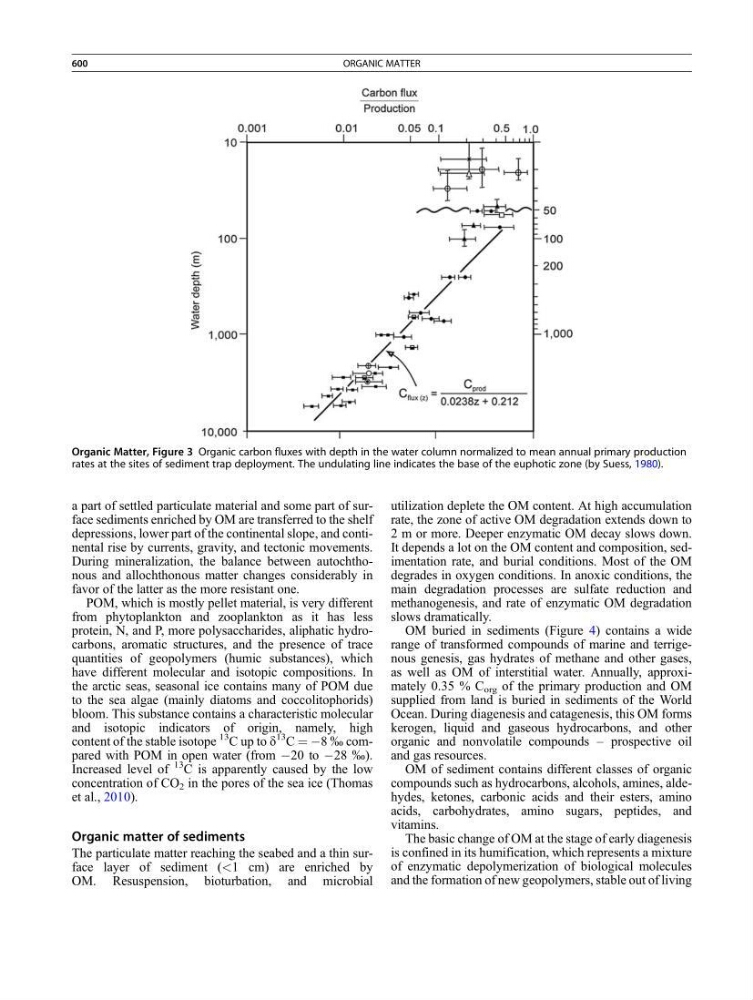
Organic Matter, Figure 3 Organic carbon fluxes with depth in the water column normalized to mean annual primary production
rates at the sites of sediment trap deployment. The undulating line indicates the base of the euphotic zone (by Suess, 1980).
600
ORGANIC MATTER