

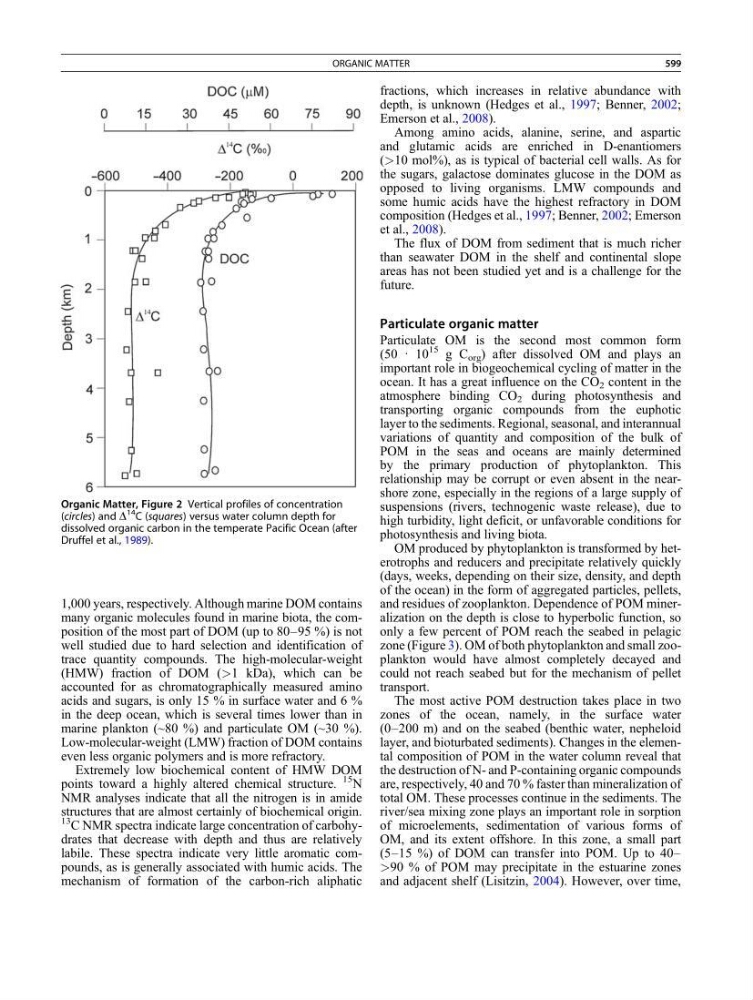
1,000 years, respectively. Although marine DOM contains
many organic molecules found in marine biota, the composition of the most part of DOM (up to 80–95 %) is not
well studied due to hard selection and identification of
trace quantity compounds. The high-molecular-weight
(HMW) fraction of DOM (>1 kDa), which can be
accounted for as chromatographically measured amino
acids and sugars, is only 15 % in surface water and 6 %
in the deep ocean, which is several times lower than in
marine plankton (~80 %) and particulate OM (~30 %).
Low-molecular-weight (LMW) fraction of DOM contains
even less organic polymers and is more refractory.
Extremely low biochemical content of HMW DOM
points toward a highly altered chemical structure.
15
N
NMR analyses indicate that all the nitrogen is in amide
structures that are almost certainly of biochemical origin.
13
C NMR spectra indicate large concentration of carbohydrates that decrease with depth and thus are relatively
labile. These spectra indicate very little aromatic compounds, as is generally associated with humic acids. The
mechanism of formation of the carbon-rich aliphatic
fractions, which increases in relative abundance with
depth, is unknown (Hedges et al., 1997; Benner, 2002;
Emerson et al., 2008).
Among amino acids, alanine, serine, and aspartic
and glutamic acids are enriched in D-enantiomers
(>10 mol%), as is typical of bacterial cell walls. As for
the sugars, galactose dominates glucose in the DOM as
opposed to living organisms. LMW compounds and
some humic acids have the highest refractory in DOM
composition (Hedges et al., 1997; Benner, 2002; Emerson
et al., 2008).
The flux of DOM from sediment that is much richer
than seawater DOM in the shelf and continental slope
areas has not been studied yet and is a challenge for the
future.
Particulate organic matter
Particulate OM is the second most common form
(50 · 10
15 g C org ) after dissolved OM and plays an
important role in biogeochemical cycling of matter in the
ocean. It has a great influence on the CO 2 content in the
atmosphere binding CO 2 during photosynthesis and
transporting organic compounds from the euphotic
layer to the sediments. Regional, seasonal, and interannual
variations of quantity and composition of the bulk of
POM in the seas and oceans are mainly determined
by the primary production of phytoplankton. This
relationship may be corrupt or even absent in the nearshore zone, especially in the regions of a large supply of
suspensions (rivers, technogenic waste release), due to
high turbidity, light deficit, or unfavorable conditions for
photosynthesis and living biota.
OM produced by phytoplankton is transformed by heterotrophs and reducers and precipitate relatively quickly
(days, weeks, depending on their size, density, and depth
of the ocean) in the form of aggregated particles, pellets,
and residues of zooplankton. Dependence of POM mineralization on the depth is close to hyperbolic function, so
only a few percent of POM reach the seabed in pelagic
zone (Figure 3). OM of both phytoplankton and small zooplankton would have almost completely decayed and
could not reach seabed but for the mechanism of pellet
transport.
The most active POM destruction takes place in two
zones of the ocean, namely, in the surface water
(0–200 m) and on the seabed (benthic water, nepheloid
layer, and bioturbated sediments). Changes in the elemental composition of POM in the water column reveal that
the destruction of N- and P-containing organic compounds
are, respectively, 40 and 70 % faster than mineralization of
total OM. These processes continue in the sediments. The
river/sea mixing zone plays an important role in sorption
of microelements, sedimentation of various forms of
OM, and its extent offshore. In this zone, a small part
(5–15 %) of DOM can transfer into POM. Up to 40–
>90 % of POM may precipitate in the estuarine zones
and adjacent shelf (Lisitzin, 2004). However, over time,
Organic Matter, Figure 2 Vertical profiles of concentration
(circles) and D
14 C (squares) versus water column depth for
dissolved organic carbon in the temperate Pacific Ocean (after
Druffel et al., 1989).
ORGANIC MATTER
599