

and other animals, the products of bacterial decay of
seston and fecal pellets, viral particles, and organic compounds that come with river runoff and from sediments.
A small part of DOM is currently linked to the activities
of people creating more and more xenobiotics. The loss
of DOM is associated with photodegradation, sorption
on sinking particles, and microbial utilization. Fungi, protozoa, and different mixotrophic organisms play a significant role in mineralization and transformation of OM, but
these processes are not well understood and
underestimated so far.
UV radiation leads to the mineralization of some DOM,
its transformation, and formation of new organo-mineral
compounds in the thin ocean surface and subsurface
layers; this, in turn, affects the physicochemical,
biological, and biochemical characteristics of the surface
layer and gas exchange in the air–water system.
Humic substances play an important role in the transition of DOM in particulate OM (POM). Labile colloidal
substance is a significant part of DOM in coastal waters.
The conservative nature of terrigenous DOC and its direct
correlation with salinity are violated in coastal conditions,
which affects the behavior and transport distance of DOM
offshore.
Marine DOM differs from river one by the lower content of unsaturated aromatic hydrocarbons, lignin phenols,
a heavier isotope composition of carbon and nitrogen,
lower C/N ratio, and much greater age according to
D
14
C. The age of water at 2,000–3,000 m and
5,000–6,000 m depths is estimated as 2–3 and 5–6
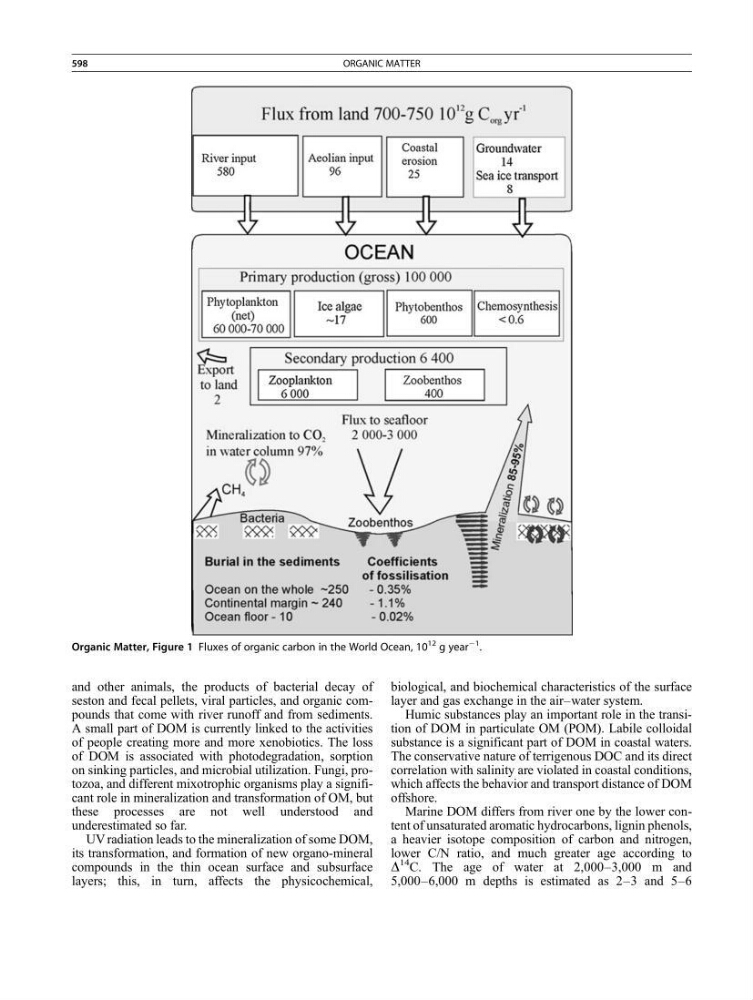
Organic Matter, Figure 1 Fluxes of organic carbon in the World Ocean, 10
12 g year
À1 .
598
ORGANIC MATTER