

being. A part of autochthonous humic acids (HA) is
formed in melanoidin reaction and differs from
allochthonous HA in increased content of nitrogen
(2–7 %) and heavy metals. Autochthonous insoluble
OM is genetically related to the HA, but has more C and
a smaller content of N and P. HA and kerogen form the
vast majority of OM of the ocean sediments (up to 95 %).
Conversion of lipids in both oxidative and reductive
environments leads to the selective preservation of
low-polar compounds, including hydrocarbons, fatty
acids, and sometimes sterols. Alteration of the carbon isotopic composition of lipids is a good indicator of the
degree of biogenic OM transformation. Hydrocarbon content in OM of recent marine sediments ranges from
<0.02 % to 4 %. They contain cyclanes >50 %, alkanes
<30 %, and arenes 10–15 %.
Among n-alkanes (or n-paraffins) the most abundant
hydrocarbons are C 15 –C 36 ; among polysubstituded
alkanes – isoprene, phytane and pristane; the isoparaffinic
hydrocarbons are less common in marine sediments. Distribution of n-alkanes is a good indicator of changes in
facies depositional environment, contribution of terrigenous components, and transformation of OM. Along with
hydrocarbons, phenols of lignin are also undoubted indicators of the contribution of terrigenous material in sedimentation (Stein and Macdonald, 2004).
Aromatic hydrocarbons of oceanic sediments include
monocyclic, uncondensed and condensed bicyclic, tricyclic, or polycyclic (PAH) structures. Benzene and its
derivatives constitute 50–80 % of aromatic hydrocarbons,
PAH – usually up to 1 %. Geochemical PAH background
is formed in the sediments under the control of lithological, climatic, pyrogenic, and anthropogenic factors. The
individual composition of PAH, along with n-alkanes
and lignin phenols, is an informative indicator of OM
transformation in the stage of sedimento-, dia-, and
catagenesis.
Summary
The organic matter (OM) in the ocean is continuously created in the form of primary production of micro- and
macroalgae and chemoautotrophic bacteria, simultaneously with processes of consumption, dying, and decay.
The remains of dead organisms found in the form of a particulate matter are a source of dissolved OM. In addition,
dissolved and suspended OM come to the ocean from
the land as part of the river and groundwater flows, wave
abrasion products, and aerosols. Dissolved OM contains
proteins, amino acids, carbohydrates, pectin, fatty acids,
and humus. Products of OM mineralization are involved
in the next biogeochemical cycles. A small part of the
OM, however, is buried in the sediments and forms the
oil and gas fields during diagenesis and catagenesis. For
the accumulation of OM, down-slope transport by turbidity currents/slumps and rapid burial are important processes for the preservation of OM in the sediments.
Bibliography
Benner, R., 2002. Chemical composition and reactivity. In Hansell,
D. A., and Carlson, C. A. (eds.), Biogeochemistry of Marine
Dissolved Organic Matter. New York: Elsevier Science,
pp. 59–90.
Druffel, E. R., Williams, P. M., and Suzuki, Y., 1989. Concentrations and radiocarbon signatures of dissolved organic matter in
the Pacific Ocean. Geophysical Research Letters, 16, 991–994.
Eglinton, T. I., and Repeta, D. J., 2003. Organic matter in the contemporary ocean. In Holland, H. D., and Turekian, K. K.
(eds.), Treatise On Geochemistry. Oxford: Elsevier-Pergamon,
pp. 145–180.
Emerson, S., Hedges, J., and Whitehead, K., 2008. Marin organic
geochemistry. In Hedges, J., and Emerson, S. (eds.), Chemical
Oceanography and the Marine Carbon Cycle. Cambridge: Cambridge University Press, pp. 261–302.
Hedges, J. I., and Keil, R. G., 1995. Sedimentary organic matter
preservation: an assessment and speculative synthesis. Marine
Chemistry, 49, 81–115.
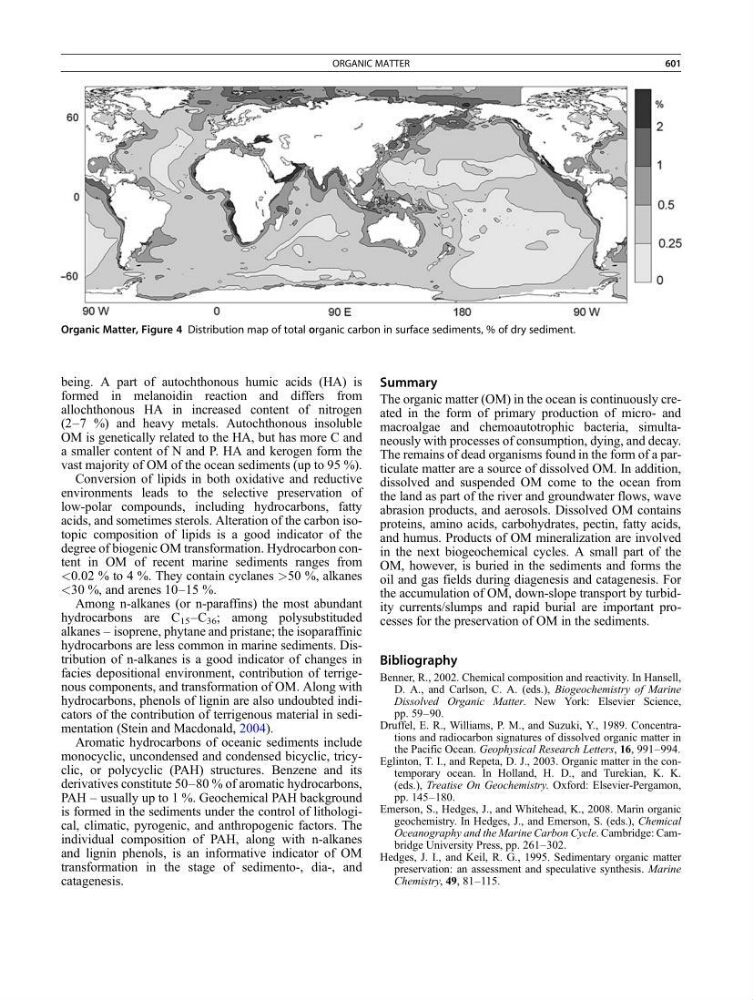
Organic Matter, Figure 4 Distribution map of total organic carbon in surface sediments, % of dry sediment.
ORGANIC MATTER
601