

With time and decreasing temperature, greenschist facies
metamorphism migrates downward. This inverse metamorphism develops over a vertical distance of some
200 m. While moving away from the ridge, the ophiolite
nappe shovels at its front and drags below its sole, marine
sediments forming ophiolite mélanges. Commonly, this
nappe rides over high-pressure mélanges, relating to some
former active margin (review in Nicolas 1989).
This is best illustrated by the Oman ophiolite, where the
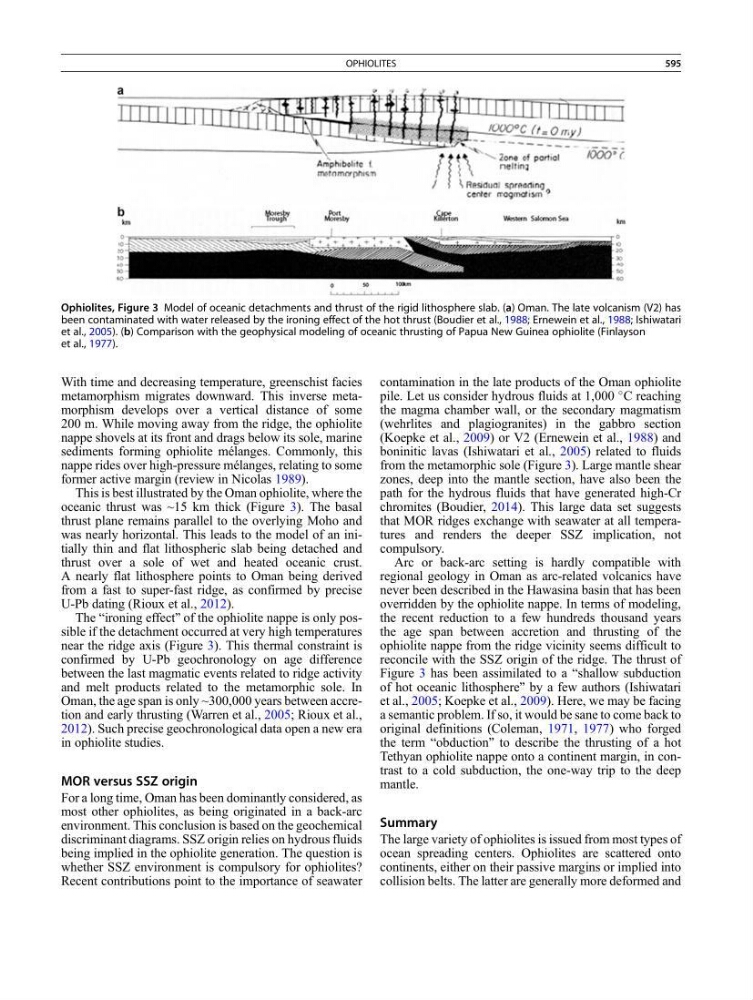
oceanic thrust was ~15 km thick (Figure 3). The basal
thrust plane remains parallel to the overlying Moho and
was nearly horizontal. This leads to the model of an initially thin and flat lithospheric slab being detached and
thrust over a sole of wet and heated oceanic crust.
A nearly flat lithosphere points to Oman being derived
from a fast to super-fast ridge, as confirmed by precise
U-Pb dating (Rioux et al., 2012).
The “ironing effect” of the ophiolite nappe is only possible if the detachment occurred at very high temperatures
near the ridge axis (Figure 3). This thermal constraint is
confirmed by U-Pb geochronology on age difference
between the last magmatic events related to ridge activity
and melt products related to the metamorphic sole. In
Oman, the age span is only ~300,000 years between accretion and early thrusting (Warren et al., 2005; Rioux et al.,
2012). Such precise geochronological data open a new era
in ophiolite studies.
MOR versus SSZ origin
For a long time, Oman has been dominantly considered, as
most other ophiolites, as being originated in a back-arc
environment. This conclusion is based on the geochemical
discriminant diagrams. SSZ origin relies on hydrous fluids
being implied in the ophiolite generation. The question is
whether SSZ environment is compulsory for ophiolites?
Recent contributions point to the importance of seawater
contamination in the late products of the Oman ophiolite
pile. Let us consider hydrous fluids at 1,000
C reaching
the magma chamber wall, or the secondary magmatism
(wehrlites and plagiogranites) in the gabbro section
(Koepke et al., 2009) or V2 (Ernewein et al., 1988) and
boninitic lavas (Ishiwatari et al., 2005) related to fluids
from the metamorphic sole (Figure 3). Large mantle shear
zones, deep into the mantle section, have also been the
path for the hydrous fluids that have generated high-Cr
chromites (Boudier, 2014). This large data set suggests
that MOR ridges exchange with seawater at all temperatures and renders the deeper SSZ implication, not
compulsory.
Arc or back-arc setting is hardly compatible with
regional geology in Oman as arc-related volcanics have
never been described in the Hawasina basin that has been
overridden by the ophiolite nappe. In terms of modeling,
the recent reduction to a few hundreds thousand years
the age span between accretion and thrusting of the
ophiolite nappe from the ridge vicinity seems difficult to
reconcile with the SSZ origin of the ridge. The thrust of
Figure 3 has been assimilated to a “shallow subduction
of hot oceanic lithosphere” by a few authors (Ishiwatari
et al., 2005; Koepke et al., 2009). Here, we may be facing
a semantic problem. If so, it would be sane to come back to
original definitions (Coleman, 1971, 1977) who forged
the term “obduction” to describe the thrusting of a hot
Tethyan ophiolite nappe onto a continent margin, in contrast to a cold subduction, the one-way trip to the deep
mantle.
Summary
The large variety of ophiolites is issued from most types of
ocean spreading centers. Ophiolites are scattered onto
continents, either on their passive margins or implied into
collision belts. The latter are generally more deformed and
Ophiolites, Figure 3 Model of oceanic detachments and thrust of the rigid lithosphere slab. (a) Oman. The late volcanism (V2) has
been contaminated with water released by the ironing effect of the hot thrust (Boudier et al., 1988; Ernewein et al., 1988; Ishiwatari
et al., 2005). (b) Comparison with the geophysical modeling of oceanic thrusting of Papua New Guinea ophiolite (Finlayson
et al., 1977).
OPHIOLITES
595