

of a mafic crust (Cannat et al., 2008). In the SWIR, the NS
diverging plate motions are responsible for the EW trend
of the rift shifts to SW-NE, presumably due to oblique
asthenospheric channeling. It is only within the thinner
and weaker rift floor that EW traces relating to the NS
extension are observed, reflecting the lithosphere tectonic
print (Cannat et al., 2008). Interestingly, below slow
spreading ridges where the lithospheric walls penetrate
deeper than 10 km, these walls seem to control somewhat
the longitudinal upper asthenospheric flow.
In comparison to the SWIR, the Gakkel Ridge is more
linear with few tectonic discontinuities, with spreading
rates decreasing eastwards that are lower than those at
the SWIR. From west to east, the topography deepens
and magmatism progressively decreases, but it is controlled neither by lower spreading rates nor by lithospheric
tectonics. Again, the source of these discrepancies lies in
primary heterogeneities of the melting mantle, either due
to temperatures and/or chemistry (variable levels of depletion/enrichment, as recently documented by Wanless
. .
. .
. .
. . .
. .
.
.
. .
. .
. .
. . .
. .
.
.
. .
. .
. .
. . .
. .
.
.
M
T
Z
crust
neovolcanic zone
corrugated
detachment surface
breakaway
debris flow
crust
4
8
spreading axis
as th e n o s p h e re
0
5
1 0
5
10 km
0 km
m
y
l o
n
i t e
s
2
6
10
M
T
Z
f u t u r e
d e t a c h m
e n t
f a u l t
f u t u r e
d e t a c h m
e n t
f a u l t
neovolcanic zone
r i s i n g m e l t
crust
lithospheric mantle
lithospheric mantle
crust
spreading axis
0
5
1 0
5
10 km
a
b
a s t h e n o s p h e r e
0 km
4
8
6
10
2
d e t a c h m e n t
f a u l t
lithospheric mantle
lithospheric mantle
nascent crust
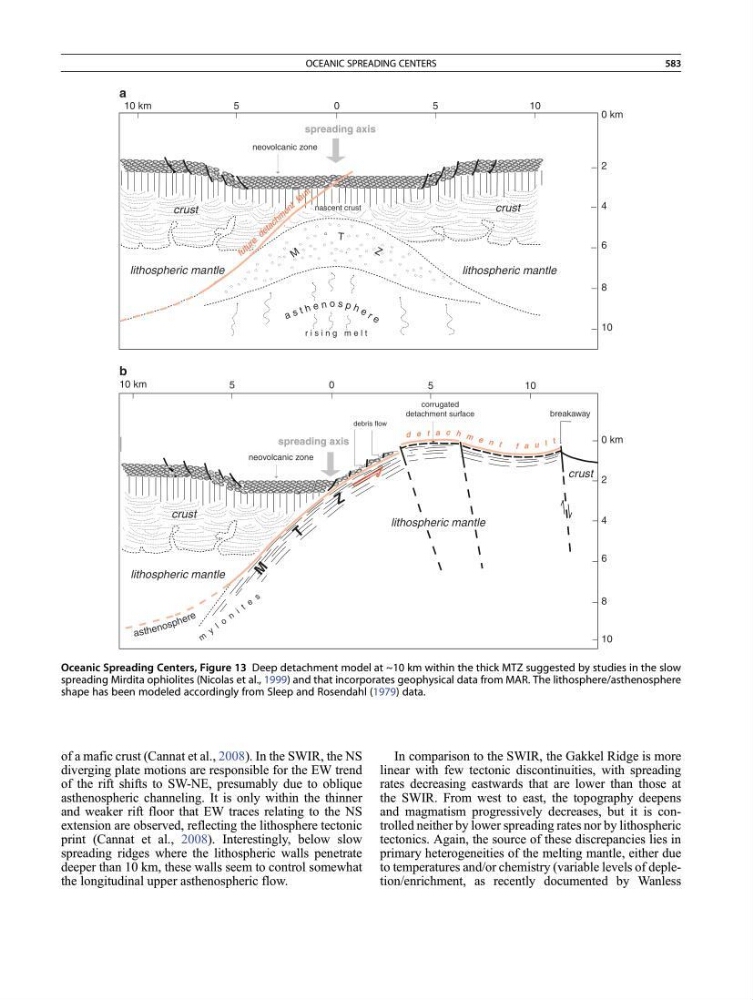
Oceanic Spreading Centers, Figure 13 Deep detachment model at ~10 km within the thick MTZ suggested by studies in the slow
spreading Mirdita ophiolites (Nicolas et al., 1999) and that incorporates geophysical data from MAR. The lithosphere/asthenosphere
shape has been modeled accordingly from Sleep and Rosendahl (1979) data.
OCEANIC SPREADING CENTERS
583