

corresponding to a depth of ~30 km (Figure 3b3). Thus,
the lithosphere thickness may attain this depth as a consequence of a much reduced melting as compared to faster
ridges. These two ultraslow ridges share many similar features. The average seafloor depth is over 3 km and down to
6 km inside deepest rifts (Figure 14). Over a thin “crust,”
the seafloor is covered with basalts and mantle
serpentinized peridotites, locally fresh in Gakkel Ridge.
The SWIR rough topography seems to result from imbrication of detachment faults, lubricated by serpentinites,
an expected consequence of spreading being dominantly
tectonic rather than magmatic (Sauter et al., 2013). Along
the western part of SWIR, the oblique spreading direction
with respect to the rift alignment creates oblique and
small-scale segmentation within the rift (Dick et al.,
2003; Cannat et al., 2008). There are, however, sharp variations along axis, defining a large-scale segmentation
(over 200 km) controlled by melting in the underlying
mantle. In western parts of the SWIR, the rift rises to a
depth of some 3 km and develop a thin, continuous mafic
crust; the drilling has revealed a gabbro layer of ~2 km
thick (Dick et al., 2003). In this region of the SWIR, the
spreading may be influenced by the South African hot
spot. Although spreading rate likely remained ultraslow
over time, the excess heat and magmatism from the hot
spot may explain both the topography and the accretion
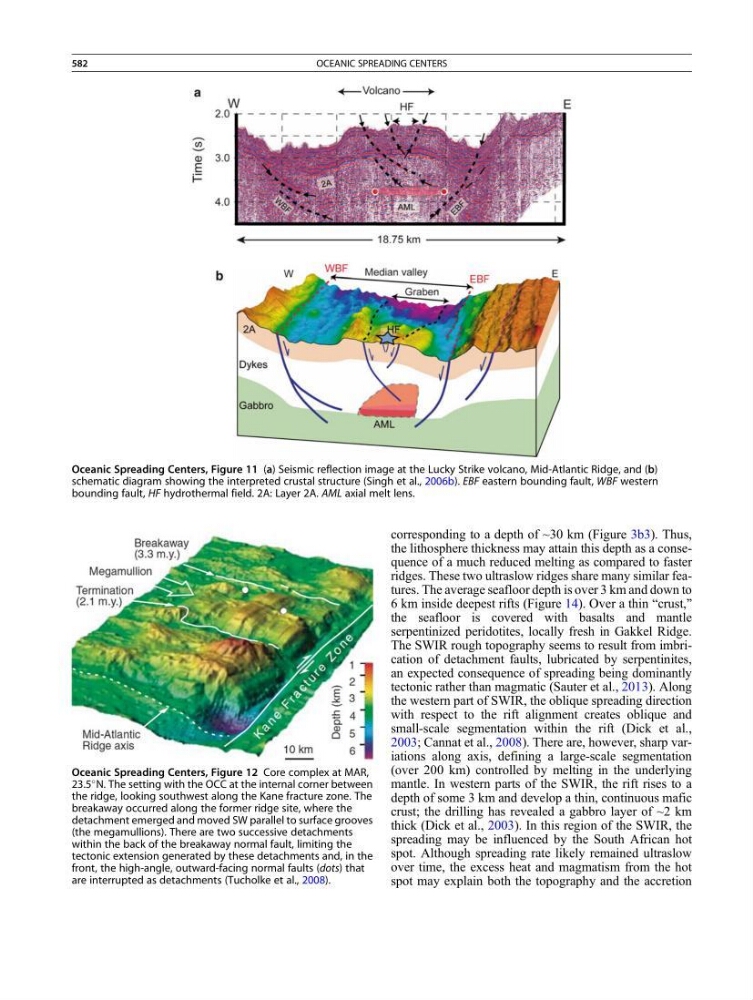
Oceanic Spreading Centers, Figure 11 (a) Seismic reflection image at the Lucky Strike volcano, Mid-Atlantic Ridge, and (b)
schematic diagram showing the interpreted crustal structure (Singh et al., 2006b). EBF eastern bounding fault, WBF western
bounding fault, HF hydrothermal field. 2A: Layer 2A. AML axial melt lens.
Oceanic Spreading Centers, Figure 12 Core complex at MAR,
23.5
N. The setting with the OCC at the internal corner between
the ridge, looking southwest along the Kane fracture zone. The
breakaway occurred along the former ridge site, where the
detachment emerged and moved SW parallel to surface grooves
(the megamullions). There are two successive detachments
within the back of the breakaway normal fault, limiting the
tectonic extension generated by these detachments and, in the
front, the high-angle, outward-facing normal faults (dots) that
are interrupted as detachments (Tucholke et al., 2008).
582
OCEANIC SPREADING CENTERS