

The crustal seismic structure at non-transform faults
show some low velocities in the lower crust, which could
be due to the serpentinization of ultramafic oceanic rocks
that likely include parts of the mantle (Cannat, 1996;
Canales et al., 2000). The crust beneath fracture zones is
generally thin, 3–4.5 km, and shows absence of the layer
2A, indicating the absence of volcanism (Detrick et al.,
1993).
Oceanic core complexes
The distinctive features of slow spreading ridges are due to
their lower thermal budget as compared to fast spreading
ridges. Because melt delivery is believed to be discontinuous in time and space, the continuous spreading imposed
by plate tectonics leads to alternate episodes of magmatic
and tectonic accretion. Magmatic accretion allows the
temporary formation of a magma chamber, such as at
Lucky Strike, with the presence of an AML. Tectonic
accretion proceeds by the normal faulting responsible for
the axial rifting and by the detachment faulting creating
the spectacular OCCs (Tucholke et al., 1998). Mantle lithosphere dips about 30
away from the ridge axial plane
(Figure 3b) and studies of ophiolites (Nicolas, 1989;
Jousselin and Nicolas, 2000) suggest that these lithospheric slopes channel mantle flow parallel to the ridge
axis between major transform faults. As a consequence,
the MTZ would become a few kilometers thick below
the ridge axis, compared to a few hundred meters at fast
spreading ridges. However, it thins out at a short distance
on each side of the ridge (Figure 13).
We briefly present the characteristic morphology of
OCC from the Atlantic seafloor (Figure 12) and, tentatively, introduce (Figure 13) a model derived from the
Mirdita ophiolite in Albania. It may complement the
marine studies on OCCs that are mostly limited to seafloor
observations. Introducing field observations on the deep
structure of OCCs in this slow spreading ophiolite, we
take into account the geophysical data obtained in OCCS
from MAR (Nooner et al., 2003; Schroeder and John,
2004; DeMartin et al., 2007; Henig et al., 2012; Hansen
et al., 2013).
Ultraslow spreading centers
Ultraslow spreading centers correspond to spreading rates
of 1–2 cm/year, rates between those that characterize slow
spreading ridges described above and those of oceanic
rifts (see Oceanic Rifts). The Southwest Indian Ridge
(SWIR) and the Gakkel Ridge in the Arctic have both been
recently studied, and a few general features can be anticipated based on the mantle melting models presented in
Figure 3. The fertile mantle rocks collected on seafloor
of these two ridges are in the field of spinel lherzolites,
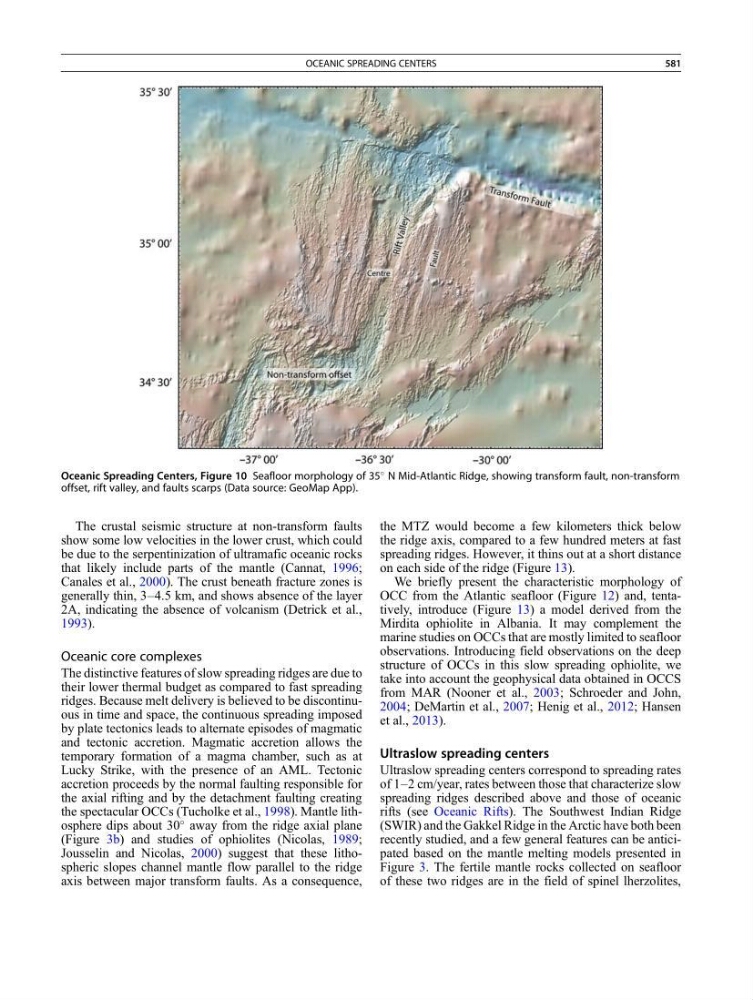
Oceanic Spreading Centers, Figure 10 Seafloor morphology of 35
N Mid-Atlantic Ridge, showing transform fault, non-transform
offset, rift valley, and faults scarps (Data source: GeoMap App).
OCEANIC SPREADING CENTERS
581