

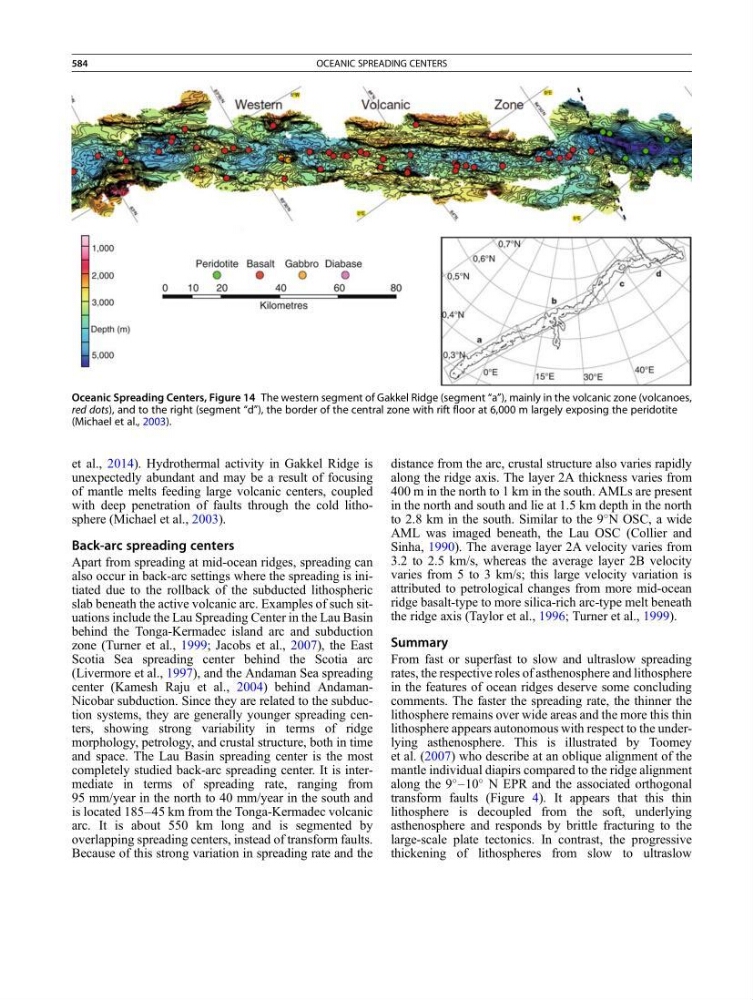
et al., 2014). Hydrothermal activity in Gakkel Ridge is
unexpectedly abundant and may be a result of focusing
of mantle melts feeding large volcanic centers, coupled
with deep penetration of faults through the cold lithosphere (Michael et al., 2003).
Back-arc spreading centers
Apart from spreading at mid-ocean ridges, spreading can
also occur in back-arc settings where the spreading is initiated due to the rollback of the subducted lithospheric
slab beneath the active volcanic arc. Examples of such situations include the Lau Spreading Center in the Lau Basin
behind the Tonga-Kermadec island arc and subduction
zone (Turner et al., 1999; Jacobs et al., 2007), the East
Scotia Sea spreading center behind the Scotia arc
(Livermore et al., 1997), and the Andaman Sea spreading
center (Kamesh Raju et al., 2004) behind AndamanNicobar subduction. Since they are related to the subduction systems, they are generally younger spreading centers, showing strong variability in terms of ridge
morphology, petrology, and crustal structure, both in time
and space. The Lau Basin spreading center is the most
completely studied back-arc spreading center. It is intermediate in terms of spreading rate, ranging from
95 mm/year in the north to 40 mm/year in the south and
is located 185–45 km from the Tonga-Kermadec volcanic
arc. It is about 550 km long and is segmented by
overlapping spreading centers, instead of transform faults.
Because of this strong variation in spreading rate and the
distance from the arc, crustal structure also varies rapidly
along the ridge axis. The layer 2A thickness varies from
400 m in the north to 1 km in the south. AMLs are present
in the north and south and lie at 1.5 km depth in the north
to 2.8 km in the south. Similar to the 9
N OSC, a wide
AML was imaged beneath, the Lau OSC (Collier and
Sinha, 1990). The average layer 2A velocity varies from
3.2 to 2.5 km/s, whereas the average layer 2B velocity
varies from 5 to 3 km/s; this large velocity variation is
attributed to petrological changes from more mid-ocean
ridge basalt-type to more silica-rich arc-type melt beneath
the ridge axis (Taylor et al., 1996; Turner et al., 1999).
Summary
From fast or superfast to slow and ultraslow spreading
rates, the respective roles of asthenosphere and lithosphere
in the features of ocean ridges deserve some concluding
comments. The faster the spreading rate, the thinner the
lithosphere remains over wide areas and the more this thin
lithosphere appears autonomous with respect to the underlying asthenosphere. This is illustrated by Toomey
et al. (2007) who describe at an oblique alignment of the
mantle individual diapirs compared to the ridge alignment
along the 9
–10
N EPR and the associated orthogonal
transform faults (Figure 4). It appears that this thin
lithosphere is decoupled from the soft, underlying
asthenosphere and responds by brittle fracturing to the
large-scale plate tectonics. In contrast, the progressive
thickening of lithospheres from slow to ultraslow
Oceanic Spreading Centers, Figure 14 The western segment of Gakkel Ridge (segment “a”), mainly in the volcanic zone (volcanoes,
red dots), and to the right (segment “d”), the border of the central zone with rift floor at 6,000 m largely exposing the peridotite
(Michael et al., 2003).
584
OCEANIC SPREADING CENTERS