

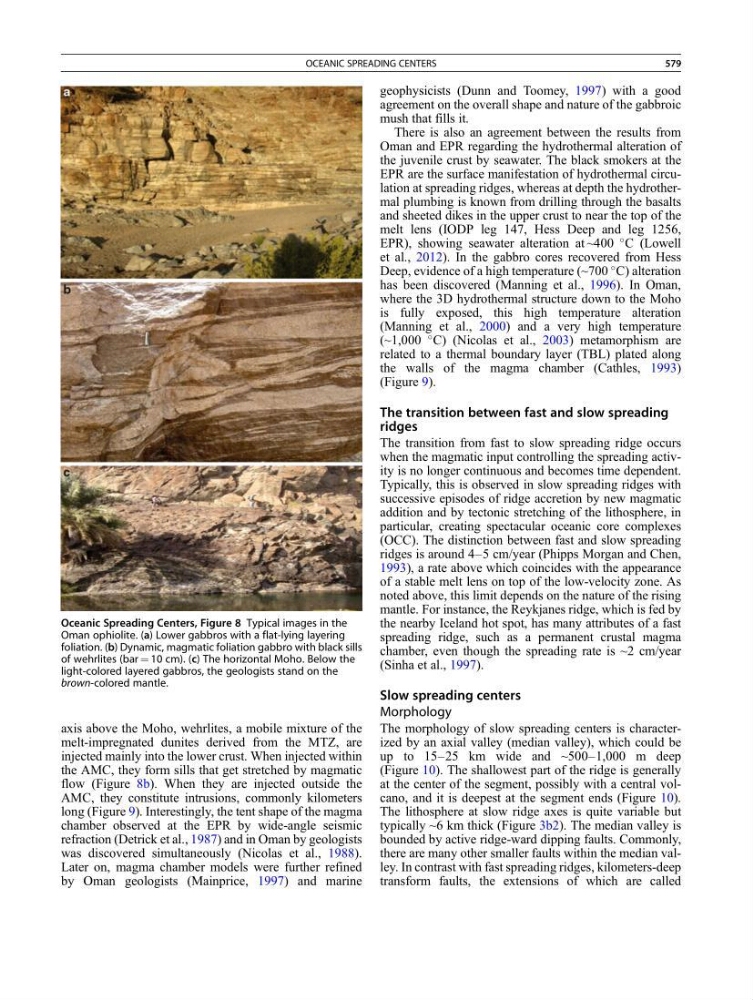
axis above the Moho, wehrlites, a mobile mixture of the
melt-impregnated dunites derived from the MTZ, are
injected mainly into the lower crust. When injected within
the AMC, they form sills that get stretched by magmatic
flow (Figure 8b). When they are injected outside the
AMC, they constitute intrusions, commonly kilometers
long (Figure 9). Interestingly, the tent shape of the magma
chamber observed at the EPR by wide-angle seismic
refraction (Detrick et al., 1987) and in Oman by geologists
was discovered simultaneously (Nicolas et al., 1988).
Later on, magma chamber models were further refined
by Oman geologists (Mainprice, 1997) and marine
geophysicists (Dunn and Toomey, 1997) with a good
agreement on the overall shape and nature of the gabbroic
mush that fills it.
There is also an agreement between the results from
Oman and EPR regarding the hydrothermal alteration of
the juvenile crust by seawater. The black smokers at the
EPR are the surface manifestation of hydrothermal circulation at spreading ridges, whereas at depth the hydrothermal plumbing is known from drilling through the basalts
and sheeted dikes in the upper crust to near the top of the
melt lens (IODP leg 147, Hess Deep and leg 1256,
EPR), showing seawater alteration at ~400
C (Lowell
et al., 2012). In the gabbro cores recovered from Hess
Deep, evidence of a high temperature (~700
C) alteration
has been discovered (Manning et al., 1996). In Oman,
where the 3D hydrothermal structure down to the Moho
is fully exposed, this high temperature alteration
(Manning et al., 2000) and a very high temperature
(~1,000
C) (Nicolas et al., 2003) metamorphism are
related to a thermal boundary layer (TBL) plated along
the walls of the magma chamber (Cathles, 1993)
(Figure 9).
The transition between fast and slow spreading
ridges
The transition from fast to slow spreading ridge occurs
when the magmatic input controlling the spreading activity is no longer continuous and becomes time dependent.
Typically, this is observed in slow spreading ridges with
successive episodes of ridge accretion by new magmatic
addition and by tectonic stretching of the lithosphere, in
particular, creating spectacular oceanic core complexes
(OCC). The distinction between fast and slow spreading
ridges is around 4–5 cm/year (Phipps Morgan and Chen,
1993), a rate above which coincides with the appearance
of a stable melt lens on top of the low-velocity zone. As
noted above, this limit depends on the nature of the rising
mantle. For instance, the Reykjanes ridge, which is fed by
the nearby Iceland hot spot, has many attributes of a fast
spreading ridge, such as a permanent crustal magma
chamber, even though the spreading rate is ~2 cm/year
(Sinha et al., 1997).
Slow spreading centers
Morphology
The morphology of slow spreading centers is characterized by an axial valley (median valley), which could be
up to 15–25 km wide and ~500–1,000 m deep
(Figure 10). The shallowest part of the ridge is generally
at the center of the segment, possibly with a central volcano, and it is deepest at the segment ends (Figure 10).
The lithosphere at slow ridge axes is quite variable but
typically ~6 km thick (Figure 3b2). The median valley is
bounded by active ridge-ward dipping faults. Commonly,
there are many other smaller faults within the median valley. In contrast with fast spreading ridges, kilometers-deep
transform faults, the extensions of which are called
Oceanic Spreading Centers, Figure 8 Typical images in the
Oman ophiolite. (a) Lower gabbros with a flat-lying layering
foliation. (b) Dynamic, magmatic foliation gabbro with black sills
of wehrlites (bar ¼ 10 cm). (c) The horizontal Moho. Below the
light-colored layered gabbros, the geologists stand on the
brown-colored mantle.
OCEANIC SPREADING CENTERS
579