

gabbros is dominantly inherited from the episodic filling
and internal convection in AML, together with intrusion
of gabbro and wehrlite sills. Layering is reinforced by
large magmatic flowage (e.g., Figure 8).
Contrasting with the AML concept at the EPR, mantle
diapirs were early discovered and mapped in the Oman
ophiolite. The mantle diapirs are derived from hot, partially molten mantle rising beneath the ridge axis. They
are ~10 km wide at the Moho level where the vertical mantle flow pattern is broken and diverges horizontally
(Rabinowicz et al., 1984) (Figure 8c). Similar mantle
upwellings have been interpreted to occur at the 9
N
EPR from seismic refraction studies (Dunn and Toomey,
1997; Toomey et al., 2007). Beneath the Moho in the
Oman ophiolite, there is a ~400 m thick Moho transition
zone (MTZ) typically composed of a residual dunite
impregnated by gabbroic melt. The MTZ at an active ridge
should be largely molten with a viscosity accounting for
the mantle flow rotation (Jousselin and Nicolas, 2000)
(Figure 8c). It is this MTZ that seems to have been imaged
by seafloor compliance studies at the EPR (Crawford and
Webb, 2002). Based on field studies in Oman, at the ridge
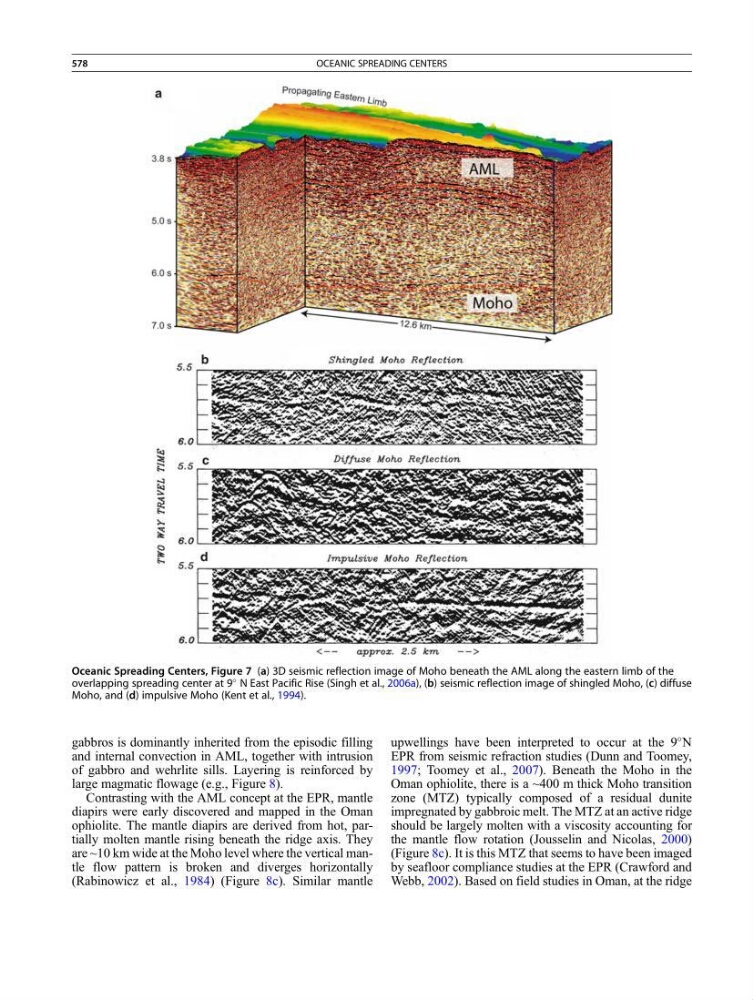
Oceanic Spreading Centers, Figure 7 (a) 3D seismic reflection image of Moho beneath the AML along the eastern limb of the
overlapping spreading center at 9
N East Pacific Rise (Singh et al., 2006a), (b) seismic reflection image of shingled Moho, (c) diffuse
Moho, and (d) impulsive Moho (Kent et al., 1994).
578
OCEANIC SPREADING CENTERS