

a matter of debate in the oceans (Kawakatsu et al., 2009;
Karato, 2012).
Hydrothermal circulation
The temperature of the melt in the AML and AMC is
~1,200
C, which is cooled by hydrothermal process as
cold seawater enters the crust (thermal sink near the ridge
axis), then rises back to the seafloor where it exists as
hydrothermal vents (black smokers) with a water temperature up to 400
C. Just below the ridge axis, the water circulates down to the AML, whereas it could potentially
circulate down to Moho depths around the AMC
(MacLennan et al., 2004). At one time it was believed that
hydrothermal circulation mainly occurred across axis, but
recent studies have shown that a significant amount
of hydrothermal circulation takes place along the ridge
axis (Fontaine and Wilcock, 2007; Tolstoy et al., 2008).
Comparing internal structures of the EPR and
Oman ophiolite
With the exception of the seafloor itself, little of the internal geology of fast spreading ridges can be directly studied, in contrast to slow spreading ridges where
kilometers of relief are exposed along deep transform
faults and oceanic core complexes. Few exceptions are
Hess Deep where the westward-propagating Galapagos
Spreading Center cuts through young the EPR crust,
exposing its crustal section. It has been drilled during the
IODP program (Legs 147 in 1993 and 345 in
2012–2013). Another site is the Pito Deep, the tip of a
propagator on the Easter microplate. So far only gabbros
(in situ) have been recovered in these sites. This is why
we briefly present some of the prominent geological features exposed in the field in the Oman ophiolite and show
how they compare with the wealth of geophysical data
discussed above (see also “Ophiolites” and “Oceanic
Rifts” in this encyclopedia).
The Oman ophiolite is a piece of oceanic lithosphere
formed 95 Ma ago that got detached and thrust on to the
passive margin of Oman about 10 Ma later. It is best suited
for a comparison with the EPR as it was formed at fast
spreading to superfast (20 cm/year) spreading centers
(Rioux et al., 2012). It is very large (500 km long and
60–80 km wide), compared with the well-studied
200 km by 50 km 8–10
N segment of the EPR
(Figure 4). The Oman ophiolite has excellent exposures,
is flat-lying, and has not been structurally dismembered.
Its structural and petrologic study is remarkably complementary to that obtained by the detailed studies conducted
around 9
N on the EPR. Two examples illustrate this complementarity. AMLs are well imaged at the EPR using
seismic reflection techniques (see above) whereas in
Oman, the existence of such a melt lens could not be imagined because AMLs are transient features of an active
ridge, vanishing at a kilometer distance from the ridge
axis. However, looking between the lid and the gabbro
unit for evidences of their presence in Oman, it has been
possible to identify their former existence along the ridge
and to describe their past magmatic history, such as episodic filling by new melt or internal convection, obviously
out of reach in active ridges. AMLs generate most of the
gabbro unit by deposition of gabbroic mushes on their
floor (Boudier and Nicolas, 2011). This is followed by
subsidence of this mush from the floor to deeper in the
crust (Nicolas et al., 2009). The typical layering of
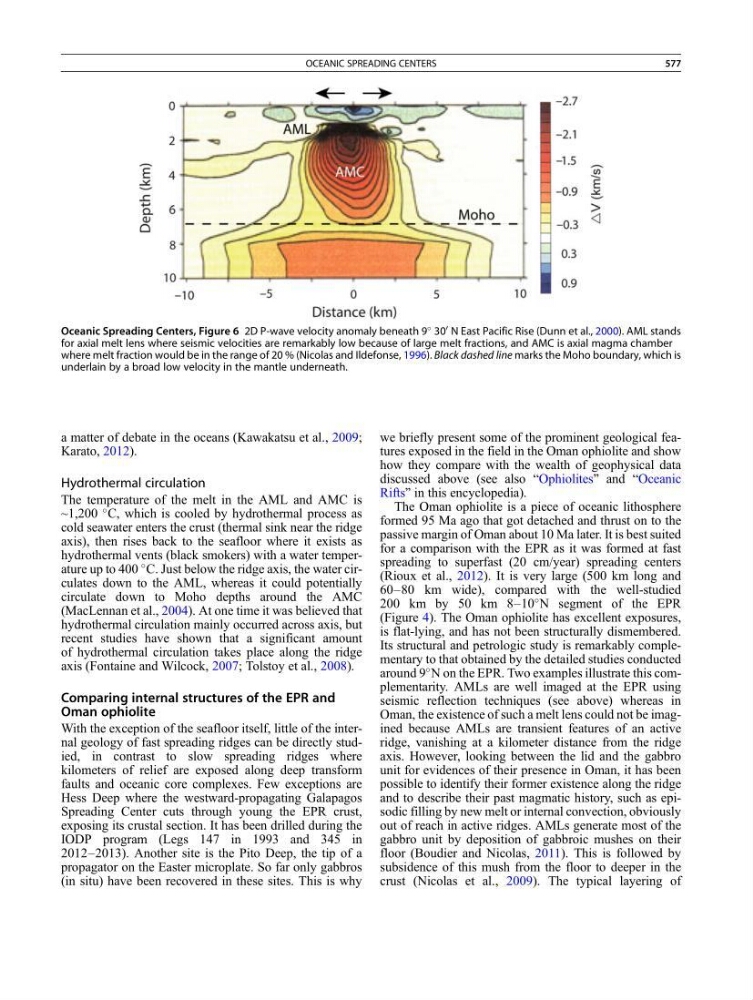
Oceanic Spreading Centers, Figure 6 2D P-wave velocity anomaly beneath 9
30
0 N East Pacific Rise (Dunn et al., 2000). AML stands
for axial melt lens where seismic velocities are remarkably low because of large melt fractions, and AMC is axial magma chamber
where melt fraction would be in the range of 20 % (Nicolas and Ildefonse, 1996). Black dashed line marks the Moho boundary, which is
underlain by a broad low velocity in the mantle underneath.
OCEANIC SPREADING CENTERS
577