

observations such as in the Rio Grande Rift where
stretching preceded volcanic activity in the rift, in contrast
with the East African Rift where asthenosphere upwelling
preceded stretching (Allen and Allen, 2005). However, in
a “normal,” homogeneous, continental lithosphere, with a
temperature at Moho depth of only ~500
C, it is not
expected that mantle peridotites would yield to the horizontal far-field tensile stress applied to the lithosphere (Nicolas
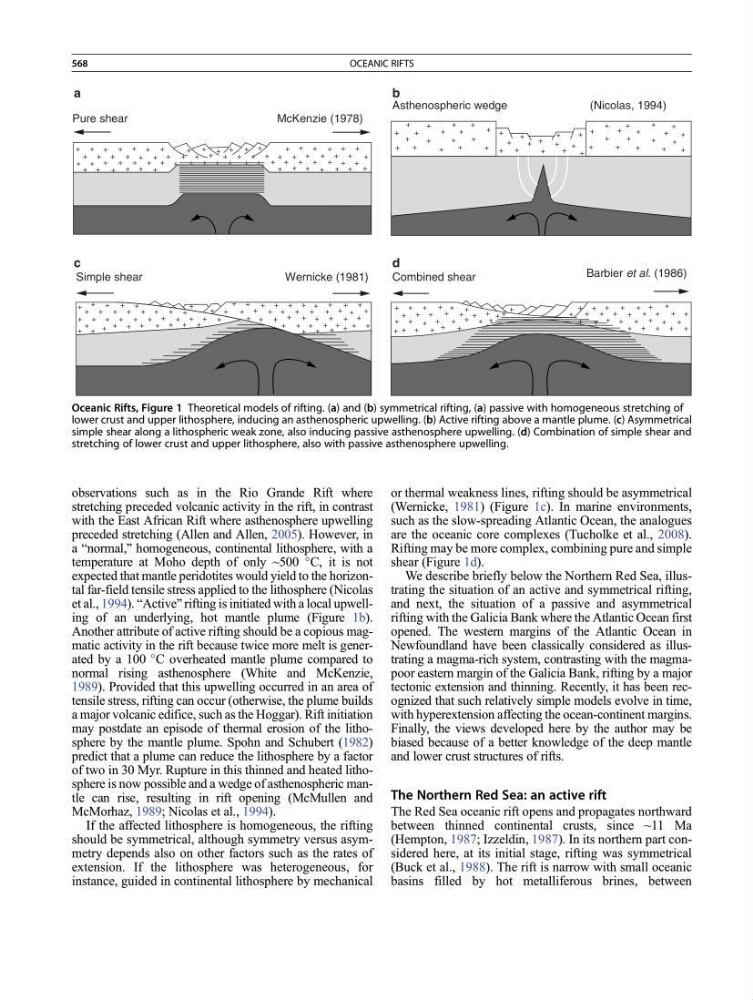
et al., 1994). “Active” rifting is initiated with a local upwelling of an underlying, hot mantle plume (Figure 1b).
Another attribute of active rifting should be a copious magmatic activity in the rift because twice more melt is generated by a 100
C overheated mantle plume compared to
normal rising asthenosphere (White and McKenzie,
1989). Provided that this upwelling occurred in an area of
tensile stress, rifting can occur (otherwise, the plume builds
a major volcanic edifice, such as the Hoggar). Rift initiation
may postdate an episode of thermal erosion of the lithosphere by the mantle plume. Spohn and Schubert (1982)
predict that a plume can reduce the lithosphere by a factor
of two in 30 Myr. Rupture in this thinned and heated lithosphere is now possible and a wedge of asthenospheric mantle can rise, resulting in rift opening (McMullen and
McMorhaz, 1989; Nicolas et al., 1994).
If the affected lithosphere is homogeneous, the rifting
should be symmetrical, although symmetry versus asymmetry depends also on other factors such as the rates of
extension. If the lithosphere was heterogeneous, for
instance, guided in continental lithosphere by mechanical
or thermal weakness lines, rifting should be asymmetrical
(Wernicke, 1981) (Figure 1c). In marine environments,
such as the slow-spreading Atlantic Ocean, the analogues
are the oceanic core complexes (Tucholke et al., 2008).
Rifting may be more complex, combining pure and simple
shear (Figure 1d).
We describe briefly below the Northern Red Sea, illustrating the situation of an active and symmetrical rifting,
and next, the situation of a passive and asymmetrical
rifting with the Galicia Bank where the Atlantic Ocean first
opened. The western margins of the Atlantic Ocean in
Newfoundland have been classically considered as illustrating a magma-rich system, contrasting with the magmapoor eastern margin of the Galicia Bank, rifting by a major
tectonic extension and thinning. Recently, it has been recognized that such relatively simple models evolve in time,
with hyperextension affecting the ocean-continent margins.
Finally, the views developed here by the author may be
biased because of a better knowledge of the deep mantle
and lower crust structures of rifts.
The Northern Red Sea: an active rift
The Red Sea oceanic rift opens and propagates northward
between thinned continental crusts, since ~11 Ma
(Hempton, 1987; Izzeldin, 1987). In its northern part considered here, at its initial stage, rifting was symmetrical
(Buck et al., 1988). The rift is narrow with small oceanic
basins filled by hot metalliferous brines, between
Pure shear
McKenzie (1978)
Asthenospheric wedge
(Nicolas, 1994)
Simple shear
Wernicke (1981)
Combined shear
a
b
c
d
Barbier et al. (1986)
Oceanic Rifts, Figure 1 Theoretical models of rifting. (a) and (b) symmetrical rifting, (a) passive with homogeneous stretching of
lower crust and upper lithosphere, inducing an asthenospheric upwelling. (b) Active rifting above a mantle plume. (c) Asymmetrical
simple shear along a lithospheric weak zone, also inducing passive asthenosphere upwelling. (d) Combination of simple shear and
stretching of lower crust and upper lithosphere, also with passive asthenosphere upwelling.
568
OCEANIC RIFTS