

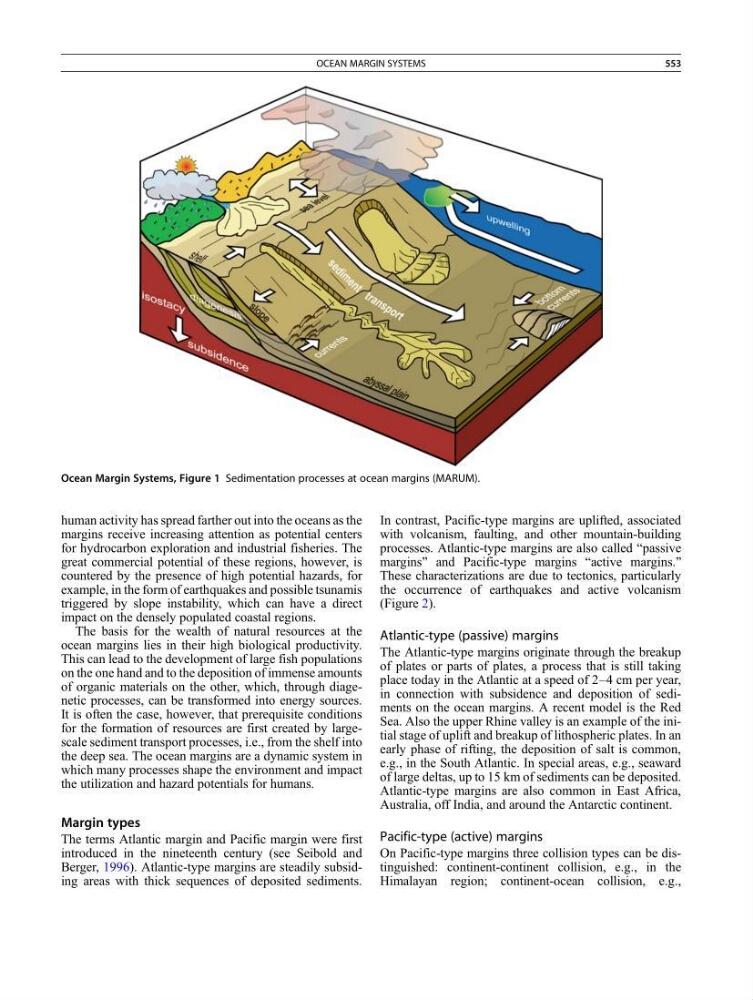
human activity has spread farther out into the oceans as the
margins receive increasing attention as potential centers
for hydrocarbon exploration and industrial fisheries. The
great commercial potential of these regions, however, is
countered by the presence of high potential hazards, for
example, in the form of earthquakes and possible tsunamis
triggered by slope instability, which can have a direct
impact on the densely populated coastal regions.
The basis for the wealth of natural resources at the
ocean margins lies in their high biological productivity.
This can lead to the development of large fish populations
on the one hand and to the deposition of immense amounts
of organic materials on the other, which, through diagenetic processes, can be transformed into energy sources.
It is often the case, however, that prerequisite conditions
for the formation of resources are first created by largescale sediment transport processes, i.e., from the shelf into
the deep sea. The ocean margins are a dynamic system in
which many processes shape the environment and impact
the utilization and hazard potentials for humans.
Margin types
The terms Atlantic margin and Pacific margin were first
introduced in the nineteenth century (see Seibold and
Berger, 1996). Atlantic-type margins are steadily subsiding areas with thick sequences of deposited sediments.
In contrast, Pacific-type margins are uplifted, associated
with volcanism, faulting, and other mountain-building
processes. Atlantic-type margins are also called “passive
margins” and Pacific-type margins “active margins.”
These characterizations are due to tectonics, particularly
the occurrence of earthquakes and active volcanism
(Figure 2).
Atlantic-type (passive) margins
The Atlantic-type margins originate through the breakup
of plates or parts of plates, a process that is still taking
place today in the Atlantic at a speed of 2–4 cm per year,
in connection with subsidence and deposition of sediments on the ocean margins. A recent model is the Red
Sea. Also the upper Rhine valley is an example of the initial stage of uplift and breakup of lithospheric plates. In an
early phase of rifting, the deposition of salt is common,
e.g., in the South Atlantic. In special areas, e.g., seaward
of large deltas, up to 15 km of sediments can be deposited.
Atlantic-type margins are also common in East Africa,
Australia, off India, and around the Antarctic continent.
Pacific-type (active) margins
On Pacific-type margins three collision types can be distinguished: continent-continent collision, e.g., in the
Himalayan region; continent-ocean collision, e.g.,
Ocean Margin Systems, Figure 1 Sedimentation processes at ocean margins (MARUM).
OCEAN MARGIN SYSTEMS
553