

between the Pacific and South America; and subductions
in the area of island arcs, e.g., in the Mariana Trench.
Faulting, shearing of sediments, volcanism, and melting
of the submerging lithosphere are characteristics of colliding margins. Special rocks called ophiolites, a mixture of
pelagic sediments and basaltic rocks, are characteristically
formed at subduction zones.
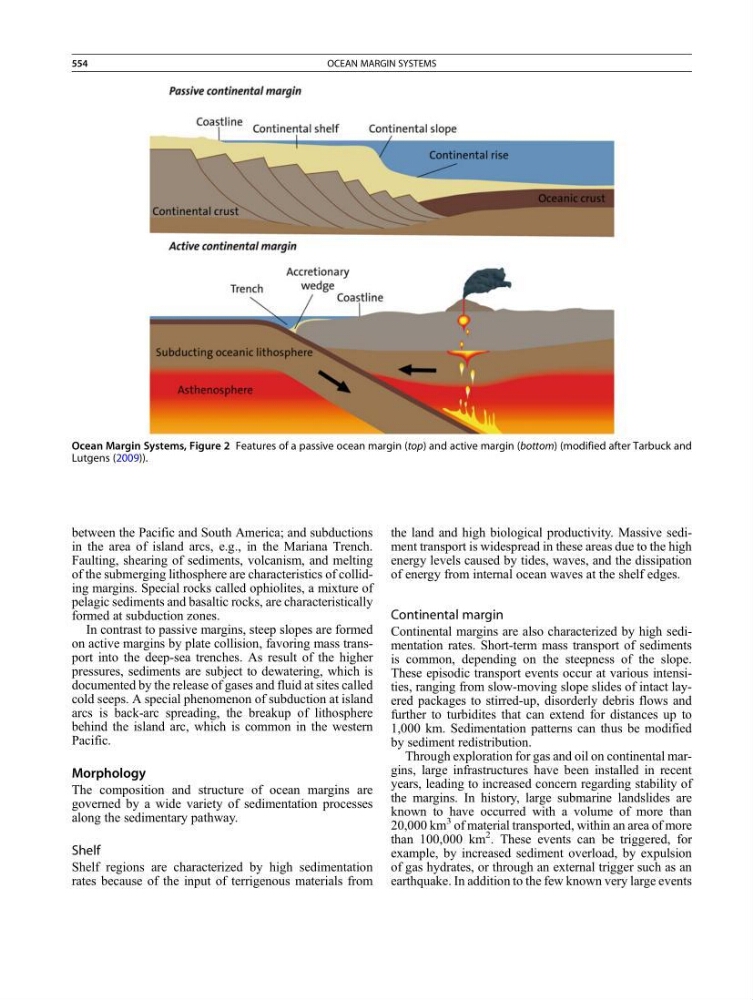
In contrast to passive margins, steep slopes are formed
on active margins by plate collision, favoring mass transport into the deep-sea trenches. As result of the higher
pressures, sediments are subject to dewatering, which is
documented by the release of gases and fluid at sites called
cold seeps. A special phenomenon of subduction at island
arcs is back-arc spreading, the breakup of lithosphere
behind the island arc, which is common in the western
Pacific.
Morphology
The composition and structure of ocean margins are
governed by a wide variety of sedimentation processes
along the sedimentary pathway.
Shelf
Shelf regions are characterized by high sedimentation
rates because of the input of terrigenous materials from
the land and high biological productivity. Massive sediment transport is widespread in these areas due to the high
energy levels caused by tides, waves, and the dissipation
of energy from internal ocean waves at the shelf edges.
Continental margin
Continental margins are also characterized by high sedimentation rates. Short-term mass transport of sediments
is common, depending on the steepness of the slope.
These episodic transport events occur at various intensities, ranging from slow-moving slope slides of intact layered packages to stirred-up, disorderly debris flows and
further to turbidites that can extend for distances up to
1,000 km. Sedimentation patterns can thus be modified
by sediment redistribution.
Through exploration for gas and oil on continental margins, large infrastructures have been installed in recent
years, leading to increased concern regarding stability of
the margins. In history, large submarine landslides are
known to have occurred with a volume of more than
20,000 km
3 of material transported, within an area of more
than 100,000 km
2
. These events can be triggered, for
example, by increased sediment overload, by expulsion
of gas hydrates, or through an external trigger such as an
earthquake. In addition to the few known very large events
Ocean Margin Systems, Figure 2 Features of a passive ocean margin (top) and active margin (bottom) (modified after Tarbuck and
Lutgens (2009)).
554
OCEAN MARGIN SYSTEMS