

institution for eventual scientific publications. Each country funds this part. In essence, drilling and sampling are
the common infrastructure supported internationally, and
all the rest is left to normal scientific competition.
The data and findings are made openly and freely available (www.iodp.org). All obtained core samples are
archived at core repositories (core repositories in North
America, Europe, and Asia store cores from global oceans
according to geographical location; Table 3) ready to be
utilized for new hypotheses to be verified or to be scrutinized by advanced analyses. Scientific drilling attempts
not to directly seek natural resources for commercial purposes but to look into their scientific significance.
The drill site needs to be characterized by geological
and geophysical methods such as the seafloor geomorphology and seismic reflection data to warrant the
discovery to be made with good chance in a safe manner.
A special international proposal evaluation scheme has
been established to allow for international experts in scientific disciplines and drilling technology to advise the
proponents and plan for an optimal drilling schedule. This
voluntary science advisory system is the core of selecting
proposals for scheduling based on scientific merits and
technical feasibilities.
Once a drilling proposal is adopted for scheduling, an
international science team is assembled to define a scientific project to achieve the proposal objectives considering
all the technical aspects of drilling offshore including
weather and ocean conditions. The team covers all aspects
of required expertise: sedimentology, paleontology, paleomagnetism, petrology, organic and inorganic geochemistry, microbiology, physical properties, etc. Chief
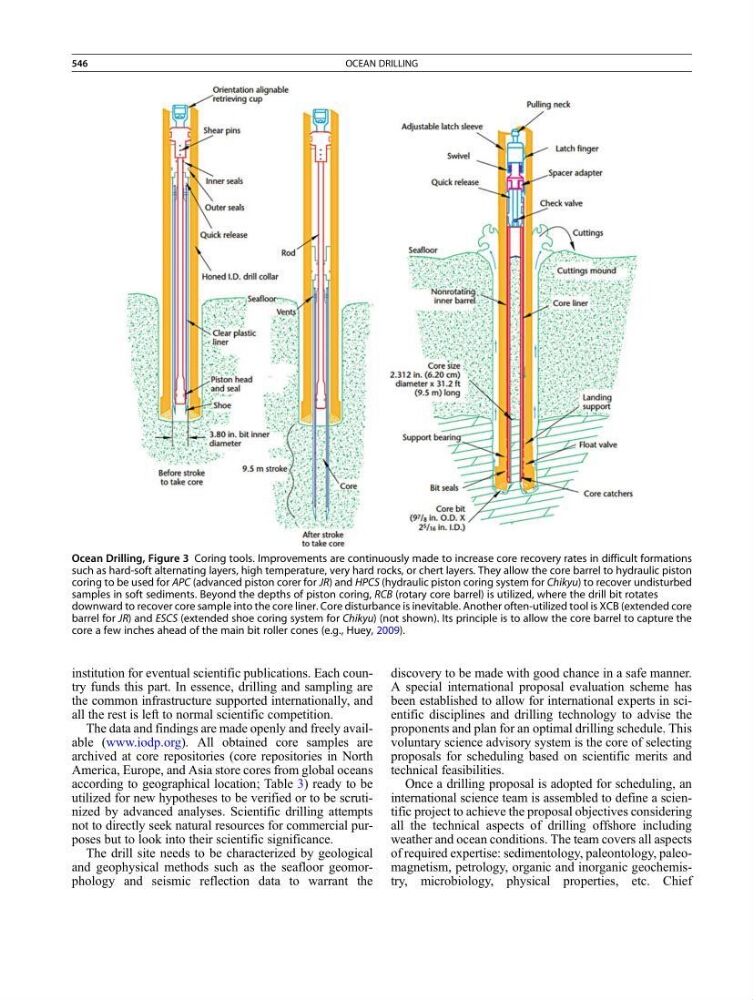
Ocean Drilling, Figure 3 Coring tools. Improvements are continuously made to increase core recovery rates in difficult formations
such as hard-soft alternating layers, high temperature, very hard rocks, or chert layers. They allow the core barrel to hydraulic piston
coring to be used for APC (advanced piston corer for JR) and HPCS (hydraulic piston coring system for Chikyu) to recover undisturbed
samples in soft sediments. Beyond the depths of piston coring, RCB (rotary core barrel) is utilized, where the drill bit rotates
downward to recover core sample into the core liner. Core disturbance is inevitable. Another often-utilized tool is XCB (extended core
barrel for JR) and ESCS (extended shoe coring system for Chikyu) (not shown). Its principle is to allow the core barrel to capture the
core a few inches ahead of the main bit roller cones (e.g., Huey, 2009).
546
OCEAN DRILLING