

the sediments and rocks by drill bits. The wire line corer
(typically each core trip brings on board a cylindrical sample (9.5 m length with 6.2 cm diameter)) runs up and down
inside the drill string as the drilling advances the corer
length. The actual drilling is made by various designs of
corers determined by the physical properties of the cores
to be taken. This is why a detailed site survey before drilling is essential to anticipate the samples. In soft sediments, hydraulic piston coring can be employed with
minimum disturbance to the obtained cores as it involves
a vertical downward thrust motion to penetrate deeper
without drill bit rotation (Figure 3).
Once a hard rock stratum is reached or the sediments
get too consolidated and hard for piston coring, rotary core
barrel (RCB) with a core bit at the bottom is used
(Figure 3). This system has been used throughout the history of scientific ocean drilling. See literature for other
variations and details (e.g., Huey, 2009). Coring challenges are met at hard rocks, chert layers, alternating soft
and hard materials such as sills into sediments, or hightemperature environments such as proximities of hydrothermal vents.
Ocean drilling logistics and technology
Scientific ocean drilling is a basic research and has been
open to any scientists to submit drilling proposals with
clear targets and objectives. A successful drilling proposal
will demonstrate that drilling is a unique method to
advance the state of scientific understanding in a significant way. Overall decadal-scale scientific goals are
defined through open international debate (ref. in Table 3),
by which each proposal is evaluated for merits. Such goals
have evolved from understanding the history and structure
of the Earth to physical and chemical processes that
shaped the present state of the Earth with increasing interest in the role of the sub-seafloor biosphere and relating to
the future of the habitable planet Earth.
Drilling is the most expensive part of the scientific
quest for new discoveries and verifications (e.g., IODP
budgets and expenditures are given in IODP Annual
Reports). International participation by national science
funding agencies and institutions has supported the ocean
drilling since 1975 (Table 2). As of 2013, there are
26 countries participating as 6 countries and 2 consortia
(the USA, Japan, PRC, Brazil, India, South Korea),
ECORD (Austria, Belgium, Canada, Denmark, Finland,
France, Germany, Iceland, Ireland, Israel, Italy, the Netherlands, Norway, Poland, Portugal, Spain, Sweden, Switzerland, the UK), and ANZIC (Australia, New Zealand).
The international cost sharing is dedicated to providing
the common infrastructure to be enjoyed by all the scientists supported by the participating member countries
through international governmental agreements. Each of
the drilling expeditions is conducted as an ocean drilling
community project with chief scientists (most often
cochiefs) nominated to oversee the science. Normally, scientific analyses take place at each scientist’s home
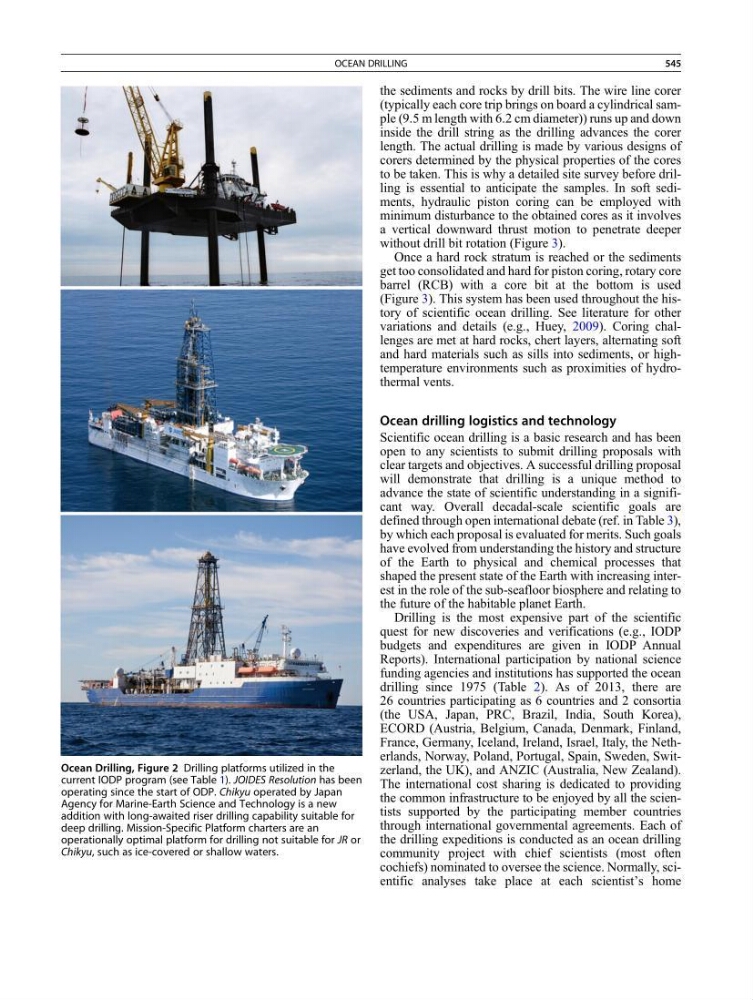
Ocean Drilling, Figure 2 Drilling platforms utilized in the
current IODP program (see Table 1). JOIDES Resolution has been
operating since the start of ODP. Chikyu operated by Japan
Agency for Marine-Earth Science and Technology is a new
addition with long-awaited riser drilling capability suitable for
deep drilling. Mission-Specific Platform charters are an
operationally optimal platform for drilling not suitable for JR or
Chikyu, such as ice-covered or shallow waters.
OCEAN DRILLING
545