

a subduction zone setting, because dewatering may
not keep pace with the rate the undercompacted
material is underthrust beneath the overriding plate. However, among the numerous other possibilities causing
undercompaction, the most prominent are gas hydrate dissociation, tectonic loading, diagenesis and mineral dehydration reactions, hydrocarbon generation, aquathermal
pressuring, or osmosis (e.g., Yassir, 1989). Several of
these processes may act simultaneously in MV areas at
depth, so that distinction between them is difficult.
A summary of various origins for elevated pore pressures
is given in Table 1.
On Earth, MVs are particularly abundant in Azerbaijan,
the Caspian Sea, and the Eastern Mediterranean Sea,
where their contributions to global budgets and fluid transfer from the geosphere to the hydrosphere/atmosphere are
significant (Kopf et al., 2001). Smaller features are typically tens of centimeters of cm to a few meters high and
wide, while larger edifices may be up to hundreds of m
high and several km wide (Kopf, 2002). In general, the
largest features have been described for the Mediterranean
Ridge accretionary complex, where seismic reflection
data reveal pie-shaped (i.e., tabular), deeply rooting MVs
of a few tens of kilometers across (Huguen et al., 2001;
Huguen et al., 2004). Evidence for a deep origin of the
ejecta is manifold, and mud and embedded clasts may
originate from different (often shallower) levels than the
aqueous or gaseous fluids (e.g., Robertson and Kopf,
1998; Kopf, 2002; Kopf and Deyhle, 2002; Dupré et al.,
2014).
In terms of their morphology, the clast content usually
defines the height, while viscosity and flux rate define
the overall shape. Little information exists concerning
the geometry of the conduit (or feeder channel) for ancient
and modern examples. Surface observations indicate
small diameters of 15 cm (Taiwan MVs; Yassir
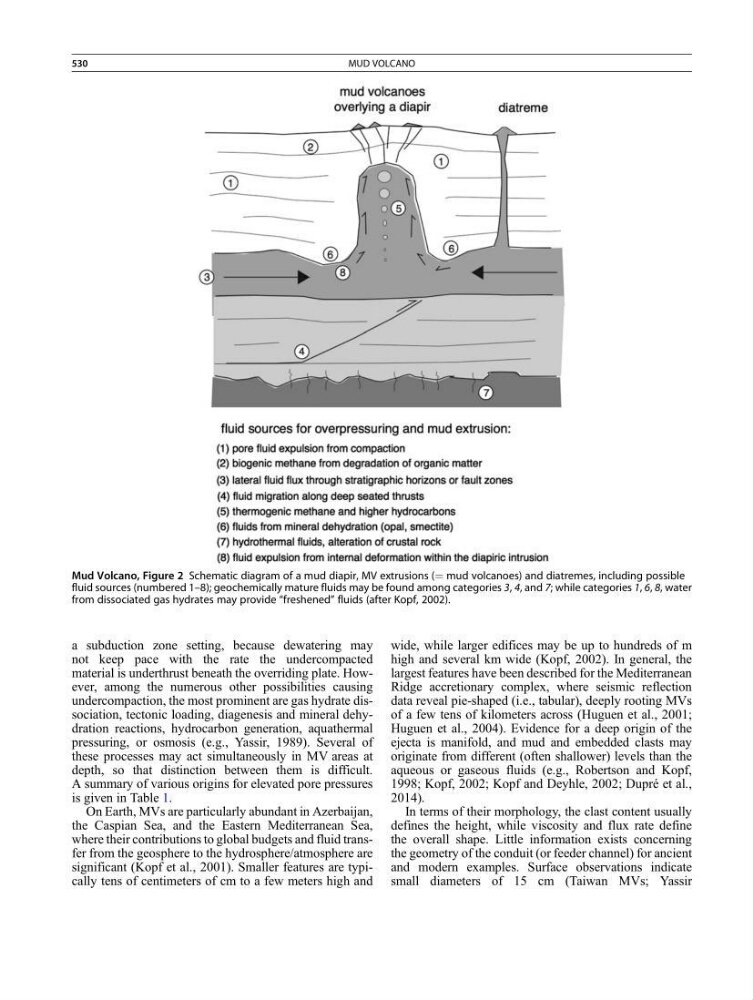
Mud Volcano, Figure 2 Schematic diagram of a mud diapir, MV extrusions (¼ mud volcanoes) and diatremes, including possible
fluid sources (numbered 1–8); geochemically mature fluids may be found among categories 3, 4, and 7; while categories 1, 6, 8, water
from dissociated gas hydrates may provide “freshened” fluids (after Kopf, 2002).
530
MUD VOLCANO