

(1989) and 30 cm (Greece; Stamatakis et al. (1987) to
1.5 m (Burma; Pascoe (1912) and 2 m (Sakhalin; Gorkun
and Siryk (1968). The first values agree well with
cemented chimneys in the ancient “Verrua” MVs in Italy
(Cavagna et al., 1998). Also, theoretical considerations
and calculations based on Stokes’ law indicate similar
diameters of 2–3 m for the Mediterranean Ridge MVs
(Kopf and Behrmann, 2000). However, some controversial data are reported for the feeder geometry at depth.
From seismic data, conduits of 1.5–3.5 km width have
been proposed for the Black Sea area (Limonov et al.,
1997). Similarly, a width of 2 km has been proposed for
the bigger of the Barbados Ridge features (Griboulard
et al., 1998) and the Alboran Sea mud domes (PerezBelzuz et al., 1997).
The relationship between the width of the conduit, the
associated ascent velocity, and the resulting surface topography is simplistically illustrated in Figure 3 (assuming
identical material properties in each case). Given the variable degree of fluid saturation and difference in overlying
medium (seawater vs. air), differences in longevity/resistance to erosion and morphology exist between onshore
and offshore features, not to mention extraterrestrial mud
volcanoes (see next paragraph).
Natural examples of pockmark fields associated with
mud volcanoes as well as onshore and offshore examples
are presented in Figure 4 and are particularly abundant in
thickly sedimented delta fans such as the Mississippi,
Nile, or Niger deltas (e.g., Loncke and Mascle, 2004; Judd
and Hovland, 2007; Sultan et al., 2014).
Mud volcanoes are commonly associated with
neotectonic regions or natural gas fields, but exceptions
to this rule are known. Extraterrestrial analogs are, e.g.,
Martian pitted cones (McGill, 2005). Undersea examples
include Haakon Mosby, Napoli and Milano, El Arraiche
(Morocco), Gulf of Cadiz, Barbados and Mediterranean
Ridges; and Conical Seamount (Marianas Arc), while subaerial examples are Lusi, Dashgil, or Lokhbatan (Kopf,
2002; van Loon, 2010). Mud volcanoes serve as “valves”
in many compressional belts, so that their episodic activity
and associated transient changes in physical and chemical
properties make them suitable indicators for, e.g., seismicity and other deep-seated processes (e.g., Hedberg, 1974;
Manga et al., 2009). Next to active margins, MVs are also
frequently associated with large deep sea fans such as that
of the Nile (Loncke and Mascle, 2004), Niger, or Gulf of
Guinea (Sultan et al., 2014). Here, the depth of origin of
the ejecta is shallower, and clasts, a prerequisite of tectonic
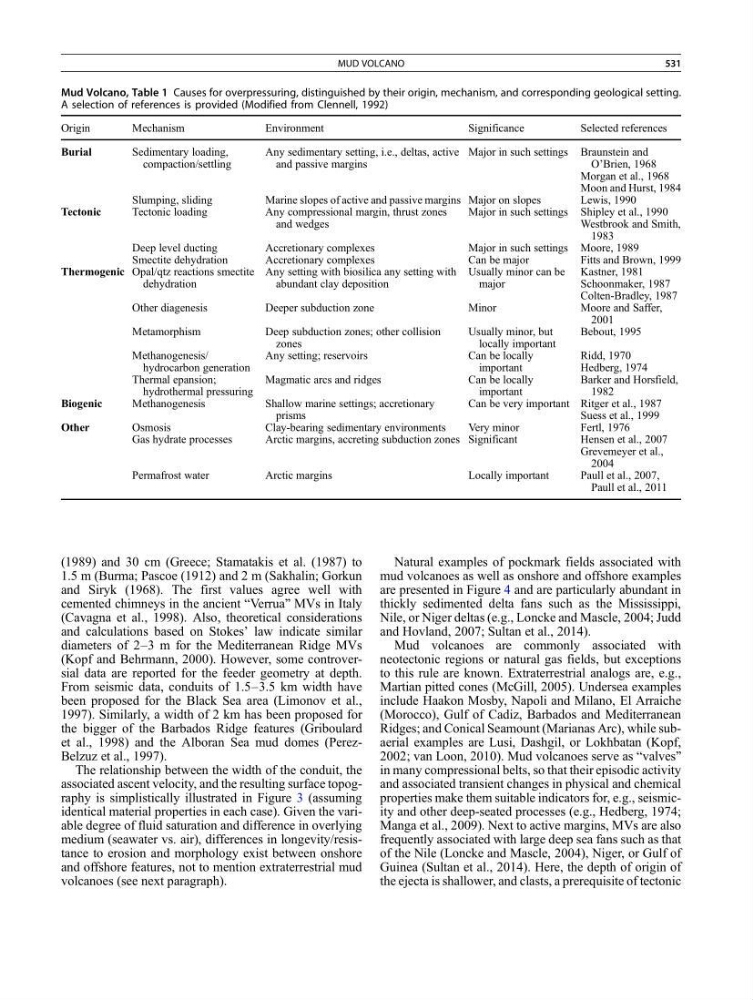
Mud Volcano, Table 1 Causes for overpressuring, distinguished by their origin, mechanism, and corresponding geological setting.
A selection of references is provided (Modified from Clennell, 1992)
Origin
Mechanism
Environment
Significance
Selected references
Burial
Sedimentary loading,
compaction/settling
Any sedimentary setting, i.e., deltas, active
and passive margins
Major in such settings Braunstein and
O’Brien, 1968
Morgan et al., 1968
Moon and Hurst, 1984
Slumping, sliding
Marine slopes of active and passive margins Major on slopes
Lewis, 1990
Tectonic
Tectonic loading
Any compressional margin, thrust zones
and wedges
Major in such settings Shipley et al., 1990
Westbrook and Smith,
1983
Deep level ducting
Accretionary complexes
Major in such settings Moore, 1989
Smectite dehydration
Accretionary complexes
Can be major
Fitts and Brown, 1999
Thermogenic Opal/qtz reactions smectite
dehydration
Any setting with biosilica any setting with
abundant clay deposition
Usually minor can be
major
Kastner, 1981
Schoonmaker, 1987
Colten-Bradley, 1987
Other diagenesis
Deeper subduction zone
Minor
Moore and Saffer,
2001
Metamorphism
Deep subduction zones; other collision
zones
Usually minor, but
locally important
Bebout, 1995
Methanogenesis/
hydrocarbon generation
Any setting; reservoirs
Can be locally
important
Ridd, 1970
Hedberg, 1974
Thermal epansion;
hydrothermal pressuring
Magmatic arcs and ridges
Can be locally
important
Barker and Horsfield,
1982
Biogenic
Methanogenesis
Shallow marine settings; accretionary
prisms
Can be very important Ritger et al., 1987
Suess et al., 1999
Other
Osmosis
Clay-bearing sedimentary environments
Very minor
Fertl, 1976
Gas hydrate processes
Arctic margins, accreting subduction zones Significant
Hensen et al., 2007
Grevemeyer et al.,
2004
Permafrost water
Arctic margins
Locally important
Paull et al., 2007,
Paull et al., 2011
MUD VOLCANO
531