

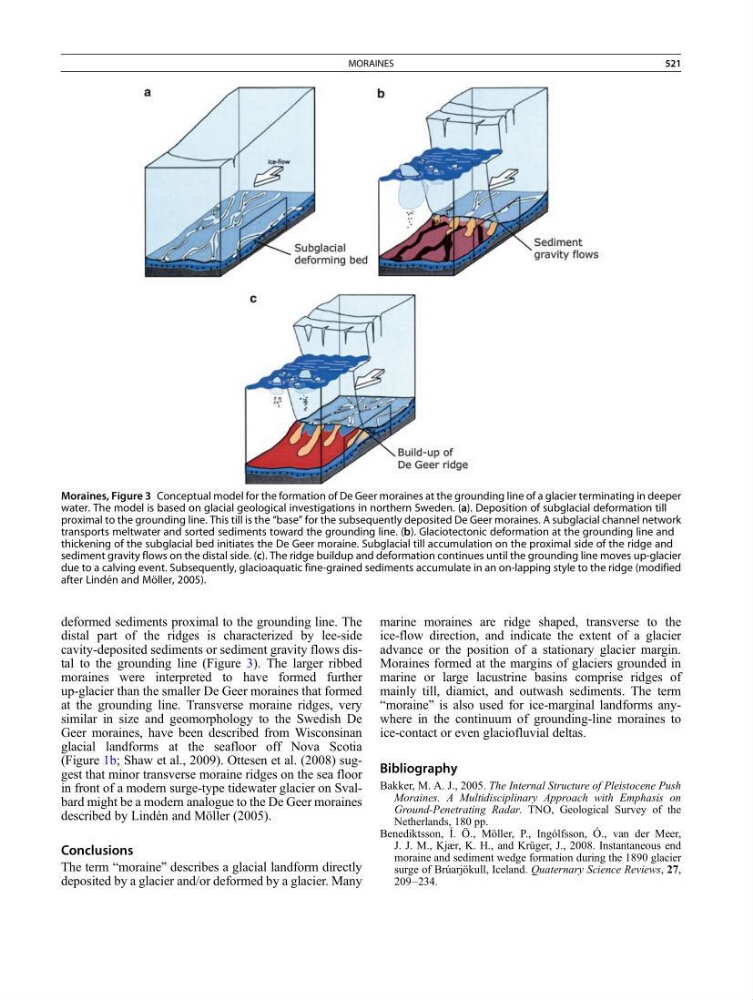
deformed sediments proximal to the grounding line. The
distal part of the ridges is characterized by lee-side
cavity-deposited sediments or sediment gravity flows distal to the grounding line (Figure 3). The larger ribbed
moraines were interpreted to have formed further
up-glacier than the smaller De Geer moraines that formed
at the grounding line. Transverse moraine ridges, very
similar in size and geomorphology to the Swedish De
Geer moraines, have been described from Wisconsinan
glacial landforms at the seafloor off Nova Scotia
(Figure 1b; Shaw et al., 2009). Ottesen et al. (2008) suggest that minor transverse moraine ridges on the sea floor
in front of a modern surge-type tidewater glacier on Svalbard might be a modern analogue to the De Geer moraines
described by Lindén and Möller (2005).
Conclusions
The term “moraine” describes a glacial landform directly
deposited by a glacier and/or deformed by a glacier. Many
marine moraines are ridge shaped, transverse to the
ice-flow direction, and indicate the extent of a glacier
advance or the position of a stationary glacier margin.
Moraines formed at the margins of glaciers grounded in
marine or large lacustrine basins comprise ridges of
mainly till, diamict, and outwash sediments. The term
“moraine” is also used for ice-marginal landforms anywhere in the continuum of grounding-line moraines to
ice-contact or even glaciofluvial deltas.
Bibliography
Bakker, M. A. J., 2005. The Internal Structure of Pleistocene Push
Moraines. A Multidisciplinary Approach with Emphasis on
Ground-Penetrating Radar. TNO, Geological Survey of the
Netherlands, 180 pp.
Benediktsson, Í. Ö., Möller, P., Ingólfsson, Ó., van der Meer,
J. J. M., Kjær, K. H., and Krüger, J., 2008. Instantaneous end
moraine and sediment wedge formation during the 1890 glacier
surge of Brúarjökull, Iceland. Quaternary Science Reviews, 27,
209–234.
Moraines, Figure 3 Conceptual model for the formation of De Geer moraines at the grounding line of a glacier terminating in deeper
water. The model is based on glacial geological investigations in northern Sweden. (a). Deposition of subglacial deformation till
proximal to the grounding line. This till is the “base” for the subsequently deposited De Geer moraines. A subglacial channel network
transports meltwater and sorted sediments toward the grounding line. (b). Glaciotectonic deformation at the grounding line and
thickening of the subglacial bed initiates the De Geer moraine. Subglacial till accumulation on the proximal side of the ridge and
sediment gravity flows on the distal side. (c). The ridge buildup and deformation continues until the grounding line moves up-glacier
due to a calving event. Subsequently, glacioaquatic fine-grained sediments accumulate in an on-lapping style to the ridge (modified
after Linde ´n and Mo ¨ ller, 2005).
MORAINES
521