

suggests that the Kregnes moraine was initially a submarine ice-contact fan that experienced glaciotectonic deformation. As sedimentation in the fjord basin progressed,
the deposit evolved into an ice-contact delta and a large
glaciofluvial delta. Similar architecture is known from
numerous other “marine moraines” (e.g., Lønne, 1995,
2001).
Lindén and Möller (2005) and Lindén et al. (2008)
described the geomorphology and sedimentology of transverse moraine ridges (ribbed moraines and De Geer
moraines) in north Sweden formed at calving tidewater
glacier margins during the retreat of the last Scandinavian
ice sheet. They showed that these moraines generally consist of a lower, proximal part of basal till or glacially
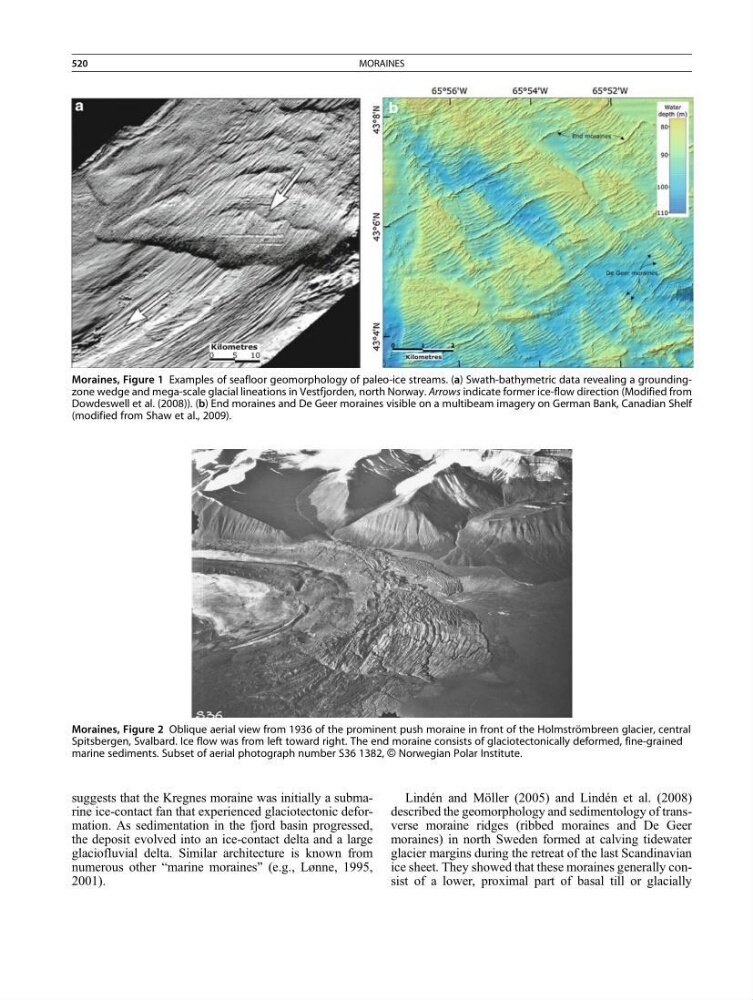
Moraines, Figure 1 Examples of seafloor geomorphology of paleo-ice streams. (a) Swath-bathymetric data revealing a groundingzone wedge and mega-scale glacial lineations in Vestfjorden, north Norway. Arrows indicate former ice-flow direction (Modified from
Dowdeswell et al. (2008)). (b) End moraines and De Geer moraines visible on a multibeam imagery on German Bank, Canadian Shelf
(modified from Shaw et al., 2009).
Moraines, Figure 2 Oblique aerial view from 1936 of the prominent push moraine in front of the Holmstro ¨ mbreen glacier, central
Spitsbergen, Svalbard. Ice flow was from left toward right. The end moraine consists of glaciotectonically deformed, fine-grained
marine sediments. Subset of aerial photograph number S36 1382, © Norwegian Polar Institute.
520
MORAINES