

sulfate-reduction strategy to single-handedly mediate both
AOM and sulfate reduction, and in so, eliminating the
need for a microbial partner to shuttle electrons or metabolites. Other substrates of oxidizing power, which include
halogenated organics and gradual dissolution of oxidantbearing minerals, are thought to play a minor role in the
overall AOM process and are detailed in a methane biogeochemistry review by Valentine (2011).
In advection-dominated systems, methane flux acts to
shoal the SMI to depths of less than a few centimeters.
In these environments, the high methane flux often overwhelms or even bypasses the AOM biofilter, leading to
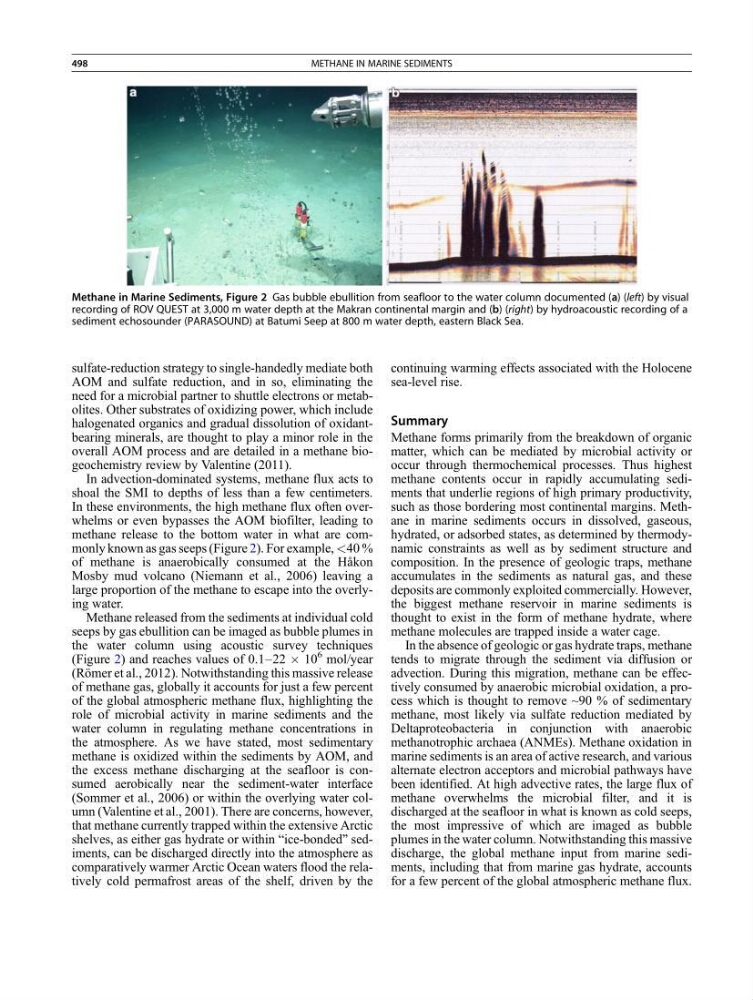
methane release to the bottom water in what are commonly known as gas seeps (Figure 2). For example, <40 %
of methane is anaerobically consumed at the Håkon
Mosby mud volcano (Niemann et al., 2006) leaving a
large proportion of the methane to escape into the overlying water.
Methane released from the sediments at individual cold
seeps by gas ebullition can be imaged as bubble plumes in
the water column using acoustic survey techniques
(Figure 2) and reaches values of 0.1–22 Â 10
6 mol/year
(Römer et al., 2012). Notwithstanding this massive release
of methane gas, globally it accounts for just a few percent
of the global atmospheric methane flux, highlighting the
role of microbial activity in marine sediments and the
water column in regulating methane concentrations in
the atmosphere. As we have stated, most sedimentary
methane is oxidized within the sediments by AOM, and
the excess methane discharging at the seafloor is consumed aerobically near the sediment-water interface
(Sommer et al., 2006) or within the overlying water column (Valentine et al., 2001). There are concerns, however,
that methane currently trapped within the extensive Arctic
shelves, as either gas hydrate or within “ice-bonded” sediments, can be discharged directly into the atmosphere as
comparatively warmer Arctic Ocean waters flood the relatively cold permafrost areas of the shelf, driven by the
continuing warming effects associated with the Holocene
sea-level rise.
Summary
Methane forms primarily from the breakdown of organic
matter, which can be mediated by microbial activity or
occur through thermochemical processes. Thus highest
methane contents occur in rapidly accumulating sediments that underlie regions of high primary productivity,
such as those bordering most continental margins. Methane in marine sediments occurs in dissolved, gaseous,
hydrated, or adsorbed states, as determined by thermodynamic constraints as well as by sediment structure and
composition. In the presence of geologic traps, methane
accumulates in the sediments as natural gas, and these
deposits are commonly exploited commercially. However,
the biggest methane reservoir in marine sediments is
thought to exist in the form of methane hydrate, where
methane molecules are trapped inside a water cage.
In the absence of geologic or gas hydrate traps, methane
tends to migrate through the sediment via diffusion or
advection. During this migration, methane can be effectively consumed by anaerobic microbial oxidation, a process which is thought to remove ~90 % of sedimentary
methane, most likely via sulfate reduction mediated by
Deltaproteobacteria in conjunction with anaerobic
methanotrophic archaea (ANMEs). Methane oxidation in
marine sediments is an area of active research, and various
alternate electron acceptors and microbial pathways have
been identified. At high advective rates, the large flux of
methane overwhelms the microbial filter, and it is
discharged at the seafloor in what is known as cold seeps,
the most impressive of which are imaged as bubble
plumes in the water column. Notwithstanding this massive
discharge, the global methane input from marine sediments, including that from marine gas hydrate, accounts
for a few percent of the global atmospheric methane flux.
Methane in Marine Sediments, Figure 2 Gas bubble ebullition from seafloor to the water column documented (a) (left) by visual
recording of ROV QUEST at 3,000 m water depth at the Makran continental margin and (b) (right) by hydroacoustic recording of a
sediment echosounder (PARASOUND) at Batumi Seep at 800 m water depth, eastern Black Sea.
498
METHANE IN MARINE SEDIMENTS