

solids in which methane molecules are held within a
hydrogen-bonded water lattice. These solids are stable at
low temperatures and high pressures, as governed by their
thermodynamic stability, and necessitate enough methane
so to stabilize the hydrate structure (Bohrmann and Torres,
2006). Upon recovery from the seafloor, methane hydrates
decompose, and at atmospheric conditions they release
approximately 164 m
3 of methane per cubic meter of
methane hydrate, thus explaining the large fraction of
methane that is sequestered within methane hydrate
deposits. This reservoir is, however, highly dynamic, and
it has been described as a carbon storage capacitor, which
stores and releases
13
C-depleted carbon at rates linked to
external conditions such as deep ocean temperature
(Dickens et al., 2011). Based on this concept, the massive
negative carbon isotopic excursion recorded in marine and
terrestrial sediments during the Paleocene-Eocene Thermal Maximum at ~ 55 Ma has been interpreted as a widespread release of isotopically light carbon from
dissociating marine methane hydrates (Dickens, 2011).
Methane sinks
The fraction of the methane that is not trapped in conventional natural gas reservoirs or within methane hydrates
migrates through the sediments via diffusion and/or
advection, and in case of passing the seafloor, oxygen
depletion in the overlying water column results as a consequence of methane oxidation (Boetius and Wenzhöfer,
2013).
In diffusion-dominated environments, methane is
almost completely consumed by the microbially driven
anaerobic oxidation of methane (AOM), which acts as a
highly efficient methane filter, preventing dissolved methane release to the ocean and atmosphere. Reeburgh
et al., (1993) estimated that this filter consumes nearly
90 % of the total methane produced in marine and
freshwater systems. Sulfate is the most likely electron
acceptor for this reaction, given its high concentration in
seawater, which supplies sulfate by diffusion into the sediments. In the sulfate-mediated AOM, several clades of
anaerobic methanotrophic archaea (ANMEs) often form
synergistic aggregates with sulfate-reducing Deltaproteobacteria (Boetius et al., 2000). Together, these microorganisms are thought to oxidize methane to carbon
dioxide while reducing sulfate (SO 4
2À
) to hydrogen sulfide (HS
À ), splitting the energy supplied by this coupled
process between them (Hoehler et al., 1994). This process
can be summarized by the net reaction:
SO 4
2À
þ CH 4 ! HS
À
þ HCO 3
À
þ H 2 O
ð3Þ
The hydrogen sulfate is feeding chemosynthetic fauna,
whereas the hydrogen carbonate is often used for carbonate precipitation. Both processes are typical seafloor manifestations at cold seeps (Bohrmann and Torres, 2006).
The sulfate-supported AOM consortia (Boetius
et al., 2000) depend on sulfate and methane and thus typically occur at the sulfate-methane interface zone (SMI), a
biogeochemical depth level where seawater sulfate and
methane from the underlying anoxic sediments converge.
The SMI depths in these environments are well defined
and typically occur from a few centimeters to several
meters below the surface, although deeper SMIs have
been observed on the Indian margin (Briggs et al., 2012)
and Demerara Rise (Arndt et al., 2009) sediment.
Alternative electron acceptors, which involve the coupling of methane oxidation to the reduction of nitrite,
nitrate, and reactive metals, have been recently
documented. An uncommon mechanism is mediated by
an extremely unusual bacterium, Methoxymirabilis
oxyfera, that makes its own oxygen to fuel AOM in anoxic
environments (Joye 2012). In addition, Milucka
et al., (2012) described an ANME-2 clade that uses
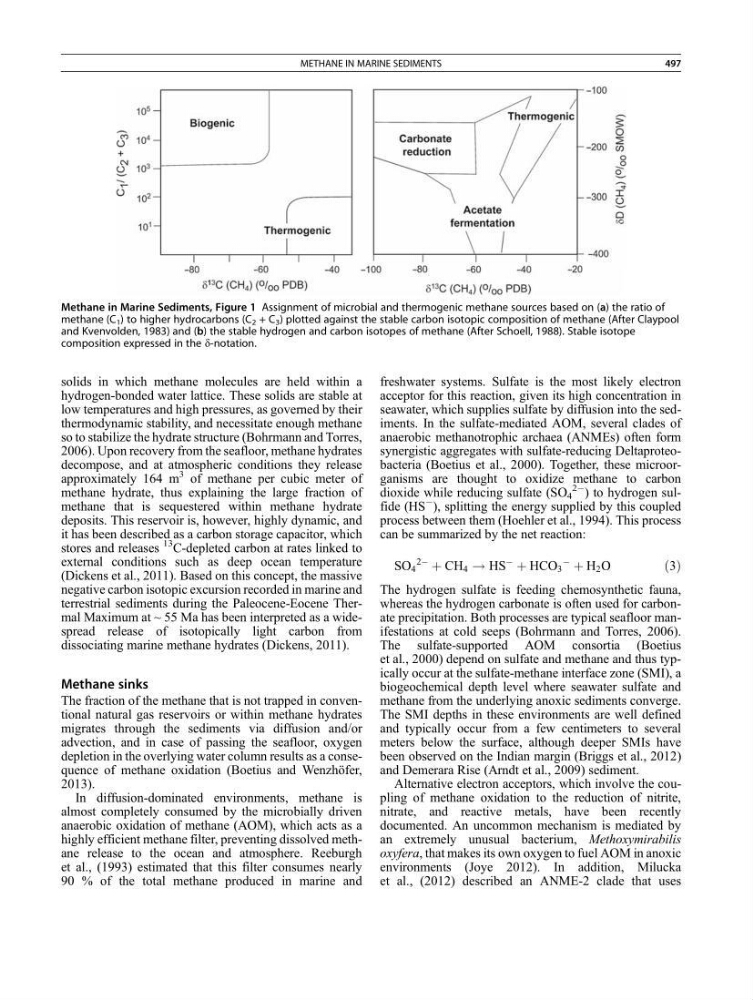
Methane in Marine Sediments, Figure 1 Assignment of microbial and thermogenic methane sources based on (a) the ratio of
methane (C 1 ) to higher hydrocarbons (C 2 + C 3 ) plotted against the stable carbon isotopic composition of methane (After Claypool
and Kvenvolden, 1983) and (b) the stable hydrogen and carbon isotopes of methane (After Schoell, 1988). Stable isotope
composition expressed in the d-notation.
METHANE IN MARINE SEDIMENTS
497