

• All oceanic crust is younger than approximately
180 million years, due to plate consumption and generation in the plate tectonic cycle.
• Lack of knowledge of how to recognize deep
oceanic impacts, since we know so little about these
structures.
• The oceans and epicontinental seas globally cover huge
areas of which only a tiny portion have been covered by
geological and geophysical analyses.
• A large number of asteroids and comets never reach the
sea floor; consequently fewer submarine craters should
be expected compared to subaerial ones (Davison and
Collins, 2007).
Through the years, crater and impact statistics have
been compiled, and, e.g., in the Task Force UK report of
2000 (Table 1), the general impact frequency and crater
sizes are listed.
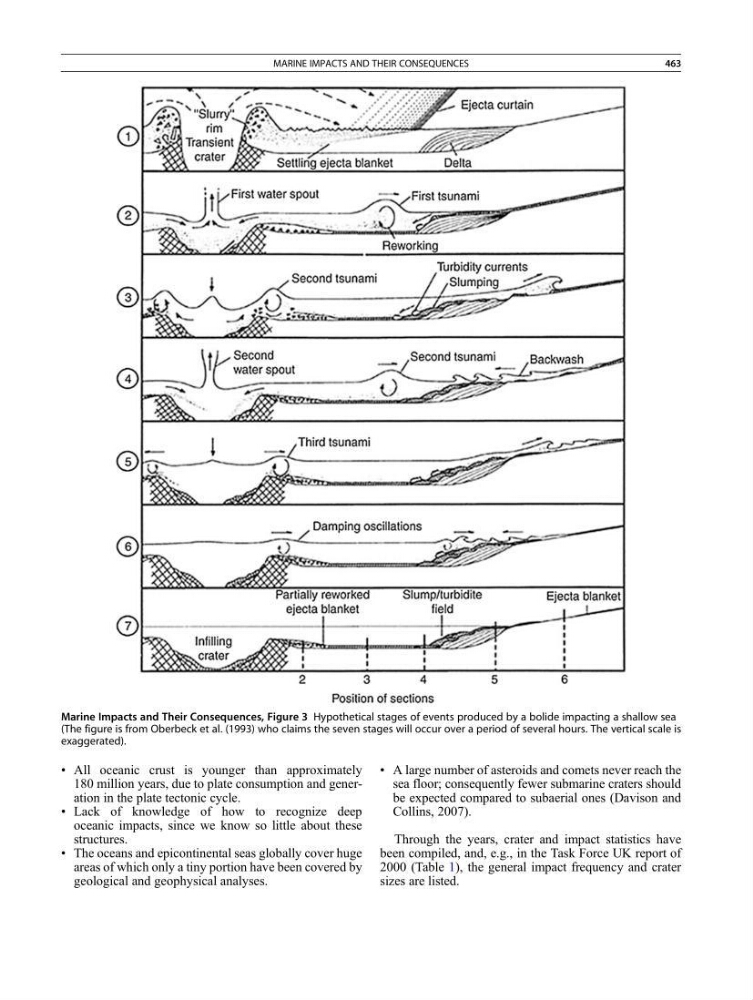
Marine Impacts and Their Consequences, Figure 3 Hypothetical stages of events produced by a bolide impacting a shallow sea
(The figure is from Oberbeck et al. (1993) who claims the seven stages will occur over a period of several hours. The vertical scale is
exaggerated).
MARINE IMPACTS AND THEIR CONSEQUENCES
463
180 million years, due to plate consumption and generation in the plate tectonic cycle.
• Lack of knowledge of how to recognize deep
oceanic impacts, since we know so little about these
structures.
• The oceans and epicontinental seas globally cover huge
areas of which only a tiny portion have been covered by
geological and geophysical analyses.
• A large number of asteroids and comets never reach the
sea floor; consequently fewer submarine craters should
be expected compared to subaerial ones (Davison and
Collins, 2007).
Through the years, crater and impact statistics have
been compiled, and, e.g., in the Task Force UK report of
2000 (Table 1), the general impact frequency and crater
sizes are listed.
Marine Impacts and Their Consequences, Figure 3 Hypothetical stages of events produced by a bolide impacting a shallow sea
(The figure is from Oberbeck et al. (1993) who claims the seven stages will occur over a period of several hours. The vertical scale is
exaggerated).
MARINE IMPACTS AND THEIR CONSEQUENCES
463