

Methods of studying marine impacts
Fossil marine impact structures may be found on land and
can consequently be as accessible for detailed analyses as
the subaerial ones. Modern and fresh submarine craters,
present on and below the ocean floor, are more difficult
and costly to study, being dependent on geophysical
investigations. In particular, seismic, gravimetric, and
magnetic surveys are needed to detect and describe these
structures and their ejecta distributions, e.g., as done in
the Chicxulub, Chesapeake Bay, and Mjølnir cases
(Gohn et al., 2009; Dypvik et al., 2010; Schulte et al.,
2010). Craters on the Earth traditionally need additional
detailed information to be recognized and accepted as
impact generated and not circular cavities with different
origins. Cores and rock samples are necessary for structural, mineralogical, and geochemical analysis (French
and Koeberl, 2010). Coring is normally expensive and
rarely done, likely one important reason for our poor
understanding of marine impacts.
Various core analyses are needed in order to differentiate crater depressions from other cavities on the seafloor,
formed by, e.g., gas discharge, other structuring on the
seafloor (faulting/fracturing), and volcanic eruptions.
Rocks and sediments affected by impact can mineralogically and geochemically be characterized by the presence
of, e.g., shocked altered minerals (shocked quartz),
Ni-rich spinels, and geochemical enrichments (Ir in particular) (French and Koeberl, 2010).
Marine impacts
In a marine impact, water absorbs the energy very effectively; consequently, a very large bolide is needed to produce even a modest crater on the abyssal plain. The
mobilization of sediment following an impact tends to
obscure such a signature except in cases where the bolide
diameter is comparable to the ocean depth (Gisler et al.,
2010). It should be mentioned that so far very few coastal
tsunami deposits related to impacts have been found and
described (e.g., Chicxulub; Smit, 1999).
Marine impacts represent an intricate mixture of relatively poorly understood processes compared to subaerial
cratering (Ormö and Lindström, 2000; Dypvik and Jansa,
2003; Dypvik and Kalleson, 2010). The relations between
bolide size (D) and water depth (H) are crucial in
constraining submarine crater formation, as also mentioned above. It has been shown that the ratio H/D is of
great importance on the resulting cratering process. No
subaqueous crater is formed at the seafloor if H/D > 10
(Gault and Sonett, 1982; Artemieva and Shuvalov,
2002), while if 10 < H/D < 1, the water column plays
an important role during the cratering process to the size
and morphology of the resulting structure (Shuvalov,
2002). When H < D, there is only a minor direct influence
of the water column to the cratering process (Shuvalov,
2002).
In shallow water impacts, the crater rims are not normally leveled out (Ormö and Lindström, 2000; Dypvik
and Jansa, 2003) and may even be taller than the returning
water and consequently even hamper the resurge of water
(e.g., the 2.7 km diameter rim of the Ritland structure; Riis
et al., 2012; Shuvalov et al., 2012). Already in 1982, Gault
and Sonett (1982) carried out experiments to model deep
and shallow ocean impacts. They showed that water is
remarkably effective in shielding the seafloor against significant excavation. In shallow water craters, their experiments demonstrated that central peaks in smaller craters
could extend even above the water surface, as, e.g., in
the Mjølnir case (Dypvik et al., 2010). In deep waters,
the rims as well as the central peaks may be quickly
leveled out by the generated current’s reworking of
soft sediments, explaining the typical marine crater
characteristic of low or absent rims (Dypvik and Jansa,
2003). Resurge gullies may be formed during rather
shallow marine impacts, cutting across the rim. Mass
and debris deposits, turbidites, and other gravity
deposits are produced as results of crater wall and central
peak collapse, during and after crater excavation. Such
gravity flow-related deposits are found both within
and outside the marine impact craters (Dypvik and
Kalleson, 2010).
Marine impacts or impact into wet targets can result in
ejecta transportation as ground-hugging flows (Melosh,
1982; Masaitis, 2002). Such accretionary impact lapilli
may occur both in proximal and distal environments relating to large- and middle-sized impact craters. The Alamo
Breccia of Western USA and Albion Formation of Mexico
and Belize are possible examples (Warme, 2004; Pope
et al., 2005; Morrow et al., 2009).
In marine impacts, the sedimentation of the modification
stage includes breccias, slumps, avalanches, mass/debris
flows, and turbidity currents. Impact-generated earthquakes may trigger liquefaction reactions in the watersaturated seafloor sediments. The impact-related sediments
rich in ejecta may consequently be widely distributed, like
the ejecta and tsunamites from the Chicxulub impact (Smit,
1999; Clayes et al., 2002). The Baltic Narva Breccia was
possibly formed from slumping, displacements, and wave
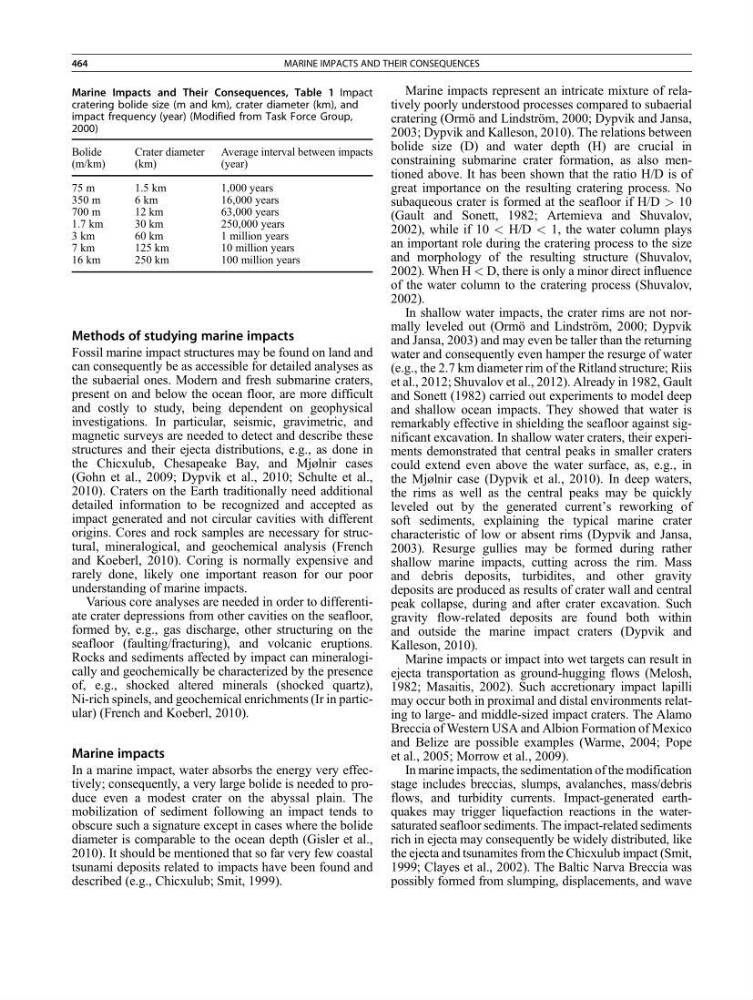
Marine Impacts and Their Consequences, Table 1 Impact
cratering bolide size (m and km), crater diameter (km), and
impact frequency (year) (Modified from Task Force Group,
2000)
Bolide
(m/km)
Crater diameter
(km)
Average interval between impacts
(year)
75 m
1.5 km
1,000 years
350 m
6 km
16,000 years
700 m
12 km
63,000 years
1.7 km
30 km
250,000 years
3 km
60 km
1 million years
7 km
125 km
10 million years
16 km
250 km
100 million years
464
MARINE IMPACTS AND THEIR CONSEQUENCES
Fossil marine impact structures may be found on land and
can consequently be as accessible for detailed analyses as
the subaerial ones. Modern and fresh submarine craters,
present on and below the ocean floor, are more difficult
and costly to study, being dependent on geophysical
investigations. In particular, seismic, gravimetric, and
magnetic surveys are needed to detect and describe these
structures and their ejecta distributions, e.g., as done in
the Chicxulub, Chesapeake Bay, and Mjølnir cases
(Gohn et al., 2009; Dypvik et al., 2010; Schulte et al.,
2010). Craters on the Earth traditionally need additional
detailed information to be recognized and accepted as
impact generated and not circular cavities with different
origins. Cores and rock samples are necessary for structural, mineralogical, and geochemical analysis (French
and Koeberl, 2010). Coring is normally expensive and
rarely done, likely one important reason for our poor
understanding of marine impacts.
Various core analyses are needed in order to differentiate crater depressions from other cavities on the seafloor,
formed by, e.g., gas discharge, other structuring on the
seafloor (faulting/fracturing), and volcanic eruptions.
Rocks and sediments affected by impact can mineralogically and geochemically be characterized by the presence
of, e.g., shocked altered minerals (shocked quartz),
Ni-rich spinels, and geochemical enrichments (Ir in particular) (French and Koeberl, 2010).
Marine impacts
In a marine impact, water absorbs the energy very effectively; consequently, a very large bolide is needed to produce even a modest crater on the abyssal plain. The
mobilization of sediment following an impact tends to
obscure such a signature except in cases where the bolide
diameter is comparable to the ocean depth (Gisler et al.,
2010). It should be mentioned that so far very few coastal
tsunami deposits related to impacts have been found and
described (e.g., Chicxulub; Smit, 1999).
Marine impacts represent an intricate mixture of relatively poorly understood processes compared to subaerial
cratering (Ormö and Lindström, 2000; Dypvik and Jansa,
2003; Dypvik and Kalleson, 2010). The relations between
bolide size (D) and water depth (H) are crucial in
constraining submarine crater formation, as also mentioned above. It has been shown that the ratio H/D is of
great importance on the resulting cratering process. No
subaqueous crater is formed at the seafloor if H/D > 10
(Gault and Sonett, 1982; Artemieva and Shuvalov,
2002), while if 10 < H/D < 1, the water column plays
an important role during the cratering process to the size
and morphology of the resulting structure (Shuvalov,
2002). When H < D, there is only a minor direct influence
of the water column to the cratering process (Shuvalov,
2002).
In shallow water impacts, the crater rims are not normally leveled out (Ormö and Lindström, 2000; Dypvik
and Jansa, 2003) and may even be taller than the returning
water and consequently even hamper the resurge of water
(e.g., the 2.7 km diameter rim of the Ritland structure; Riis
et al., 2012; Shuvalov et al., 2012). Already in 1982, Gault
and Sonett (1982) carried out experiments to model deep
and shallow ocean impacts. They showed that water is
remarkably effective in shielding the seafloor against significant excavation. In shallow water craters, their experiments demonstrated that central peaks in smaller craters
could extend even above the water surface, as, e.g., in
the Mjølnir case (Dypvik et al., 2010). In deep waters,
the rims as well as the central peaks may be quickly
leveled out by the generated current’s reworking of
soft sediments, explaining the typical marine crater
characteristic of low or absent rims (Dypvik and Jansa,
2003). Resurge gullies may be formed during rather
shallow marine impacts, cutting across the rim. Mass
and debris deposits, turbidites, and other gravity
deposits are produced as results of crater wall and central
peak collapse, during and after crater excavation. Such
gravity flow-related deposits are found both within
and outside the marine impact craters (Dypvik and
Kalleson, 2010).
Marine impacts or impact into wet targets can result in
ejecta transportation as ground-hugging flows (Melosh,
1982; Masaitis, 2002). Such accretionary impact lapilli
may occur both in proximal and distal environments relating to large- and middle-sized impact craters. The Alamo
Breccia of Western USA and Albion Formation of Mexico
and Belize are possible examples (Warme, 2004; Pope
et al., 2005; Morrow et al., 2009).
In marine impacts, the sedimentation of the modification
stage includes breccias, slumps, avalanches, mass/debris
flows, and turbidity currents. Impact-generated earthquakes may trigger liquefaction reactions in the watersaturated seafloor sediments. The impact-related sediments
rich in ejecta may consequently be widely distributed, like
the ejecta and tsunamites from the Chicxulub impact (Smit,
1999; Clayes et al., 2002). The Baltic Narva Breccia was
possibly formed from slumping, displacements, and wave
Marine Impacts and Their Consequences, Table 1 Impact
cratering bolide size (m and km), crater diameter (km), and
impact frequency (year) (Modified from Task Force Group,
2000)
Bolide
(m/km)
Crater diameter
(km)
Average interval between impacts
(year)
75 m
1.5 km
1,000 years
350 m
6 km
16,000 years
700 m
12 km
63,000 years
1.7 km
30 km
250,000 years
3 km
60 km
1 million years
7 km
125 km
10 million years
16 km
250 km
100 million years
464
MARINE IMPACTS AND THEIR CONSEQUENCES