

columns. The interaction of the impacting body and the
water causes loss of the body’s kinetic energy through
oceanic drag prior to the ocean floor collision
(Wünnemann and Lange, 2002).
Oberbeck et al. (1993) presented one of the first
detailed descriptions of marine impacts and submarine
craters, discussing ejecta distribution, tsunami generation,
crater formation, and current generation. Focusing on
shallow seas, their Figure 6 (Figure 3 here) still gives a
good illustration of the marine impacts, crater formation
and violent ejecta distribution, tsunami generation, active
crater modification, and later postimpact sedimentation
filling of the craters.
Water depth will have little effect for the large bolides,
but for small- and medium-sized ones, the ocean will function as an efficient filter, with marine impact craters only
forming in relatively shallow water (H) compared to the
size of the bolide (D) (Artemieva and Shuvalov, 2002);
H < D.
Impact craters in marine sedimentary basins are filled
by postimpact sediments rather quickly after impact.
Consequently, submarine craters commonly are very
well preserved compared to subaerial ones where
erosion-dominated processes are more active. The wellpreserved submarine craters of Mjølnir and Chesapeake
Bay are good examples (Gohn et al., 2009; Dypvik et al.,
2010).
The Earth Impact Database (December 2013) names
183 craters of which only 28 (may be three additional
ones, totally 31) have been recognized as marine impacts
(Figure 1). They all have been formed by impact into
marine basins, but presently, most of them occur on land
though a few are still located in a submarine setting.
A closer look at the numbers, e.g., simple subtraction
(183 À 28(31)), gives 155(152) structures which should
represent the minimum number of subaerial impacts.
155(152) on land impacts should, taking the land/sea area
ratio into consideration, indicate at least 379(372) marine
impacts/submarine craters. Since 155(152) clearly is a
minimum number, the 379(372) may also be regarded as
a minimum total for marine impacts.
The fact that only 28 marine impact structures have
been described so far is probably due to:
• The difficulties in searching for marine impact structures and too few engaged impact researchers.
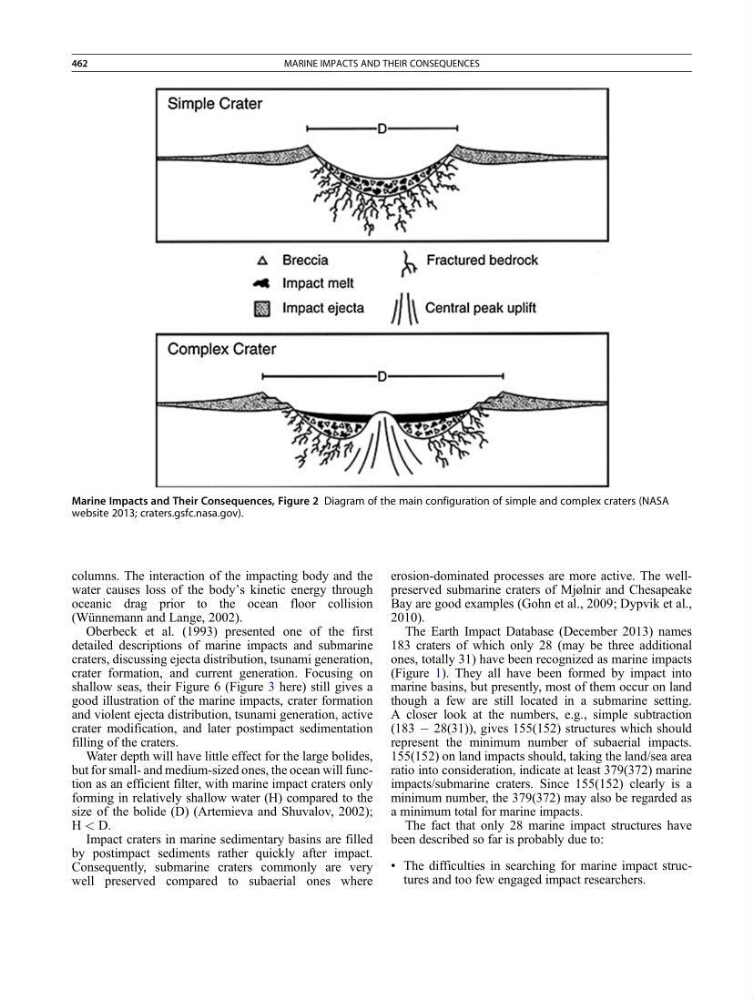
Marine Impacts and Their Consequences, Figure 2 Diagram of the main configuration of simple and complex craters (NASA
website 2013; craters.gsfc.nasa.gov).
462
MARINE IMPACTS AND THEIR CONSEQUENCES
water causes loss of the body’s kinetic energy through
oceanic drag prior to the ocean floor collision
(Wünnemann and Lange, 2002).
Oberbeck et al. (1993) presented one of the first
detailed descriptions of marine impacts and submarine
craters, discussing ejecta distribution, tsunami generation,
crater formation, and current generation. Focusing on
shallow seas, their Figure 6 (Figure 3 here) still gives a
good illustration of the marine impacts, crater formation
and violent ejecta distribution, tsunami generation, active
crater modification, and later postimpact sedimentation
filling of the craters.
Water depth will have little effect for the large bolides,
but for small- and medium-sized ones, the ocean will function as an efficient filter, with marine impact craters only
forming in relatively shallow water (H) compared to the
size of the bolide (D) (Artemieva and Shuvalov, 2002);
H < D.
Impact craters in marine sedimentary basins are filled
by postimpact sediments rather quickly after impact.
Consequently, submarine craters commonly are very
well preserved compared to subaerial ones where
erosion-dominated processes are more active. The wellpreserved submarine craters of Mjølnir and Chesapeake
Bay are good examples (Gohn et al., 2009; Dypvik et al.,
2010).
The Earth Impact Database (December 2013) names
183 craters of which only 28 (may be three additional
ones, totally 31) have been recognized as marine impacts
(Figure 1). They all have been formed by impact into
marine basins, but presently, most of them occur on land
though a few are still located in a submarine setting.
A closer look at the numbers, e.g., simple subtraction
(183 À 28(31)), gives 155(152) structures which should
represent the minimum number of subaerial impacts.
155(152) on land impacts should, taking the land/sea area
ratio into consideration, indicate at least 379(372) marine
impacts/submarine craters. Since 155(152) clearly is a
minimum number, the 379(372) may also be regarded as
a minimum total for marine impacts.
The fact that only 28 marine impact structures have
been described so far is probably due to:
• The difficulties in searching for marine impact structures and too few engaged impact researchers.
Marine Impacts and Their Consequences, Figure 2 Diagram of the main configuration of simple and complex craters (NASA
website 2013; craters.gsfc.nasa.gov).
462
MARINE IMPACTS AND THEIR CONSEQUENCES