

Impact cratering
According to NASA (2012), several thousand hazardous
asteroids and comets exist, but detailed knowledge of their
distribution is still lacking. Compositionally, the bolides
can be recognized by comparable minerals to terrestrial
rocks, often with the addition of enrichments in Pt-group
metals (Ru, Rh, Pd, Os, Ir, Pt) and siderophile elements
(e.g., Ni, Co, Au). High enrichment of Ir is of special interest and commonly used as an extraterrestrial indicator
(French and Koeberl, 2010).
Generally, two main types of impact structure appear:
simple and complex (Melosh, 1989; French, 1998). The
simple craters are normally bowl shaped and less than
4 km in diameter, while the complex craters (>4 km)
can have various shapes, often with a central peak and in
some cases internal ring(s) (Figure 2).
Crater formation is completed within a few minutes, the
actual time depending mainly on crater size which is controlled by bolide size, target composition, bolide velocity,
and composition. The crater development can be
subdivided into three main stages: contact/compression,
excavation, and modification (French, 1998). In the contact and compression stage, kinetic energy is converted
into shock waves that are transmitted into the target material; the duration of this stage is only a few seconds
(Melosh, 1989). The result is a fractured and brecciated
target area and a totally or partially evaporated projectile.
The succeeding excavation stage lasts longer than the contact/compression stage and is the result of the release
waves (rarefaction) when the crater is opened up and a
bowl-shaped depression is formed in the target site.
Crushed and melted material is ejected, and a so-called
transient crater is formed. The transient crater is a bowlshaped depression with a structurally uplifted rim.
Ejecta deposits have been recognized in association
with several impacts, i.e., with wide distributions of
crushed target material as well as melted bolide and target
material. In the marine impact cases, this phase is highly
influenced and volatized by the vaporized water
(Figure 2).
The excavation stage is followed by a modification
stage dominated by processes remodeling the unstable
transient craters, controlled by gravity and rock mechanics
and crater sedimentation. The modification stage can last
longer than the excavation stage, i.e., a few minutes for
the largest impacts (French, 1998).
Marine target sites consist of three layers: from top
down, the water column, thick sedimentary successions,
and underlying crystalline basement. Their different thicknesses and rheological properties greatly influence
cratering developments. First, a crater is generated in the
water, then a crater is formed on the sea floor, and finally,
in the crystalline basement if enough energy is still left
after the bolide’s penetration of the water and sedimentary
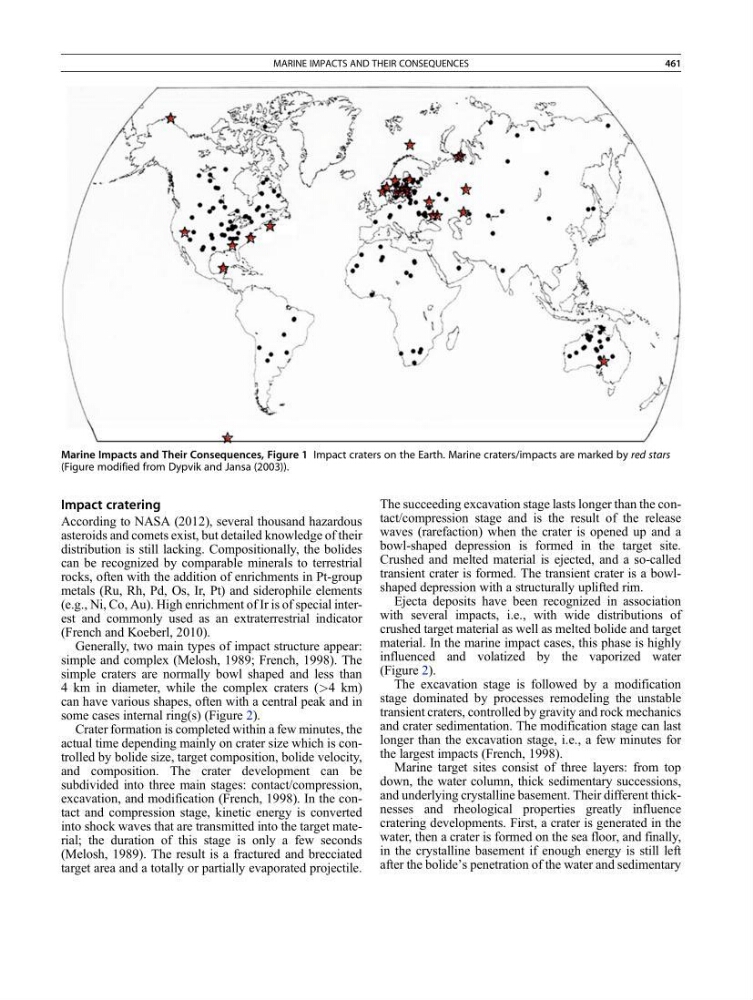
Marine Impacts and Their Consequences, Figure 1 Impact craters on the Earth. Marine craters/impacts are marked by red stars
(Figure modified from Dypvik and Jansa (2003)).
MARINE IMPACTS AND THEIR CONSEQUENCES
461
According to NASA (2012), several thousand hazardous
asteroids and comets exist, but detailed knowledge of their
distribution is still lacking. Compositionally, the bolides
can be recognized by comparable minerals to terrestrial
rocks, often with the addition of enrichments in Pt-group
metals (Ru, Rh, Pd, Os, Ir, Pt) and siderophile elements
(e.g., Ni, Co, Au). High enrichment of Ir is of special interest and commonly used as an extraterrestrial indicator
(French and Koeberl, 2010).
Generally, two main types of impact structure appear:
simple and complex (Melosh, 1989; French, 1998). The
simple craters are normally bowl shaped and less than
4 km in diameter, while the complex craters (>4 km)
can have various shapes, often with a central peak and in
some cases internal ring(s) (Figure 2).
Crater formation is completed within a few minutes, the
actual time depending mainly on crater size which is controlled by bolide size, target composition, bolide velocity,
and composition. The crater development can be
subdivided into three main stages: contact/compression,
excavation, and modification (French, 1998). In the contact and compression stage, kinetic energy is converted
into shock waves that are transmitted into the target material; the duration of this stage is only a few seconds
(Melosh, 1989). The result is a fractured and brecciated
target area and a totally or partially evaporated projectile.
The succeeding excavation stage lasts longer than the contact/compression stage and is the result of the release
waves (rarefaction) when the crater is opened up and a
bowl-shaped depression is formed in the target site.
Crushed and melted material is ejected, and a so-called
transient crater is formed. The transient crater is a bowlshaped depression with a structurally uplifted rim.
Ejecta deposits have been recognized in association
with several impacts, i.e., with wide distributions of
crushed target material as well as melted bolide and target
material. In the marine impact cases, this phase is highly
influenced and volatized by the vaporized water
(Figure 2).
The excavation stage is followed by a modification
stage dominated by processes remodeling the unstable
transient craters, controlled by gravity and rock mechanics
and crater sedimentation. The modification stage can last
longer than the excavation stage, i.e., a few minutes for
the largest impacts (French, 1998).
Marine target sites consist of three layers: from top
down, the water column, thick sedimentary successions,
and underlying crystalline basement. Their different thicknesses and rheological properties greatly influence
cratering developments. First, a crater is generated in the
water, then a crater is formed on the sea floor, and finally,
in the crystalline basement if enough energy is still left
after the bolide’s penetration of the water and sedimentary
Marine Impacts and Their Consequences, Figure 1 Impact craters on the Earth. Marine craters/impacts are marked by red stars
(Figure modified from Dypvik and Jansa (2003)).
MARINE IMPACTS AND THEIR CONSEQUENCES
461