

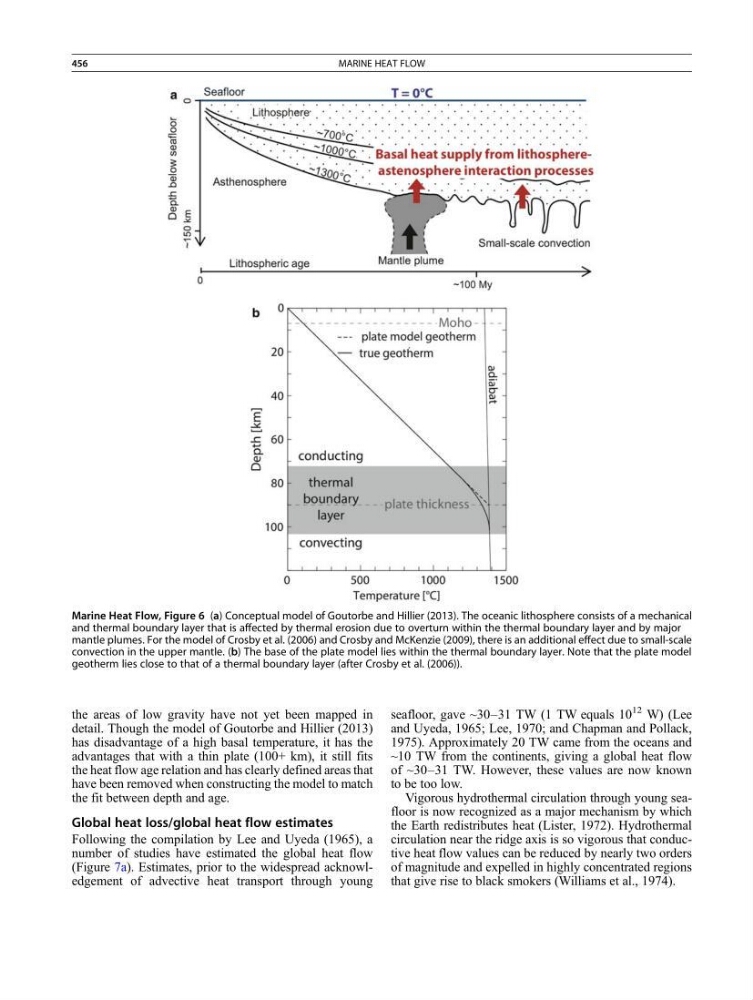
the areas of low gravity have not yet been mapped in
detail. Though the model of Goutorbe and Hillier (2013)
has disadvantage of a high basal temperature, it has the
advantages that with a thin plate (100+ km), it still fits
the heat flow age relation and has clearly defined areas that
have been removed when constructing the model to match
the fit between depth and age.
Global heat loss/global heat flow estimates
Following the compilation by Lee and Uyeda (1965), a
number of studies have estimated the global heat flow
(Figure 7a). Estimates, prior to the widespread acknowledgement of advective heat transport through young
seafloor, gave ~30–31 TW (1 TW equals 10
12 W) (Lee
and Uyeda, 1965; Lee, 1970; and Chapman and Pollack,
1975). Approximately 20 TW came from the oceans and
~10 TW from the continents, giving a global heat flow
of ~30–31 TW. However, these values are now known
to be too low.
Vigorous hydrothermal circulation through young seafloor is now recognized as a major mechanism by which
the Earth redistributes heat (Lister, 1972). Hydrothermal
circulation near the ridge axis is so vigorous that conductive heat flow values can be reduced by nearly two orders
of magnitude and expelled in highly concentrated regions
that give rise to black smokers (Williams et al., 1974).
Marine Heat Flow, Figure 6 (a) Conceptual model of Goutorbe and Hillier (2013). The oceanic lithosphere consists of a mechanical
and thermal boundary layer that is affected by thermal erosion due to overturn within the thermal boundary layer and by major
mantle plumes. For the model of Crosby et al. (2006) and Crosby and McKenzie (2009), there is an additional effect due to small-scale
convection in the upper mantle. (b) The base of the plate model lies within the thermal boundary layer. Note that the plate model
geotherm lies close to that of a thermal boundary layer (after Crosby et al. (2006)).
456
MARINE HEAT FLOW
detail. Though the model of Goutorbe and Hillier (2013)
has disadvantage of a high basal temperature, it has the
advantages that with a thin plate (100+ km), it still fits
the heat flow age relation and has clearly defined areas that
have been removed when constructing the model to match
the fit between depth and age.
Global heat loss/global heat flow estimates
Following the compilation by Lee and Uyeda (1965), a
number of studies have estimated the global heat flow
(Figure 7a). Estimates, prior to the widespread acknowledgement of advective heat transport through young
seafloor, gave ~30–31 TW (1 TW equals 10
12 W) (Lee
and Uyeda, 1965; Lee, 1970; and Chapman and Pollack,
1975). Approximately 20 TW came from the oceans and
~10 TW from the continents, giving a global heat flow
of ~30–31 TW. However, these values are now known
to be too low.
Vigorous hydrothermal circulation through young seafloor is now recognized as a major mechanism by which
the Earth redistributes heat (Lister, 1972). Hydrothermal
circulation near the ridge axis is so vigorous that conductive heat flow values can be reduced by nearly two orders
of magnitude and expelled in highly concentrated regions
that give rise to black smokers (Williams et al., 1974).
Marine Heat Flow, Figure 6 (a) Conceptual model of Goutorbe and Hillier (2013). The oceanic lithosphere consists of a mechanical
and thermal boundary layer that is affected by thermal erosion due to overturn within the thermal boundary layer and by major
mantle plumes. For the model of Crosby et al. (2006) and Crosby and McKenzie (2009), there is an additional effect due to small-scale
convection in the upper mantle. (b) The base of the plate model lies within the thermal boundary layer. Note that the plate model
geotherm lies close to that of a thermal boundary layer (after Crosby et al. (2006)).
456
MARINE HEAT FLOW